• 文献检索
  • 文档翻译
  • 深度研究
  • 学术资讯
  • Suppr Zotero 插件Zotero 插件
  • 邀请有礼
  • 套餐&价格
  • 历史记录
应用&插件
Suppr Zotero 插件Zotero 插件浏览器插件Mac 客户端Windows 客户端微信小程序
定价
高级版会员购买积分包购买API积分包
服务
文献检索文档翻译深度研究API 文档MCP 服务
关于我们
关于 Suppr公司介绍联系我们用户协议隐私条款
关注我们

Suppr 超能文献

核心技术专利:CN118964589B侵权必究
粤ICP备2023148730 号-1Suppr @ 2026

文献检索

告别复杂PubMed语法,用中文像聊天一样搜索,搜遍4000万医学文献。AI智能推荐,让科研检索更轻松。

立即免费搜索

文件翻译

保留排版,准确专业,支持PDF/Word/PPT等文件格式,支持 12+语言互译。

免费翻译文档

深度研究

AI帮你快速写综述,25分钟生成高质量综述,智能提取关键信息,辅助科研写作。

立即免费体验

一种用于预测90天和365天短期动脉粥样硬化性心血管疾病(ASCVD)风险的新型机器学习模型。

A novel, machine-learning model for prediction of short-term ASCVD risk over 90 and 365 days.

作者信息

Gazit Tomer, Mann Hanan, Gaber Shiri, Adamenko Pavel, Pariente Granit, Volsky Liron, Dolev Amir, Lyson Helena, Zimlichman Eyal, Pandit Jay A, Paz Edo

机构信息

Hello Heart, Inc., Menlo Park, CA, United States.

Sheba Medical Center, Tel Hashomer, Israel.

出版信息

Front Digit Health. 2024 Nov 1;6:1485508. doi: 10.3389/fdgth.2024.1485508. eCollection 2024.

DOI:10.3389/fdgth.2024.1485508
PMID:39552935
原文链接:https://pmc.ncbi.nlm.nih.gov/articles/PMC11564171/
Abstract

BACKGROUND

Current atherosclerotic cardiovascular disease (ASCVD) risk assessment tools like the Pooled Cohort Equations (PCEs) and PREVENT™ scores offer long-term predictions but may not effectively drive behavior change. Short-term risk predictions using mobile health (mHealth) data and electronic health records (EHRs) could enhance clinical decision-making and patient engagement. The aim of this study was to develop a short-term ASCVD risk prediction model for hypertensive individuals using mHealth and EHR data and compare its performance to existing risk assessment tools.

METHODS

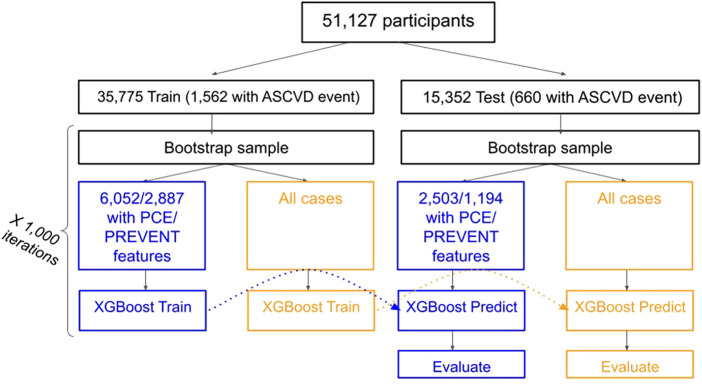
This is a retrospective cohort study including 51,127 hypertensive participants aged ≥18 years old who enrolled in the Hello Heart CV risk self-management program between January 2015 and January 2024. A machine learning (ML) model was derived from EHR data and mHealth measurements of blood pressure (BP) and heart rate (HR) collected via at-home BP monitors. Its performance was compared to that of PCE and PREVENT.

RESULTS

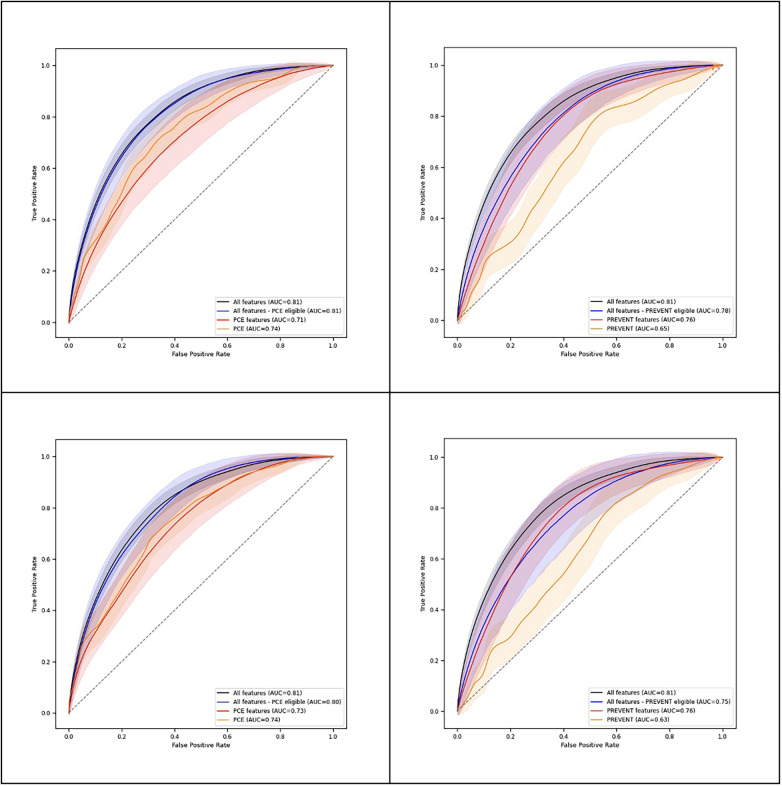
The XgBoost model incorporating 291 features outperformed the PCE and PREVENT scores in discriminating ASCVD risk for both prediction periods. For 90-day prediction, mean C-statistics were 0.81 (XgBoost) vs. 0.74 (PCE) and 0.65 (PREVENT). Similar findings were observed for 365-day prediction. mHealth measurements incrementally enhanced 365-day risk prediction (ROC-AUC 0.82 vs. 0.80 without mHealth).

CONCLUSION

An EHR and mHealth-based ML model offers superior short-term ASCVD prediction compared to traditional tools. This approach supports personalized preventive strategies, particularly for populations with incomplete features for PCE or PREVENT. Further research should explore this novel risk prediction framework, and particularly additional mHealth data integration for broader applicability and increased predictive power.

摘要

背景

目前的动脉粥样硬化性心血管疾病(ASCVD)风险评估工具,如合并队列方程(PCEs)和PREVENT™评分,可提供长期预测,但可能无法有效推动行为改变。利用移动健康(mHealth)数据和电子健康记录(EHRs)进行短期风险预测,可加强临床决策和患者参与度。本研究的目的是使用mHealth和EHR数据,为高血压患者开发一个短期ASCVD风险预测模型,并将其性能与现有的风险评估工具进行比较。

方法

这是一项回顾性队列研究,纳入了2015年1月至2024年1月期间参加Hello Heart心血管风险自我管理项目的51127名年龄≥18岁的高血压参与者。通过家庭血压监测仪收集的EHR数据以及血压(BP)和心率(HR)的mHealth测量值,得出一个机器学习(ML)模型。将其性能与PCE和PREVENT的性能进行比较。

结果

在两个预测期内,纳入291个特征的XgBoost模型在区分ASCVD风险方面均优于PCE和PREVENT评分。对于90天预测,平均C统计量分别为0.81(XgBoost)、0.74(PCE)和0.65(PREVENT)。365天预测也观察到类似结果。mHealth测量值可逐步增强365天风险预测(有mHealth时的受试者工作特征曲线下面积为0.82,无mHealth时为0.80)。

结论

与传统工具相比,基于EHR和mHealth的ML模型提供了更优短期ASCVD预测。这种方法支持个性化预防策略,特别是对于PCE或PREVENT特征不完整的人群。进一步研究应探索这种新型风险预测框架,尤其是整合更多mHealth数据,以实现更广泛的适用性和更高的预测能力。
https://cdn.ncbi.nlm.nih.gov/pmc/blobs/407a/11564171/8f0153d52bdb/fdgth-06-1485508-g002.jpg
https://cdn.ncbi.nlm.nih.gov/pmc/blobs/407a/11564171/3a9bde76ad70/fdgth-06-1485508-g001.jpg
https://cdn.ncbi.nlm.nih.gov/pmc/blobs/407a/11564171/8f0153d52bdb/fdgth-06-1485508-g002.jpg
https://cdn.ncbi.nlm.nih.gov/pmc/blobs/407a/11564171/3a9bde76ad70/fdgth-06-1485508-g001.jpg
https://cdn.ncbi.nlm.nih.gov/pmc/blobs/407a/11564171/8f0153d52bdb/fdgth-06-1485508-g002.jpg

相似文献

1
A novel, machine-learning model for prediction of short-term ASCVD risk over 90 and 365 days.一种用于预测90天和365天短期动脉粥样硬化性心血管疾病(ASCVD)风险的新型机器学习模型。
Front Digit Health. 2024 Nov 1;6:1485508. doi: 10.3389/fdgth.2024.1485508. eCollection 2024.
2
Comparing the performance of machine learning and conventional models for predicting atherosclerotic cardiovascular disease in a general Chinese population.比较机器学习模型和传统模型在预测一般中国人群中动脉粥样硬化性心血管疾病方面的性能。
BMC Med Inform Decis Mak. 2023 Jul 24;23(1):134. doi: 10.1186/s12911-023-02242-z.
3
Machine learning and atherosclerotic cardiovascular disease risk prediction in a multi-ethnic population.多民族人群中的机器学习与动脉粥样硬化性心血管疾病风险预测
NPJ Digit Med. 2020 Sep 23;3:125. doi: 10.1038/s41746-020-00331-1. eCollection 2020.
4
Tailoring Risk Prediction Models to Local Populations.针对当地人群定制风险预测模型。
JAMA Cardiol. 2024 Nov 1;9(11):1018-1028. doi: 10.1001/jamacardio.2024.2912.
5
Evaluation of Atherosclerotic Cardiovascular Risk Prediction Models in China: Results From the CHERRY Study.中国动脉粥样硬化性心血管疾病风险预测模型的评估:CHERRY研究结果
JACC Asia. 2022 Jan 4;2(1):33-43. doi: 10.1016/j.jacasi.2021.10.007. eCollection 2022 Feb.
6
Automating and improving cardiovascular disease prediction using Machine learning and EMR data features from a regional healthcare system.利用机器学习和来自区域医疗保健系统的电子病历数据特征来自动化和改进心血管疾病预测。
Int J Med Inform. 2022 Jul;163:104786. doi: 10.1016/j.ijmedinf.2022.104786. Epub 2022 Apr 29.
7
Incorporating longitudinal history of risk factors into atherosclerotic cardiovascular disease risk prediction using deep learning.利用深度学习将风险因素的纵向病史纳入动脉粥样硬化性心血管疾病风险预测。
Res Sq. 2023 Oct 13:rs.3.rs-3405388. doi: 10.21203/rs.3.rs-3405388/v1.
8
Performance of the American Heart Association/American College of Cardiology Pooled Cohort Equations to Estimate Atherosclerotic Cardiovascular Disease Risk by Self-reported Physical Activity Levels.基于自我报告的体力活动水平评估美国心脏协会/美国心脏病学会合并队列方程对动脉粥样硬化性心血管疾病风险的表现。
JAMA Cardiol. 2021 Jun 1;6(6):690-696. doi: 10.1001/jamacardio.2021.0948.
9
Performance of the Pooled Cohort Equations to Estimate Atherosclerotic Cardiovascular Disease Risk by Body Mass Index.基于体重指数的 pooled cohort equations 评估动脉粥样硬化性心血管疾病风险的性能。
JAMA Netw Open. 2020 Oct 1;3(10):e2023242. doi: 10.1001/jamanetworkopen.2020.23242.
10
Estimation of Atherosclerotic Cardiovascular Disease Risk Among Patients in the Veterans Affairs Health Care System.在退伍军人事务医疗保健系统中的患者中估算动脉粥样硬化性心血管疾病风险。
JAMA Netw Open. 2020 Jul 1;3(7):e208236. doi: 10.1001/jamanetworkopen.2020.8236.

本文引用的文献

1
Addressing label noise for electronic health records: insights from computer vision for tabular data.解决电子健康记录中的标签噪声:来自表格数据计算机视觉的见解。
BMC Med Inform Decis Mak. 2024 Jun 27;24(1):183. doi: 10.1186/s12911-024-02581-5.
2
Effectiveness of mobile health applications on clinical outcomes and health behaviors in patients with coronary heart disease: A systematic review and meta-analysis.移动健康应用程序对冠心病患者临床结局和健康行为的有效性:一项系统评价和荟萃分析。
Int J Nurs Sci. 2024 Mar 10;11(2):258-275. doi: 10.1016/j.ijnss.2024.03.012. eCollection 2024 Apr.
3
What to Know About PREVENT, the AHA's New Cardiovascular Disease Risk Calculator.
关于美国心脏协会(AHA)新的心血管疾病风险计算器PREVENT,你需要了解的内容。
JAMA. 2024 Jan 23;331(4):277-279. doi: 10.1001/jama.2023.25115.
4
Risk Prediction for Atherosclerotic Cardiovascular Disease With and Without Race Stratification.有无种族分层情况下动脉粥样硬化性心血管疾病的风险预测
JAMA Cardiol. 2024 Jan 1;9(1):55-62. doi: 10.1001/jamacardio.2023.4520.
5
Novel Prediction Equations for Absolute Risk Assessment of Total Cardiovascular Disease Incorporating Cardiovascular-Kidney-Metabolic Health: A Scientific Statement From the American Heart Association.纳入心血管-肾脏-代谢健康因素的全心血管疾病绝对风险评估新预测方程:美国心脏协会科学声明
Circulation. 2023 Dec 12;148(24):1982-2004. doi: 10.1161/CIR.0000000000001191. Epub 2023 Nov 10.
6
Development and Validation of the American Heart Association's PREVENT Equations.美国心脏协会 PREVENT 方程的制定与验证。
Circulation. 2024 Feb 6;149(6):430-449. doi: 10.1161/CIRCULATIONAHA.123.067626. Epub 2023 Nov 10.
7
Mobile health can be patient-centered and help solve inequality issues in Brazil's Unified Health System.移动健康可以以患者为中心,并有助于解决巴西统一卫生系统中的不平等问题。
Front Public Health. 2023 Apr 27;11:1032412. doi: 10.3389/fpubh.2023.1032412. eCollection 2023.
8
Prediction of short-term atrial fibrillation risk using primary care electronic health records.利用初级保健电子健康记录预测短期心房颤动风险。
Heart. 2023 Jun 26;109(14):1072-1079. doi: 10.1136/heartjnl-2022-322076.
9
Machine learning applied to electronic health record data in home healthcare: A scoping review.机器学习在家庭医疗保健中的电子健康记录数据中的应用:范围综述。
Int J Med Inform. 2023 Feb;170:104978. doi: 10.1016/j.ijmedinf.2022.104978. Epub 2022 Dec 30.
10
Elevated Levels of Serum Alkaline Phosphatase are Associated with Increased Risk of Cardiovascular Disease: A Prospective Cohort Study.血清碱性磷酸酶水平升高与心血管疾病风险增加相关:一项前瞻性队列研究。
J Atheroscler Thromb. 2023 Jul 1;30(7):795-819. doi: 10.5551/jat.63646. Epub 2022 Oct 19.