• 文献检索
  • 文档翻译
  • 深度研究
  • 学术资讯
  • Suppr Zotero 插件Zotero 插件
  • 邀请有礼
  • 套餐&价格
  • 历史记录
应用&插件
Suppr Zotero 插件Zotero 插件浏览器插件Mac 客户端Windows 客户端微信小程序
定价
高级版会员购买积分包购买API积分包
服务
文献检索文档翻译深度研究API 文档MCP 服务
关于我们
关于 Suppr公司介绍联系我们用户协议隐私条款
关注我们

Suppr 超能文献

核心技术专利:CN118964589B侵权必究
粤ICP备2023148730 号-1Suppr @ 2026

文献检索

告别复杂PubMed语法,用中文像聊天一样搜索,搜遍4000万医学文献。AI智能推荐,让科研检索更轻松。

立即免费搜索

文件翻译

保留排版,准确专业,支持PDF/Word/PPT等文件格式,支持 12+语言互译。

免费翻译文档

深度研究

AI帮你快速写综述,25分钟生成高质量综述,智能提取关键信息,辅助科研写作。

立即免费体验

比较机器学习模型和传统模型在预测一般中国人群中动脉粥样硬化性心血管疾病方面的性能。

Comparing the performance of machine learning and conventional models for predicting atherosclerotic cardiovascular disease in a general Chinese population.

机构信息

Department of Cardiology, The First Hospital of China Medical University, No. 155, Nanjing Bei Street, Shenyang, 110001, China.

Guangdong Provincial People's Hospital (Guangdong Academy of Medical Sciences), Southern Medical University, 106 Zhongshan 2nd Road, Guangzhou, 510080, China.

出版信息

BMC Med Inform Decis Mak. 2023 Jul 24;23(1):134. doi: 10.1186/s12911-023-02242-z.

DOI:10.1186/s12911-023-02242-z
PMID:37488520
原文链接:https://pmc.ncbi.nlm.nih.gov/articles/PMC10367272/
Abstract

BACKGROUND

Accurately predicting the risk of atherosclerotic cardiovascular disease (ASCVD) is crucial for implementing individualized prevention strategies and improving patient outcomes. Our objective is to develop machine learning (ML)-based models for predicting ASCVD risk in a prospective Chinese population and compare their performance with conventional regression models.

METHODS

A hybrid dataset consisting of 551 features was used, including 98 demographic, behavioral, and psychological features, 444 Electrocardiograph (ECG) features, and 9 Echocardiography (Echo) features. Seven machine learning (ML)-based models were trained, validated, and tested after selecting the 30 most informative features. We compared the discrimination, calibration, net benefit, and net reclassification improvement (NRI) of the ML models with those of conventional ASCVD risk calculators, such as the Pooled Cohort Equations (PCE) and Prediction for ASCVD Risk in China (China-PAR).

RESULTS

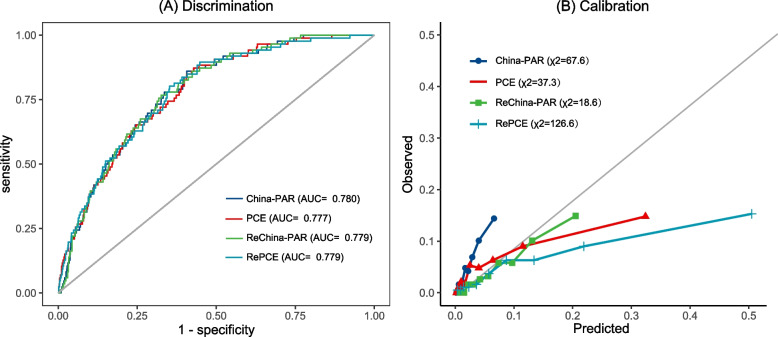
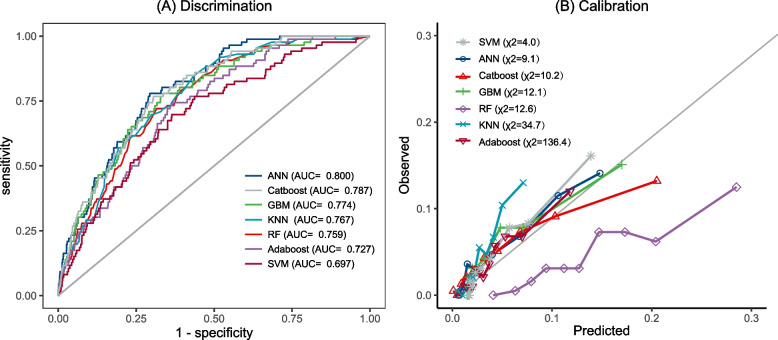
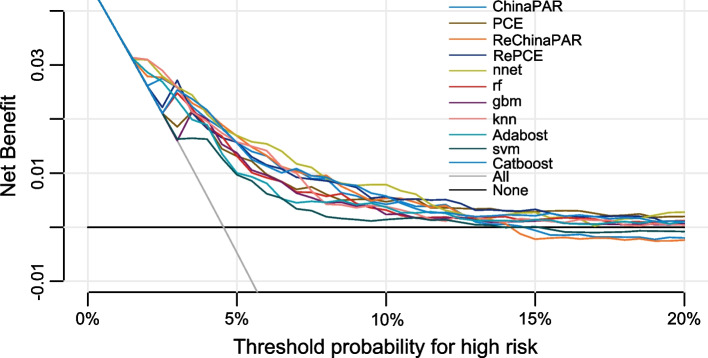
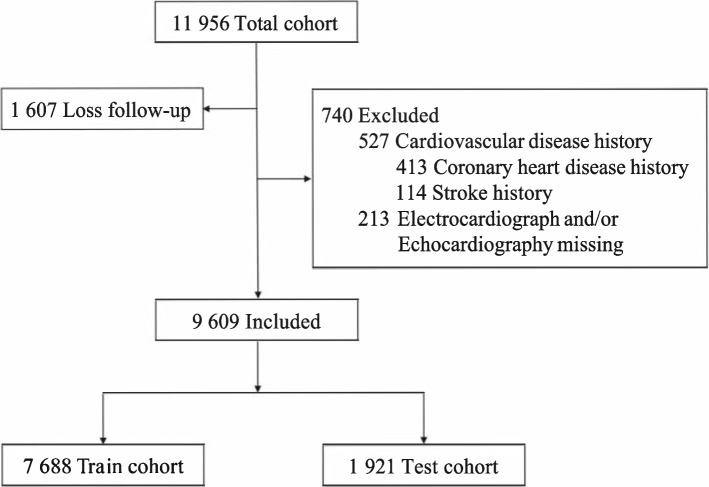
The study included 9,609 participants (mean age 53.4 ± 10.4 years, 53.7% female), and during a median follow-up of 4.7 years, 431 (4.5%) participants developed ASCVD. In the testing set, the final ML-based ANN model outperformed PCE, China-PAR, recalibrated PCE, and recalibrated China-PAR in predicting ASCVD. This was demonstrated by the model's higher area under the curve (AUC) of 0.800, compared to 0.777, 0.780, 0.779, and 0.779 for the other models, respectively. Additionally, the model had a lower Hosmer-Lemeshow χ2 of 9.1, compared to 37.3, 67.6, 126.6, and 18.6 for the other models. The net benefit at a threshold of 5% was also higher for the ML-based ANN model at 0.017, compared to 0.016, 0.013, 0.017, and 0.016 for the other models, respectively. Furthermore, the NRI was 0.089 for the ML-based ANN model, while it was 0.355, 0.098, and 0.088 for PCE, China-PAR, and recalibrated PCE, respectively.

CONCLUSIONS

Compared to conventional regression ASCVD risk calculators, such as PCE and China-PAR, the ANN prediction model may help optimize identification of individuals at heightened cardiovascular risk by flexibly incorporating a wider range of potential predictors. The findings may help guide clinical decision-making and ultimately contribute to ASCVD prevention and management.

摘要

背景

准确预测动脉粥样硬化性心血管疾病(ASCVD)的风险对于实施个体化预防策略和改善患者预后至关重要。我们的目标是为前瞻性中国人群开发基于机器学习(ML)的 ASCVD 风险预测模型,并比较其与传统回归模型的性能。

方法

使用了一个混合数据集,其中包含 98 个人口统计学、行为和心理特征、444 个心电图(ECG)特征和 9 个超声心动图(Echo)特征。在选择了 30 个最有信息量的特征后,我们训练、验证和测试了七个基于机器学习(ML)的模型。我们将 ML 模型的区分度、校准度、净效益和净重新分类改善(NRI)与传统的 ASCVD 风险计算器(如 Pooled Cohort Equations [PCE] 和 Prediction for ASCVD Risk in China [China-PAR])进行了比较。

结果

该研究共纳入了 9609 名参与者(平均年龄 53.4±10.4 岁,53.7%为女性),在中位随访 4.7 年后,有 431 名(4.5%)参与者发生了 ASCVD。在测试集中,最终的基于机器学习的 ANN 模型在预测 ASCVD 方面优于 PCE、China-PAR、重新校准的 PCE 和重新校准的 China-PAR。这表现在模型的曲线下面积(AUC)更高,分别为 0.800、0.777、0.780、0.779 和 0.779。此外,模型的 Hosmer-Lemeshow χ2 值也更低,为 9.1,而其他模型的 Hosmer-Lemeshow χ2 值分别为 37.3、67.6、126.6 和 18.6。在阈值为 5%时,基于机器学习的 ANN 模型的净效益也更高,分别为 0.017、0.016、0.013、0.017 和 0.016。此外,基于机器学习的 ANN 模型的 NRI 为 0.089,而 PCE、China-PAR 和重新校准的 PCE 的 NRI 分别为 0.355、0.098 和 0.088。

结论

与传统的回归 ASCVD 风险计算器(如 PCE 和 China-PAR)相比,ANN 预测模型通过灵活地纳入更广泛的潜在预测因素,可能有助于优化对心血管风险升高的个体的识别。研究结果可能有助于指导临床决策,并最终有助于 ASCVD 的预防和管理。
https://cdn.ncbi.nlm.nih.gov/pmc/blobs/483c/10367272/2ac8eb1d5f21/12911_2023_2242_Fig5_HTML.jpg
https://cdn.ncbi.nlm.nih.gov/pmc/blobs/483c/10367272/1edbc0fe9937/12911_2023_2242_Fig1_HTML.jpg
https://cdn.ncbi.nlm.nih.gov/pmc/blobs/483c/10367272/57c249201f84/12911_2023_2242_Fig2_HTML.jpg
https://cdn.ncbi.nlm.nih.gov/pmc/blobs/483c/10367272/947246c4fe76/12911_2023_2242_Fig3_HTML.jpg
https://cdn.ncbi.nlm.nih.gov/pmc/blobs/483c/10367272/e5ccda9316a7/12911_2023_2242_Fig4_HTML.jpg
https://cdn.ncbi.nlm.nih.gov/pmc/blobs/483c/10367272/2ac8eb1d5f21/12911_2023_2242_Fig5_HTML.jpg
https://cdn.ncbi.nlm.nih.gov/pmc/blobs/483c/10367272/1edbc0fe9937/12911_2023_2242_Fig1_HTML.jpg
https://cdn.ncbi.nlm.nih.gov/pmc/blobs/483c/10367272/57c249201f84/12911_2023_2242_Fig2_HTML.jpg
https://cdn.ncbi.nlm.nih.gov/pmc/blobs/483c/10367272/947246c4fe76/12911_2023_2242_Fig3_HTML.jpg
https://cdn.ncbi.nlm.nih.gov/pmc/blobs/483c/10367272/e5ccda9316a7/12911_2023_2242_Fig4_HTML.jpg
https://cdn.ncbi.nlm.nih.gov/pmc/blobs/483c/10367272/2ac8eb1d5f21/12911_2023_2242_Fig5_HTML.jpg

相似文献

1
Comparing the performance of machine learning and conventional models for predicting atherosclerotic cardiovascular disease in a general Chinese population.比较机器学习模型和传统模型在预测一般中国人群中动脉粥样硬化性心血管疾病方面的性能。
BMC Med Inform Decis Mak. 2023 Jul 24;23(1):134. doi: 10.1186/s12911-023-02242-z.
2
[Application of the China-PAR risk prediction model for atherosclerotic cardiovascular disease in a rural northern Chinese population].中国-PAR动脉粥样硬化性心血管疾病风险预测模型在中国北方农村人群中的应用
Beijing Da Xue Xue Bao Yi Xue Ban. 2017 Jun 18;49(3):439-445.
3
Evaluation of Atherosclerotic Cardiovascular Risk Prediction Models in China: Results From the CHERRY Study.中国动脉粥样硬化性心血管疾病风险预测模型的评估:CHERRY研究结果
JACC Asia. 2022 Jan 4;2(1):33-43. doi: 10.1016/j.jacasi.2021.10.007. eCollection 2022 Feb.
4
Comparative Analysis of Three Atherosclerotic Cardiovascular Disease Risk Prediction Models in Individuals Aged 75 and Older.75 岁及以上人群三种动脉粥样硬化性心血管病风险预测模型的比较分析。
Clin Interv Aging. 2024 Mar 20;19:529-538. doi: 10.2147/CIA.S454060. eCollection 2024.
5
Performance of atherosclerotic cardiovascular risk prediction models in a rural Northern Chinese population: Results from the Fangshan Cohort Study.中国北方农村人群动脉粥样硬化性心血管病风险预测模型的表现:来自房山队列研究的结果。
Am Heart J. 2019 May;211:34-44. doi: 10.1016/j.ahj.2019.01.009. Epub 2019 Feb 5.
6
External validation of three atherosclerotic cardiovascular disease risk equations in rural areas of Xinjiang, China.中国新疆农村地区三个动脉粥样硬化性心血管疾病风险方程的外部验证
BMC Public Health. 2020 Sep 29;20(1):1471. doi: 10.1186/s12889-020-09579-4.
7
Performance of the Pooled Cohort Equations to Estimate Atherosclerotic Cardiovascular Disease Risk by Body Mass Index.基于体重指数的 pooled cohort equations 评估动脉粥样硬化性心血管疾病风险的性能。
JAMA Netw Open. 2020 Oct 1;3(10):e2023242. doi: 10.1001/jamanetworkopen.2020.23242.
8
Predicting the 10-Year Risks of Atherosclerotic Cardiovascular Disease in Chinese Population: The China-PAR Project (Prediction for ASCVD Risk in China).预测中国人群动脉粥样硬化性心血管疾病 10 年风险:中国 PAR 项目(中国 ASCVD 风险预测)。
Circulation. 2016 Nov 8;134(19):1430-1440. doi: 10.1161/CIRCULATIONAHA.116.022367. Epub 2016 Sep 28.
9
Combining European and U.S. risk prediction models with polygenic risk scores to refine cardiovascular prevention: the CoLaus|PsyCoLaus Study.将欧洲和美国的风险预测模型与多基因风险评分相结合,以完善心血管预防:CoLaus|PsyCoLaus 研究。
Eur J Prev Cardiol. 2023 May 9;30(7):561-571. doi: 10.1093/eurjpc/zwad012.
10
Chinese ASCVD risk equations rather than pooled cohort equations are better to identify macro- and microcirculation abnormalities.中国 ASCVD 风险方程优于汇总队列方程,更能识别大血管和微血管病变。
BMC Cardiovasc Disord. 2020 Mar 24;20(1):145. doi: 10.1186/s12872-020-01425-0.

引用本文的文献

1
A hybrid algorithm-based ECG risk prediction model for cardiovascular disease.一种基于混合算法的心血管疾病心电图风险预测模型。
Eur Heart J Digit Health. 2025 Mar 19;6(3):466-475. doi: 10.1093/ehjdh/ztaf023. eCollection 2025 May.
2
Life-Course Multidisciplinary Psychosocial Predictors of Dementia Among Older Adults: Results From the Health and Retirement Study.老年人痴呆症的生命历程多学科社会心理预测因素:健康与退休研究的结果
Innov Aging. 2024 Oct 18;8(11):igae092. doi: 10.1093/geroni/igae092. eCollection 2024.

本文引用的文献

1
Evaluation of Atherosclerotic Cardiovascular Risk Prediction Models in China: Results From the CHERRY Study.中国动脉粥样硬化性心血管疾病风险预测模型的评估:CHERRY研究结果
JACC Asia. 2022 Jan 4;2(1):33-43. doi: 10.1016/j.jacasi.2021.10.007. eCollection 2022 Feb.
2
Machine learning derived ECG risk score improves cardiovascular risk assessment in conjunction with coronary artery calcium scoring.机器学习得出的心电图风险评分与冠状动脉钙化评分相结合可改善心血管风险评估。
Front Cardiovasc Med. 2022 Oct 5;9:976769. doi: 10.3389/fcvm.2022.976769. eCollection 2022.
3
Deep neural survival networks for cardiovascular risk prediction: The Multi-Ethnic Study of Atherosclerosis (MESA).
深度学习生存网络在心血管风险预测中的应用:动脉粥样硬化多民族研究(MESA)。
Comput Biol Med. 2021 Dec;139:104983. doi: 10.1016/j.compbiomed.2021.104983. Epub 2021 Oct 29.
4
Quantifying and Understanding the Higher Risk of Atherosclerotic Cardiovascular Disease Among South Asian Individuals: Results From the UK Biobank Prospective Cohort Study.量化和理解南亚个体患动脉粥样硬化性心血管疾病的更高风险:来自英国生物银行前瞻性队列研究的结果。
Circulation. 2021 Aug 10;144(6):410-422. doi: 10.1161/CIRCULATIONAHA.120.052430. Epub 2021 Jul 12.
5
Pre-existing and machine learning-based models for cardiovascular risk prediction.基于既有数据和机器学习的心血管风险预测模型。
Sci Rep. 2021 Apr 26;11(1):8886. doi: 10.1038/s41598-021-88257-w.
6
Machine learning-based prediction of adverse events following an acute coronary syndrome (PRAISE): a modelling study of pooled datasets.基于机器学习的急性冠状动脉综合征后不良事件预测(PRAISE):汇总数据集的建模研究。
Lancet. 2021 Jan 16;397(10270):199-207. doi: 10.1016/S0140-6736(20)32519-8.
7
Cardiovascular risk factors in China: a nationwide population-based cohort study.中国心血管危险因素:一项基于全国人群的队列研究。
Lancet Public Health. 2020 Dec;5(12):e672-e681. doi: 10.1016/S2468-2667(20)30191-2.
8
Machine Learning Adds to Clinical and CAC Assessments in Predicting 10-Year CHD and CVD Deaths.机器学习在预测 10 年冠心病和心血管疾病死亡方面增加了临床和 CAC 评估。
JACC Cardiovasc Imaging. 2021 Mar;14(3):615-625. doi: 10.1016/j.jcmg.2020.08.024. Epub 2020 Oct 28.
9
Machine learning and atherosclerotic cardiovascular disease risk prediction in a multi-ethnic population.多民族人群中的机器学习与动脉粥样硬化性心血管疾病风险预测
NPJ Digit Med. 2020 Sep 23;3:125. doi: 10.1038/s41746-020-00331-1. eCollection 2020.
10
How Machine Learning Will Transform Biomedicine.机器学习如何改变生物医学。
Cell. 2020 Apr 2;181(1):92-101. doi: 10.1016/j.cell.2020.03.022.