Mistry Laresh N, Neelkanthan Shreyas, Deshpande Shantanu S, Jawdekar Ashwin M, Shah Pakhi P, Khachane Nikita A
Department of Pediatric and Preventive Dentistry, Bharati Vidyapeeth (Deemed to be University) Dental College and Hospital, Navi Mumbai, IND.
Cureus. 2024 Oct 15;16(10):e71562. doi: 10.7759/cureus.71562. eCollection 2024 Oct.
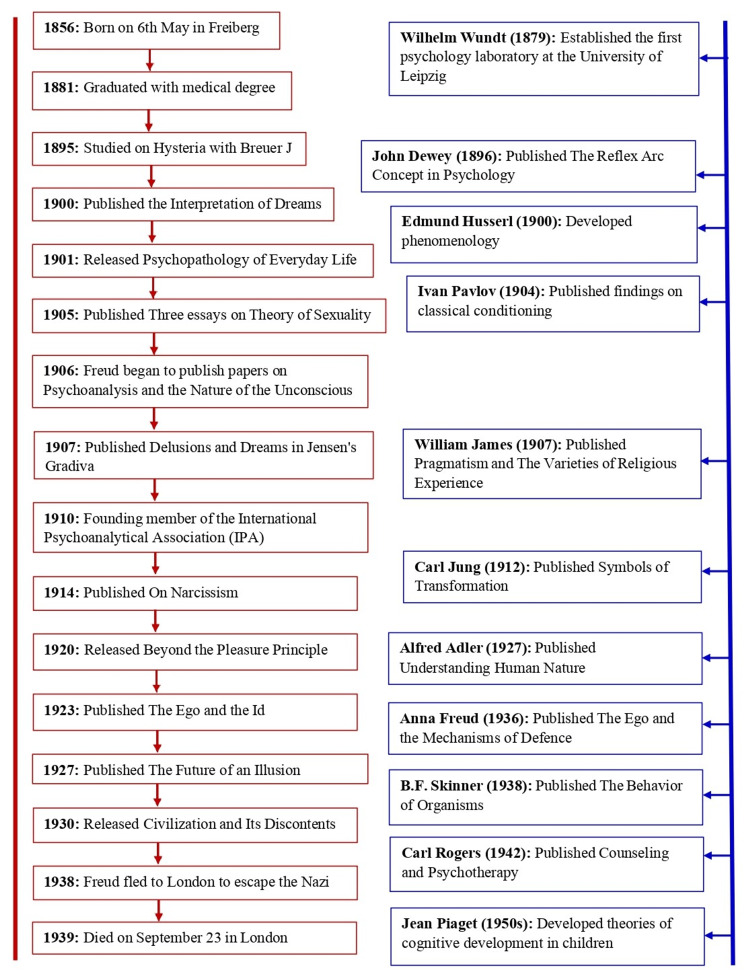
This biography of Sigmund Freud examines the life and contributions of the individual recognized as the progenitor of psychoanalysis, analyzing his significant influence on the fields of psychology, culture, and the comprehension of the human psyche. Sigmund Freud was born in 1856 in Freiburg, Moravia. His early education and burgeoning interest in the field of medicine established a critical foundation for the development of his innovative theories. Following his academic pursuits with distinguished individuals such as Jean-Martin Charcot in Paris, Freud formulated his theories regarding the unconscious mind, mechanisms of repression, and the importance of dreams. Freud's theoretical framework presented constructs such as the id, ego, and superego, fundamentally transforming our understanding of human behavior and motivation. The implementation of innovative methodologies, including free association and transference, has significantly contributed to the evolution of contemporary psychotherapy, facilitating the exploration of inner conflicts and unconscious desires among individuals. In the face of criticism and controversy, Freud's theories exerted a significant influence on psychology, as well as on art, literature, and popular culture, thereby shaping the intellectual landscape of the 20th century. The article further investigates Freud's personal life, encompassing his familial relationships. This also elucidates the diverse benchmarks of human psychiatry that were established during the era of Sigmund Freud. This review characterizes Freud as a multifaceted individual, a trailblazer whose contributions to the understanding of the human psyche persist in relevance, inciting discussions and encouraging further investigation across diverse disciplines. The narrative provides a comprehensive examination of Freud's life, contributions, and lasting impact, emphasizing his significance as a pivotal intellectual whose ideas continue to shape modern discourse surrounding identity, sexuality, and mental health.
这本关于西格蒙德·弗洛伊德的传记审视了这位被公认为精神分析学鼻祖的个人的生平与贡献,分析了他对心理学、文化以及人类心理理解领域的重大影响。西格蒙德·弗洛伊德于1856年出生在摩拉维亚的弗赖堡。他早期的教育以及对医学领域迅速增长的兴趣为其创新理论的发展奠定了关键基础。在跟随巴黎的让-马丁·沙可等杰出人士进行学术追求之后,弗洛伊德形成了他关于潜意识、压抑机制以及梦的重要性的理论。弗洛伊德的理论框架提出了本我、自我和超我等概念,从根本上改变了我们对人类行为和动机的理解。包括自由联想和移情在内的创新方法的应用,对当代心理治疗的发展起到了重大推动作用,有助于探索个体内心的冲突和潜意识欲望。尽管面临批评和争议,弗洛伊德的理论对心理学以及艺术、文学和流行文化都产生了重大影响,从而塑造了20世纪的知识景观。文章进一步探究了弗洛伊德的个人生活,包括他的家庭关系。这也阐明了在西格蒙德·弗洛伊德时代确立的人类精神病学的各种基准。这篇综述将弗洛伊德描述为一个多面的个体,一位开拓者,他对人类心理理解的贡献至今仍然具有相关性,引发了各学科的讨论并鼓励进一步研究。该叙述全面审视了弗洛伊德的生平、贡献和持久影响,强调了他作为一位关键知识分子的重要性,其思想继续塑造着围绕身份、性取向和心理健康的现代话语。