Tononi Giulio
Department of Psychiatry, University of Wisconsin, Madison, USA.
BMC Neurosci. 2004 Nov 2;5:42. doi: 10.1186/1471-2202-5-42.
Consciousness poses two main problems. The first is understanding the conditions that determine to what extent a system has conscious experience. For instance, why is our consciousness generated by certain parts of our brain, such as the thalamocortical system, and not by other parts, such as the cerebellum? And why are we conscious during wakefulness and much less so during dreamless sleep? The second problem is understanding the conditions that determine what kind of consciousness a system has. For example, why do specific parts of the brain contribute specific qualities to our conscious experience, such as vision and audition?
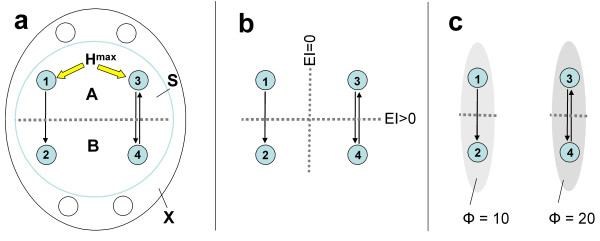
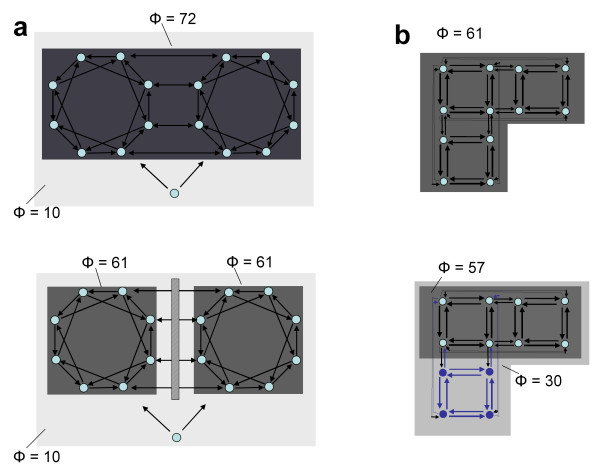
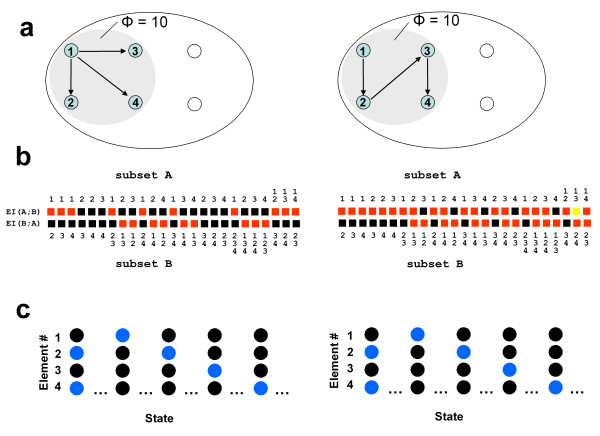
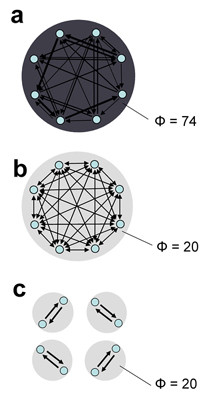
This paper presents a theory about what consciousness is and how it can be measured. According to the theory, consciousness corresponds to the capacity of a system to integrate information. This claim is motivated by two key phenomenological properties of consciousness: differentiation - the availability of a very large number of conscious experiences; and integration - the unity of each such experience. The theory states that the quantity of consciousness available to a system can be measured as the Phi value of a complex of elements. Phi is the amount of causally effective information that can be integrated across the informational weakest link of a subset of elements. A complex is a subset of elements with Phi>0 that is not part of a subset of higher Phi. The theory also claims that the quality of consciousness is determined by the informational relationships among the elements of a complex, which are specified by the values of effective information among them. Finally, each particular conscious experience is specified by the value, at any given time, of the variables mediating informational interactions among the elements of a complex.
The information integration theory accounts, in a principled manner, for several neurobiological observations concerning consciousness. As shown here, these include the association of consciousness with certain neural systems rather than with others; the fact that neural processes underlying consciousness can influence or be influenced by neural processes that remain unconscious; the reduction of consciousness during dreamless sleep and generalized seizures; and the time requirements on neural interactions that support consciousness.
The theory entails that consciousness is a fundamental quantity, that it is graded, that it is present in infants and animals, and that it should be possible to build conscious artifacts.
意识存在两个主要问题。第一个问题是理解那些决定一个系统具有何种程度的意识体验的条件。例如,为什么我们的意识是由大脑的某些部分,如丘脑皮质系统产生的,而不是由其他部分,如小脑产生的?以及为什么我们在清醒时有意识,而在无梦睡眠时意识则少得多?第二个问题是理解那些决定一个系统具有何种意识的条件。例如,为什么大脑的特定部分会为我们的意识体验贡献特定的特质,如视觉和听觉?
本文提出了一种关于意识是什么以及如何对其进行测量的理论。根据该理论,意识对应于一个系统整合信息的能力。这一主张是由意识的两个关键现象学特性所推动的:区分性——大量意识体验的可得性;以及整合性——每一种此类体验的统一性。该理论指出,一个系统所具有的意识量可以用一组元素复合体的Φ值来衡量。Φ是能够跨越一组元素的信息最薄弱环节进行整合的因果有效信息量。一个复合体是一组Φ>0的元素子集,且不是更高Φ值子集的一部分。该理论还声称,意识的特质由一个复合体中各元素之间的信息关系所决定,这些信息关系由它们之间的有效信息值来规定。最后,每一种特定的意识体验由在任何给定时间介导一个复合体中各元素之间信息交互的变量的值所规定。
信息整合理论以一种有原则的方式解释了关于意识的若干神经生物学观察结果。如下所示,这些观察结果包括意识与某些神经系统而非其他系统的关联;意识背后的神经过程能够影响无意识的神经过程或被其影响这一事实;无梦睡眠和全身性癫痫发作期间意识的减弱;以及支持意识的神经交互作用的时间要求。
该理论意味着意识是一个基本量度,它是分级的,存在于婴儿和动物之中,并且应该有可能制造出有意识的人工制品。