Çınar Şevki, Altan Çınar Bike, Güneş Bağlan Gökçe, Yıldırım Ersin
Department of Prosthodontics, Faculty of Dentistry, University of Health Sciences, Tıbbiye Street No: 38, 34668, Uskudar, Istanbul, Turkey.
Department of Orthodontics, Faculty of Dentistry, University of Health Sciences, Turkey.
Heliyon. 2024 Oct 31;10(21):e40018. doi: 10.1016/j.heliyon.2024.e40018. eCollection 2024 Nov 15.
To evaluate the shear bond strength (SBS) of ceramic and metallic orthodontic brackets bonded to lithium disilicate ceramics or hybrid ceramics and subjected to different surface conditioning treatments.
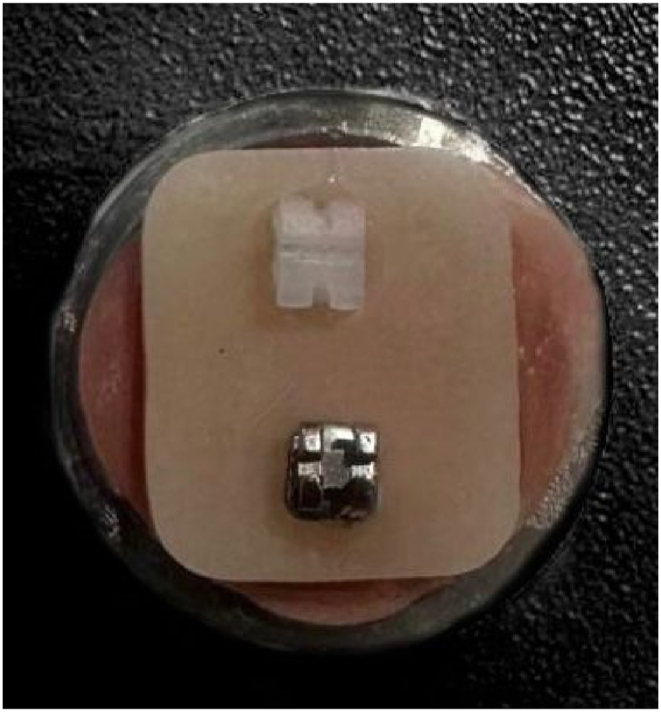
In total, 300 specimens were fabricated from GC LiSi (lithium disilicate) and GC Cerasmart (hybrid) ceramic blocks. The specimens were divided into four groups according to the following surface treatments: hydrofluoric acid (HF); sandblasting with 50 μm aluminum oxide; Monobond Etch and Prime; and erbium-doped yttrium aluminum garnet (Er-YAG) laser. Metal (Victory Series) and ceramic (Clarity) brackets were bonded using an orthodontic adhesive resin (Transbond XT; 3M Unitek, CA, USA). The specimens were then stored in three different mediums (artificial saliva, mouth rinse, and gastric juice) and thermocycled. An SBS test was performed after 1 week. The surface morphology was examined after the conditioning treatments using a scanning electron microscope. Data were analyzed using analysis of variance, -test, and Duncan test.
The SBS data revealed that the type of computer-aided design/computer-aided manufacturing (CAD/CAM) block and surface conditioning method significantly affected the SBS. The highest SBS was recorded (10.112 MPa) for the HF-treated hybrid ceramic blocks stored in the saliva medium, while the lowest SBS (1.862 MPa) was reported for the Er-YAG laser-treated lithium disilicate ceramic blocks stored in the gastric juice medium. GC Cerasmart exhibited better bond strength than that of GC LiSi; however, no significant difference was observed between the ceramic and metal brackets.
The CAD/CAM material, surface conditioning method, and medium affect the SBS.
评估粘结于二硅酸锂陶瓷或混合陶瓷上并经过不同表面处理的陶瓷和金属正畸托槽的剪切粘结强度(SBS)。
总共从GC LiSi(二硅酸锂)和GC Cerasmart(混合)陶瓷块制备了300个样本。根据以下表面处理将样本分为四组:氢氟酸(HF);用50μm氧化铝喷砂;Monobond蚀刻和底涂;掺铒钇铝石榴石(Er-YAG)激光。使用正畸粘结树脂(Transbond XT;3M Unitek,美国加利福尼亚州)粘结金属(Victory系列)和陶瓷(Clarity)托槽。然后将样本储存在三种不同介质(人工唾液、漱口水和胃液)中并进行热循环。1周后进行SBS测试。使用扫描电子显微镜在处理后检查表面形态。数据采用方差分析、t检验和邓肯检验进行分析。
SBS数据显示,计算机辅助设计/计算机辅助制造(CAD/CAM)块的类型和表面处理方法对SBS有显著影响。储存在唾液介质中的HF处理混合陶瓷块的SBS最高(10.112MPa),而储存在胃液介质中的Er-YAG激光处理二硅酸锂陶瓷块的SBS最低(1.862MPa)。GC Cerasmart表现出比GC LiSi更好的粘结强度;然而,陶瓷和金属托槽之间未观察到显著差异。
CAD/CAM材料、表面处理方法和介质会影响SBS。