Huang Amy Y, Burke Kelly P, Porter Ryan, Meiger Lynn, Fatouros Peter, Yang Jiekun, Robitschek Emily, Vokes Natalie, Ricker Cora, Rosado Valeria, Tarantino Giuseppe, Chen Jiajia, Aprati Tyler J, Glettig Marc C, He Yiwen, Wang Cassia, Fu Doris, Ho Li-Lun, Galani Kyriakitsa, Freeman Gordon J, Buchbinder Elizabeth I, Stephen Hodi F, Kellis Manolis, Boland Genevieve M, Sharpe Arlene H, Liu David
Dana-Farber Cancer Institute, Boston, MA, USA.
Broad Institute of Harvard and Massachusetts Institute of Technology, Cambridge, MA, USA.
bioRxiv. 2024 Oct 30:2024.10.29.620300. doi: 10.1101/2024.10.29.620300.
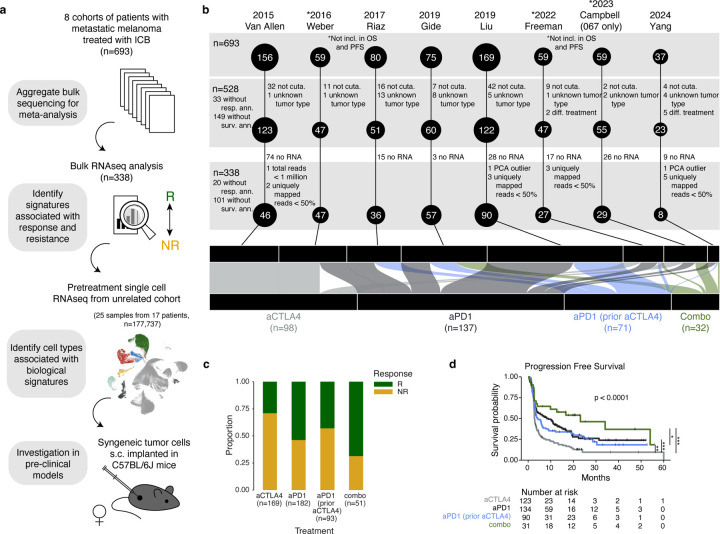
While immune-checkpoint blockade (ICB) has revolutionized treatment of metastatic melanoma over the last decade, the identification of broadly applicable robust biomarkers has been challenging, driven in large part by the heterogeneity of ICB regimens and patient and tumor characteristics. To disentangle these features, we performed a standardized meta-analysis of eight cohorts of patients treated with anti-PD-1 (n=290), anti-CTLA-4 (n=175), and combination anti-PD-1/anti-CTLA-4 (n=51) with RNA sequencing of pre-treatment tumor and clinical annotations. Stratifying by immune-high vs -low tumors, we found that surprisingly, high immune infiltrate was a biomarker for response to combination ICB, but not anti-PD-1 alone. Additionally, hypoxia-related signatures were associated with non-response to anti-PD-1, but only amongst immune infiltrate-high melanomas. In a cohort of scRNA-seq of patients with metastatic melanoma, hypoxia also correlated with immunosuppression and changes in tumor-stromal communication in the tumor microenvironment (TME). Clinically actionable targets of hypoxia signaling were also uniquely expressed across different cell types. We focused on one such target, HIF-2, which was specifically upregulated in endothelial cells and fibroblasts but not in immune cells or tumor cells. HIF-2 inhibition, in combination with anti-PD-1, enhanced tumor growth control in pre-clinical models, but only in a more immune-infiltrated melanoma model. Our work demonstrates how careful stratification by clinical and molecular characteristics can be leveraged to derive meaningful biological insights and lead to the rational discovery of novel clinical targets for combination therapy.
在过去十年中,免疫检查点阻断(ICB)彻底改变了转移性黑色素瘤的治疗方式,但确定广泛适用的可靠生物标志物一直具有挑战性,这在很大程度上是由ICB方案以及患者和肿瘤特征的异质性所驱动的。为了厘清这些特征,我们对八组接受抗程序性死亡蛋白1(PD-1)治疗(n = 290)、抗细胞毒性T淋巴细胞相关蛋白4(CTLA-4)治疗(n = 175)以及抗PD-1/抗CTLA-4联合治疗(n = 51)的患者队列进行了标准化的荟萃分析,并对治疗前肿瘤进行了RNA测序和临床注释。通过免疫高浸润与低浸润肿瘤进行分层,我们惊讶地发现,高免疫浸润是联合ICB治疗反应的生物标志物,但单独使用抗PD-1治疗时并非如此。此外,缺氧相关特征与抗PD-1治疗无反应相关,但仅在免疫浸润高的黑色素瘤中存在。在一组转移性黑色素瘤患者的单细胞RNA测序(scRNA-seq)中,缺氧也与免疫抑制以及肿瘤微环境(TME)中肿瘤-基质通讯的变化相关。缺氧信号的临床可操作靶点也在不同细胞类型中独特表达。我们聚焦于其中一个这样的靶点,即缺氧诱导因子-2(HIF-2),它在内皮细胞和成纤维细胞中特异性上调,但在免疫细胞或肿瘤细胞中未上调。在临床前模型中,HIF-2抑制与抗PD-1联合使用可增强肿瘤生长控制,但仅在免疫浸润程度更高的黑色素瘤模型中有效。我们的研究表明,如何通过临床和分子特征进行仔细分层,以获得有意义的生物学见解,并合理发现联合治疗的新型临床靶点。