Department of Nursing, Shanghai Ninth People's Hospital, Shanghai JiaoTong University School of Medicine, Shanghai, China.
School of Nursing, Shanghai JiaoTong University, Shanghai, China.
Health Expect. 2024 Dec;27(6):e70112. doi: 10.1111/hex.70112.
Patient Engagement in Research (PER) has demonstrated benefits for patients, researchers and research outcomes. However, China lacks substantial experience in implementing PER. The implementation of PER in China faces unique challenges due to social-cultural differences. This study explores the perspectives of Chinese researchers to identify barriers and facilitators, aiming to guide future PER initiatives and enhance the role of patients in research.
Purposive sampling was employed to recruit clinical researchers with diverse healthcare backgrounds in China. Semi-structured interviews, conducted by a qualified researcher, followed interview guidelines derived from a literature review and pilot study modifications. Thematic analysis was applied using QSR Nvivo 8.0.
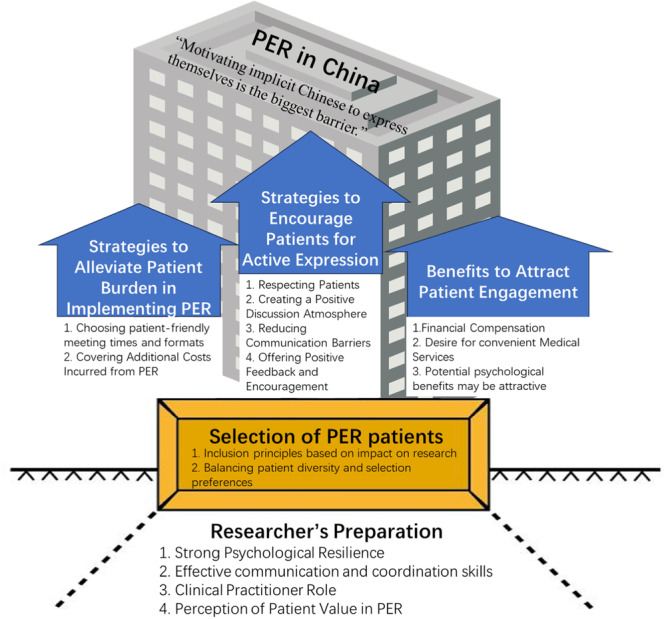
A total of 13 participants were included. Five main themes were identified from interview: (1) selection of patients for research engagement, (2) strategies to alleviate the patient burden in implementing PER, (3) strategies to encourage patients for active expression, (4) benefits to attract patient engagement and (5) researcher's preparation.
The cultural trait of 'reservedness' in Chinese culture hinders active expression by patients in the research engagement process. Researchers tend to recruit patients with specific characteristics and emphasize the importance of aligning benefits with patient values to motivate engagement. Addressing patient burden is crucial, and researchers should be well-prepared before PER. These findings underscore the necessity of adopting culturally adapted strategies in PER to effectively address specific challenges.
The public participated in the interpretation of the interview results, enriching our understanding of the results.
患者参与研究(PER)已被证明对患者、研究人员和研究结果都有益处。然而,中国在实施 PER 方面经验不足。由于社会文化差异,PER 在我国的实施面临着独特的挑战。本研究旨在探讨中国研究人员的观点,以确定障碍和促进因素,为未来的 PER 计划提供指导,并增强患者在研究中的作用。
采用目的抽样法,在中国招募具有不同医疗背景的临床研究人员。合格的研究人员采用半结构式访谈,访谈指南来源于文献综述和试点研究的修改。使用 QSR Nvivo 8.0 进行主题分析。
共纳入 13 名参与者。访谈中确定了五个主要主题:(1)选择参与研究的患者,(2)减轻实施 PER 中患者负担的策略,(3)鼓励患者积极表达的策略,(4)吸引患者参与的益处,以及(5)研究人员的准备。
中国文化中的“含蓄”文化特征阻碍了患者在研究参与过程中的积极表达。研究人员倾向于招募具有特定特征的患者,并强调将利益与患者价值观保持一致以激励参与的重要性。解决患者负担是至关重要的,研究人员在进行 PER 之前应做好充分准备。这些发现强调了在 PER 中采用文化适应性策略的必要性,以有效地应对特定的挑战。
公众参与了访谈结果的解释,丰富了我们对结果的理解。