Centre Nacional d'Anàlisi Genòmica (CNAG), Baldiri Reixac 4, Barcelona, 08028, Spain.
Universitat de Barcelona (UB), Barcelona, Spain.
BMC Genomics. 2024 Nov 21;25(1):1124. doi: 10.1186/s12864-024-11015-5.
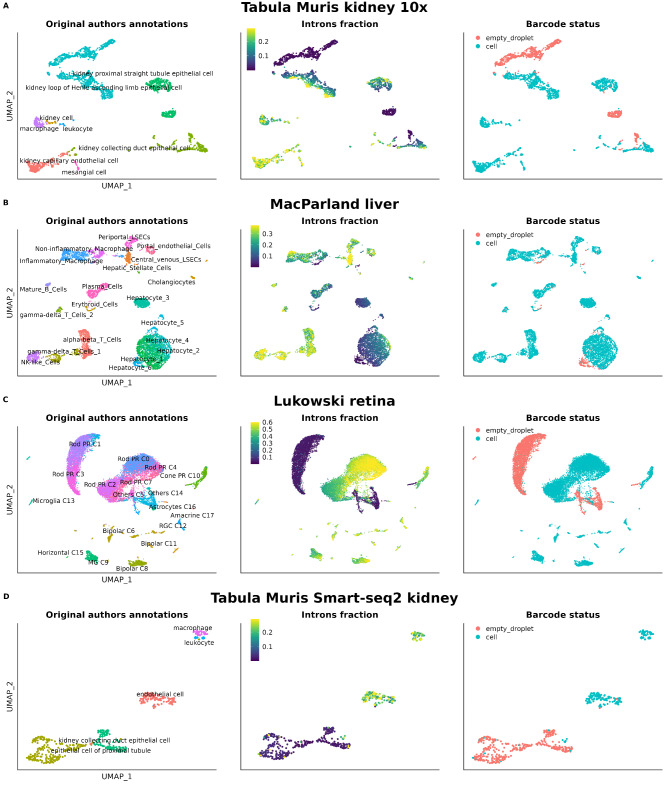
The advent of droplet-based single-cell RNA-sequencing (scRNA-seq) has dramatically increased data throughput, enabling the release of a diverse array of tissue cell atlases to the public. However, we will show that prominent initiatives such as the Human Cell Atlas [1], the Tabula Sapiens [2] and the Tabula Muris [3] contain a significant amount of contamination products (frequently affecting the whole organ) in their data portals due to suboptimal quality filtering. Our work addresses a critical gap by advocating for more stringent quality filtering, highlighting the imperative for a shift from existing standards, which currently lean towards greater permissiveness. We will show the importance of incorporating cell intronic fraction in quality control -or MALAT1 expression otherwise- showcasing its informative nature and potential to elevate cell atlas data reliability. In summary, here, we unveil the hidden intronic landscape of every tissue and highlight the importance of more rigorous single-cell RNA-sequencing quality assessment in cell atlases to enhance their applicability in diverse downstream analyses.
基于液滴的单细胞 RNA 测序(scRNA-seq)的出现极大地提高了数据通量,使各种组织细胞图谱得以向公众发布。然而,我们将表明,一些重要的倡议,如人类细胞图谱 [1]、智者图谱 [2] 和老鼠图谱 [3],由于质量过滤不佳,其数据门户中包含大量污染产物(通常影响整个器官)。我们的工作通过提倡更严格的质量过滤来解决这一关键差距,强调需要从目前偏向更大宽容度的现有标准转变。我们将展示在质量控制中纳入细胞内含子分数的重要性 - 或 MALAT1 表达 - 展示其信息性质和提高细胞图谱数据可靠性的潜力。总之,在这里,我们揭示了每个组织的隐藏内含子景观,并强调了在细胞图谱中进行更严格的单细胞 RNA-seq 质量评估的重要性,以提高它们在各种下游分析中的适用性。