Central Research Laboratory, The Second Hospital, Cheeloo College of Medicine, Shandong University, Jinan, China.
Jinan Maternity and Child Health Care Hospital, Jinan, China.
J Transl Med. 2024 Nov 21;22(1):1049. doi: 10.1186/s12967-024-05879-0.
Initial telomere length (TL) in newborns is the major determinant for TL in later life while TL in newborn/early-life predicts long-term health and lifespan. It is important to identify key factors that affect telomere homeostasis throughout embryonic development for precision interventions to maintain optimal TL in fetus/prenatal infants. SARS-CoV-2 has caused a widespread global pandemic of COVID-19, but it remains unclear whether maternal SARS-CoV-2 infection impairs prenatal telomere homeostasis.
We recruited 413 normally delivered newborns whose mothers were either non-infected or infected with SARS-CoV-2 during different trimesters of pregnancy (otherwise healthy). Telomere length (TL) in cord blood (CB) was assessed using qPCR. CB and maternal blood were analyzed for cytokine levels. Placental senescence was determined using senescence-associated β-galactosidase staining.
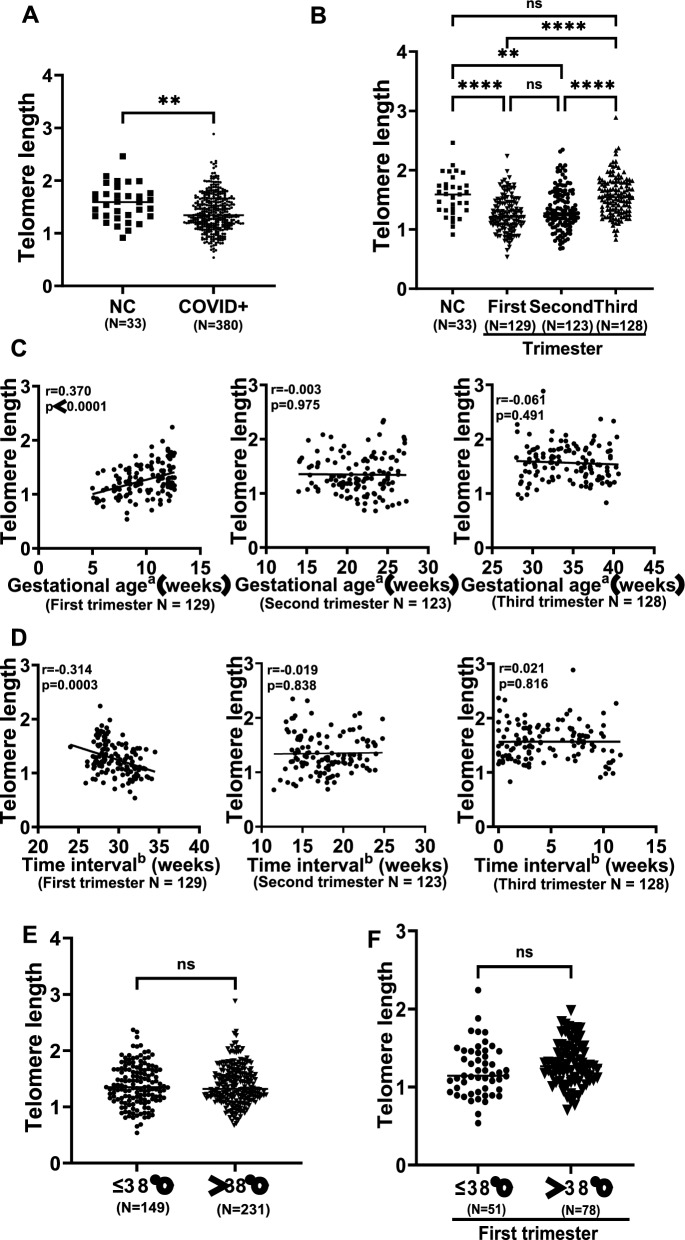
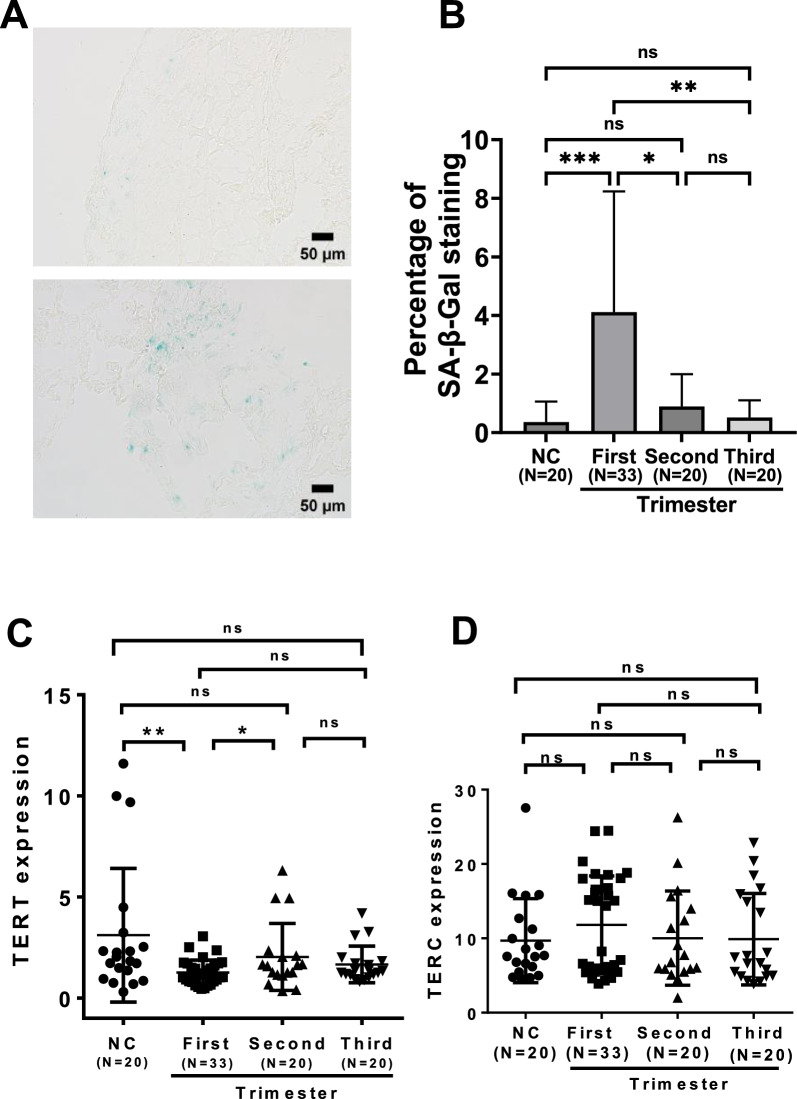
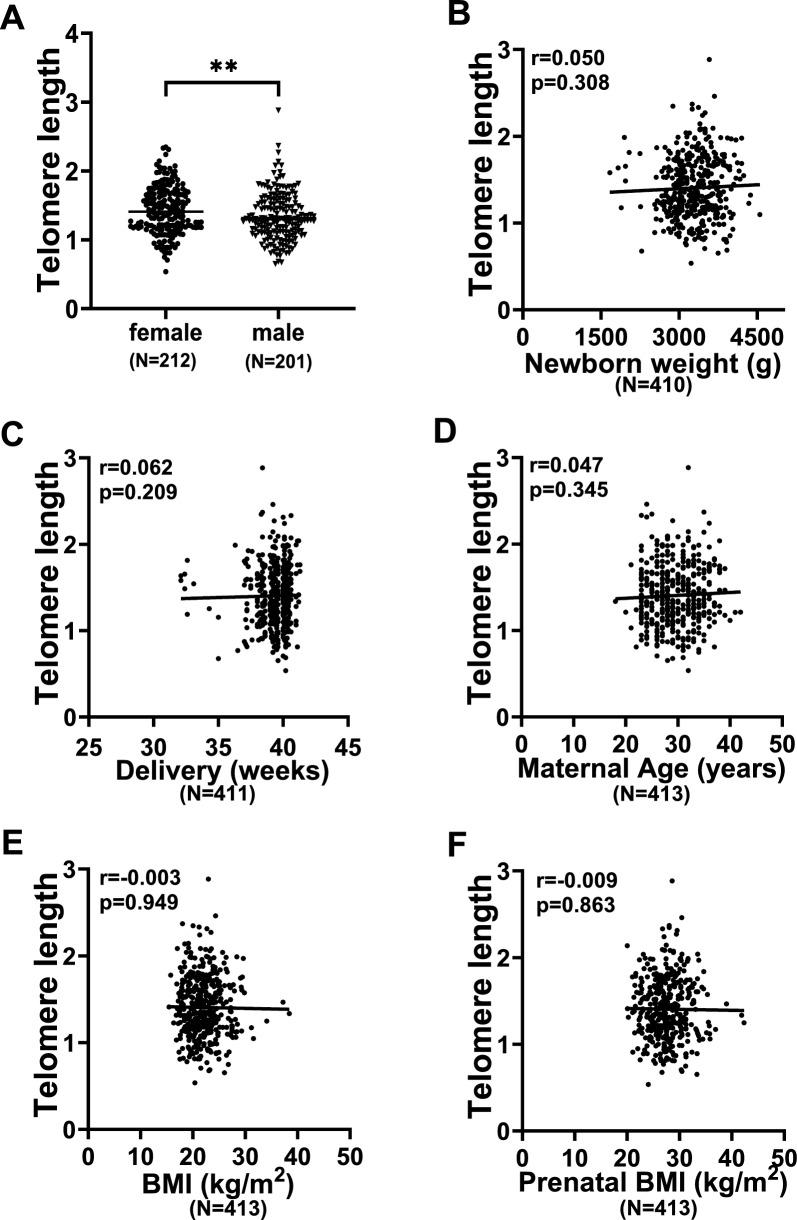
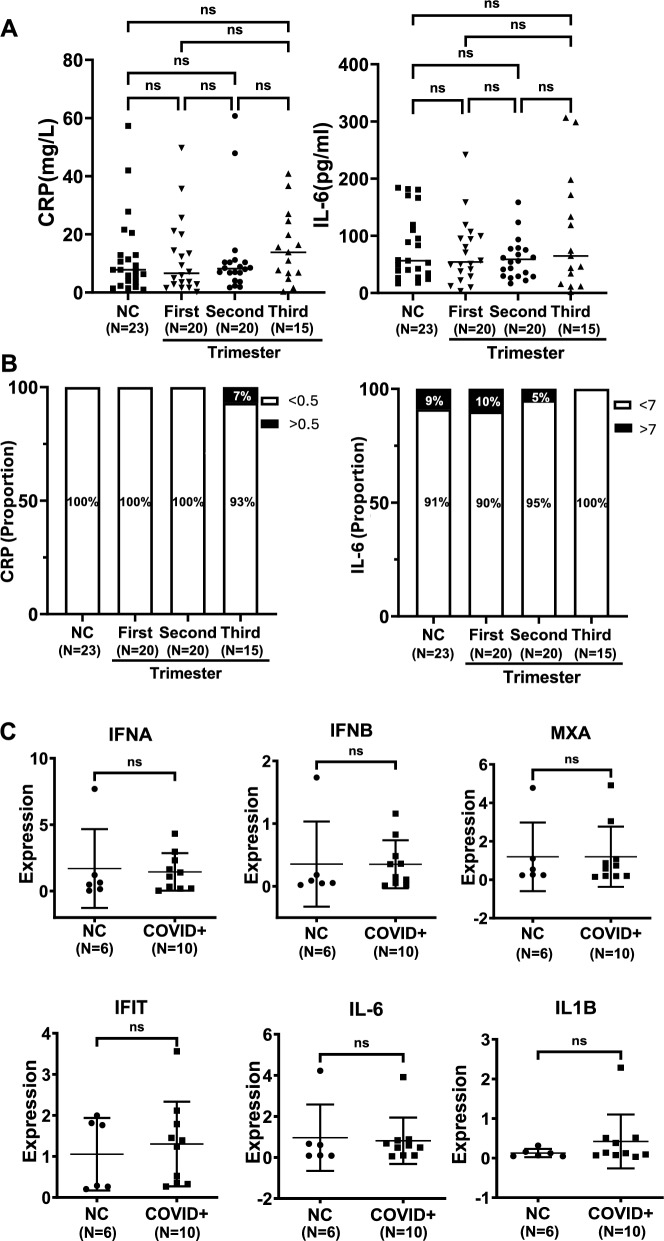
Control (non-infected maternal) newborn TL was significantly longer than that from maternal infection (1.568 ± 0.340 vs 1.390 ± 0.350, P = 0.005). Such shorter TL was observed only if maternal infection of SARS-CoV-2 occurred in the first and second trimesters of pregnancy (1.261 ± 0.340 and 1.346 ± 0.353, P < 0.0001 and 0.001, respectively). There were no differences in TL between controls and infection at the third trimester (1.568 ± 0.340 vs 1.565 ± 0.329, P > 0.05). Across the first trimester, there was a positive correlation between newborn TL and gestational weeks with maternal infection, suggesting that the earlier maternal infection occurs, the worse effect is taken on fetal telomere homeostasis. Placental senescence coupled with the downregulated expression of telomerase reverse transcriptase was significantly more frequent from the maternal infection at the first trimester. There were no differences in IL-6, C reactive protein and other cytokine levels in CB and maternal serum or placentas.
Maternal SARS-CoV-2 infection at the first and second trimesters leads to significantly shorter TL and earlier infection causes much more severe TL damage. The infection-mediated cell senescence and other histopathological abnormalities result in defective placental function through which fetal telomere homeostasis is impaired. Thus, vaccination against COVID-19 should be done in advance for women who plan pregnancy.
新生儿的初始端粒长度(TL)是其日后 TL 的主要决定因素,而新生儿/生命早期的 TL 可预测长期健康和寿命。确定影响胚胎发育过程中端粒动态平衡的关键因素对于维持胎儿/产前婴儿最佳 TL 的精确干预非常重要。SARS-CoV-2 已在全球范围内引发了 COVID-19 大流行,但目前尚不清楚母体 SARS-CoV-2 感染是否会损害产前端粒动态平衡。
我们招募了 413 名正常分娩的新生儿,其母亲在妊娠的不同 trimester 中要么未感染 SARS-CoV-2,要么感染了 SARS-CoV-2(健康状况良好)。使用 qPCR 评估脐带血(CB)中的 TL。分析 CB 和母体血液中的细胞因子水平。使用衰老相关的β-半乳糖苷酶染色来确定胎盘衰老。
对照(未感染的母体)新生儿的 TL 明显长于母体感染的 TL(1.568±0.340 对 1.390±0.350,P=0.005)。只有在母体 SARS-CoV-2 感染发生在妊娠第一和第二 trimester 时才会观察到这种较短的 TL(1.261±0.340 和 1.346±0.353,P<0.0001 和 0.001)。在第三 trimester 中,对照组和感染组之间的 TL 没有差异(1.568±0.340 对 1.565±0.329,P>0.05)。在整个第一 trimester 中,新生儿 TL 与母体感染的妊娠周数之间存在正相关,表明母体感染越早,对胎儿端粒动态平衡的影响越严重。与第一 trimester 母体感染相关的胎盘衰老与端粒酶逆转录酶的下调表达显著更为频繁。CB 和母体血清或胎盘中的 IL-6、C 反应蛋白和其他细胞因子水平没有差异。
母体 SARS-CoV-2 在第一和第二 trimester 的感染导致明显较短的 TL,而更早的感染则导致更严重的 TL 损伤。感染介导的细胞衰老和其他组织病理学异常通过损害胎盘功能导致胎儿端粒动态平衡受损。因此,对于计划怀孕的女性,应提前接种 COVID-19 疫苗。