Department of Human Life Design and Science, Faculty of Design, Kyushu University, Fukuoka, 815-8540, Japan.
Department of Physical Therapy, School of Rehabilitation, Tokyo Professional University of Health Science, Tokyo, Japan.
J Physiol Anthropol. 2024 Nov 21;43(1):29. doi: 10.1186/s40101-024-00376-1.
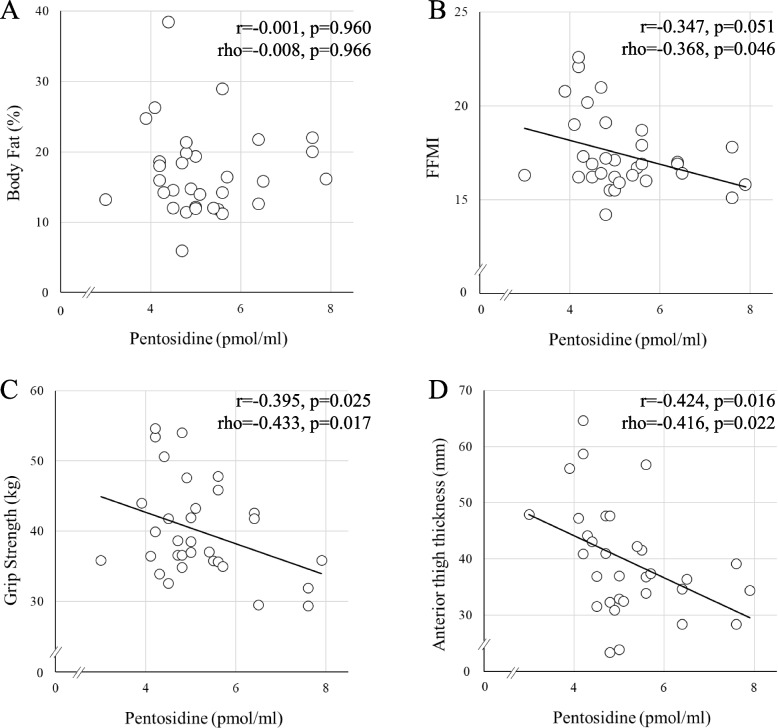
Pentosidine is representative of the cross-linked structure of advanced glycation end products (AGEs) and has been suggested as a biomarker to assess bone and muscle quality. As studies on pentosidine in young adult men remain limited, we aimed to clarify the associations of urinary pentosidine with musculoskeletal status and physical performance in young men. Participants in this study comprised 32 men (age range: 19-39 years). Anthropometric measurements (body composition by InBody 430; stiffness index by ultrasound), muscle performance (grip strength by dynamometer, thigh muscle thickness by ultrasound), physical performance (functional reach test, 30-s chair stand test, and timed up and go test), and urinary biomarkers (pentosidine, N-telopeptide of type I collagen, and creatinine) were measured. In partial correlation analysis adjusted for age and height, higher urinary pentosidine levels were significantly associated with lower fat-free mass index (rho = - 0.368, p = 0.046), grip strength (rho = - 0.433, p = 0.017), rectus femoris thickness (rho = - 0.393, p = 0.032), and anterior thigh thickness (rho = - 0.416, p = 0.022), and a marginally inverse correlation was noted between urinary pentosidine levels and functional reach test (rho = - 0.327, p = 0.078). Our findings suggest that pentosidine correlates inversely with a few muscle and physical performance indicators. Pending future validations, urinary pentosidine may be a biomarker of AGEs in young men.
戊糖素是糖基化终产物(AGEs)交联结构的代表,已被提议作为评估骨骼和肌肉质量的生物标志物。由于关于年轻成年男性戊糖素的研究仍然有限,我们旨在阐明尿戊糖素与年轻男性骨骼肌状况和身体表现的关系。本研究的参与者包括 32 名男性(年龄范围:19-39 岁)。进行了人体测量学测量(InBody 430 进行身体成分测量;超声进行硬度指数测量)、肌肉表现(测力计进行握力测量,超声进行大腿肌肉厚度测量)、身体表现(功能伸展测试、30 秒椅站立测试和计时起立行走测试)和尿生物标志物(戊糖素、I 型胶原 N-末端肽和肌酐)的测量。在调整年龄和身高的偏相关分析中,较高的尿戊糖素水平与较低的去脂体重指数(rho=-0.368,p=0.046)、握力(rho=-0.433,p=0.017)、股直肌厚度(rho=-0.393,p=0.032)和前大腿厚度(rho=-0.416,p=0.022)呈显著负相关,尿戊糖素水平与功能伸展测试之间存在边缘负相关(rho=-0.327,p=0.078)。我们的研究结果表明,戊糖素与一些肌肉和身体表现指标呈负相关。在未来的验证中,尿戊糖素可能是年轻男性 AGEs 的生物标志物。