McNeil Dominic G, Lindsay Riki S, Worn Ryan, Spittle Michael, Gabbett Tim J
Institute of Health and Wellbeing, Federation University Australia, Victoria, Australia.
Institute of Education, Arts and Community, Federation University Australia, Victoria, Australia.
Sports Health. 2025 Jan-Feb;17(1):156-163. doi: 10.1177/19417381241297161. Epub 2024 Nov 22.
Athletes often face the dual challenge of high training loads with insufficient time to recover. Equally, in any team, sports medicine and performance staff are required to progress training loads in healthy athletes and avoid prolonged reductions in training load in injured athletes. In both cases, the implementation of a well-established psychological technique known as motor imagery (MI) can be used to counteract adverse training adaptations such as excessive fatigue, reduced capacity, diminished performance, and heightened injury susceptibility.
Narrative overview.
Level 5.
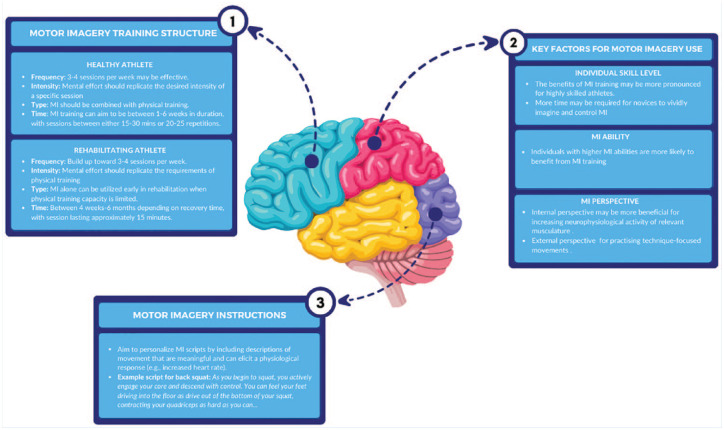
MI has been shown to enhance performance outcomes in a range of contexts including rehabilitation, skill acquisition, return-to-sport protocols, and strength and conditioning. Specific performance outcomes include reduction of strength loss and muscular atrophy, improved training engagement of injured and/or rehabilitating athletes, promotion of recovery, and development of sport-specific skills/game tactics. To achieve improvements in such outcomes, it is recommended that practitioners consider the following factors when implementing MI: individual skill level (ie, more time may be required for novices to obtain benefits), MI ability (ie, athletes with greater capacity to create vivid and controllable mental images of their performance will likely benefit more from MI training), and the perspective employed (ie, an internal perspective may be more beneficial for increasing neurophysiological activity whereas an external perspective may be better for practicing technique-focused movements).
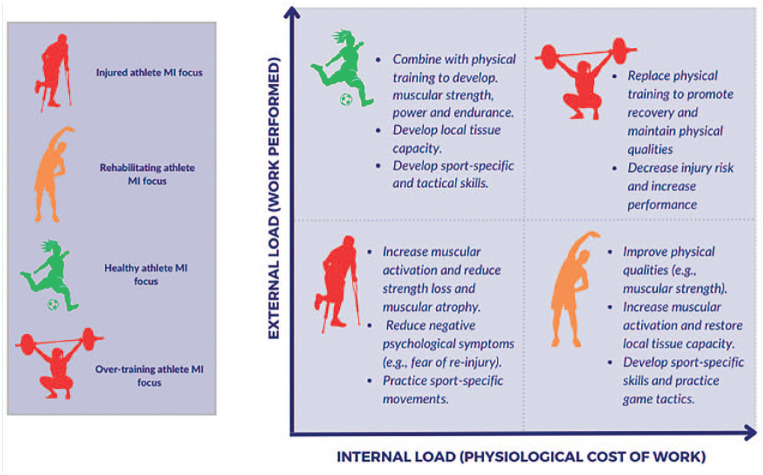
We provide practical recommendations grounded in established frameworks on how MI can be used to reduce strength loss and fear of reinjury in athletes with acute injury, improve physical qualities in rehabilitating athletes, reduce physical loads in overtrained athletes, and to develop tactical and technical skills in healthy athletes.
运动员常常面临训练负荷大但恢复时间不足的双重挑战。同样,在任何团队中,运动医学和表现提升人员都需要在健康运动员中逐步增加训练负荷,并避免受伤运动员的训练负荷长时间降低。在这两种情况下,一种被称为运动想象(MI)的成熟心理技术的应用,可以用来对抗诸如过度疲劳、能力下降、表现降低和受伤易感性增加等不良训练适应性问题。
叙述性综述。
5级。
运动想象已被证明在一系列情境中能提升表现结果,包括康复、技能习得、重返运动方案以及力量和体能训练。具体的表现结果包括减少力量损失和肌肉萎缩、提高受伤和/或正在康复的运动员的训练参与度、促进恢复以及发展特定运动技能/比赛战术。为了在这些结果上取得改善,建议从业者在实施运动想象时考虑以下因素:个人技能水平(即新手可能需要更多时间才能获得益处)、运动想象能力(即能够更生动且可控地在脑海中呈现自己表现的运动员可能从运动想象训练中获益更多)以及所采用的视角(即内部视角可能更有利于增加神经生理活动,而外部视角可能更适合练习以技术为重点的动作)。
我们基于既定框架提供实用建议,说明如何利用运动想象来减少急性受伤运动员的力量损失和再次受伤恐惧、提高正在康复的运动员的身体素质、减轻过度训练运动员的身体负荷,以及在健康运动员中发展战术和技术技能。