Oracle Life Sciences, Oracle Corporation, 2300 Oracle Way, Austin, TX, 78741, USA.
M/A/R/C Research, 1425 Greenway Drive, Suite 300, Irving, TX, 75038, USA.
BMC Public Health. 2024 Nov 22;24(1):3249. doi: 10.1186/s12889-024-20463-3.
Quitting cigarette smoking can substantially reduce or eliminate the risk of developing numerous chronic diseases. Use of flavored tobacco or nicotine products is commonly cited by adults who smoke cigarettes to be important in helping them reduce or quit smoking. The purpose of this analysis was to understand the association between the levels of use of flavored oral nicotine products and smoking reduction and quitting and how reduction or quitting may differ between predominant users of fruit/other versus mint flavored oral nicotine products after six months of use.
Participants were provided with their choice of a variety of forms and flavors of Rogue nicotine products (Study Products) over a 6-month actual use period and completed online surveys assessing tobacco, nicotine and Study Product use at Baseline and Months 1, 2, 4, and 6 thereafter.
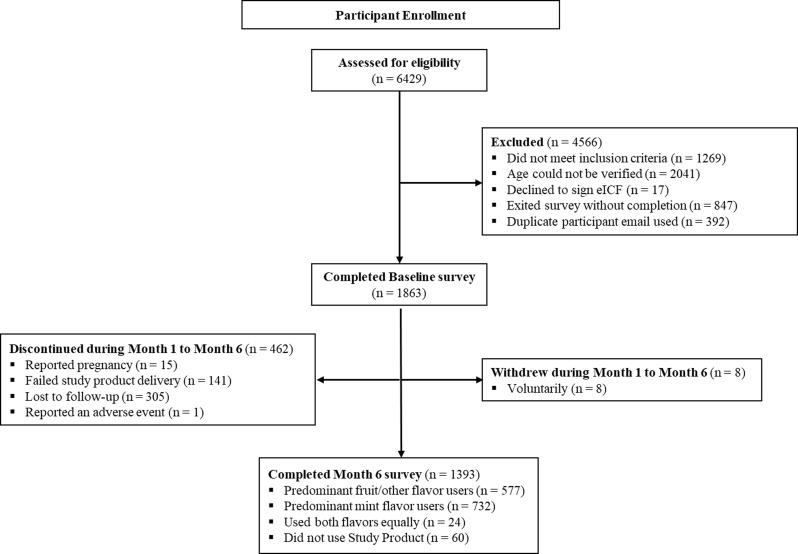
Among the 1393 participants at Month 6, 41.4% and 52.5% used predominantly fruit/other or mint Study Product flavors, respectively. Compared to predominant mint users, predominant fruit/other users had greater cigarette reduction (mean reduction: 50.0% vs. 48.4%) and a higher proportion had quit smoking (proportion quit: 15.4% vs. 11.6%) at Month 6. Additionally, 38.8% of predominant fruit/other users and 39.3% of predominant mint users reduced their cigarette consumption by ≥ 50% from Baseline. Increased use of fruit/other flavors was independently associated with smoking reduction (8.6% greater reduction per 10 pieces/day; p < 0.001) and odds of quitting smoking (OR = 1.29 [95% CI: 1.04-1.59] per 10 pieces/day; p = 0.017). Increased use of mint flavors was independently associated with smoking reduction (7.5% greater reduction per 10 mint pieces/day; p < 0.001) but not with odds of quitting smoking.
Increased use of either fruit/other or mint flavored Study Products at Month 6 was associated with significantly increased smoking reduction, whereas only increased use of fruit/other flavors was associated with greater odds of quitting smoking among participants in the study.
This study was observational. Participants were not prospectively assigned to one or more health-related interventions and could choose to use or not use the commercially available study products provided during the study. Thus, the study was not registered in a trial database by the Sponsor.
戒烟可显著降低或消除罹患多种慢性病的风险。使用调味烟草或尼古丁产品是吸烟成年人帮助其减少或戒烟的重要原因。本分析旨在了解使用各种口味的口服尼古丁产品与减少吸烟和戒烟的关联,以及使用 6 个月后,主要使用水果/其他口味与薄荷口味的口服尼古丁产品的使用者之间,减少或戒烟的情况是否存在差异。
在实际使用 6 个月期间,参与者可选择各种形式和口味的 Rogue 尼古丁产品(研究产品),并在基线和此后的第 1、2、4 和 6 个月完成在线调查,评估烟草、尼古丁和研究产品的使用情况。
在第 6 个月的 1393 名参与者中,分别有 41.4%和 52.5%的参与者主要使用水果/其他或薄荷口味的研究产品。与主要使用薄荷口味的使用者相比,主要使用水果/其他口味的使用者的吸烟量减少更多(平均减少量:50.0%比 48.4%),且戒烟比例更高(戒烟比例:15.4%比 11.6%)。此外,38.8%的主要使用水果/其他口味的使用者和 39.3%的主要使用薄荷口味的使用者从基线开始就将其吸烟量减少了≥50%。增加使用水果/其他口味与吸烟量减少相关(每天增加 10 片,减少 8.6%;p<0.001),且与戒烟几率相关(每天增加 10 片,OR=1.29[95%CI:1.04-1.59];p=0.017)。增加使用薄荷口味与吸烟量减少相关(每天增加 10 片薄荷口味,减少 7.5%;p<0.001),但与戒烟几率无关。
在第 6 个月时,增加使用水果/其他口味或薄荷口味的研究产品与吸烟量显著减少显著相关,而仅增加使用水果/其他口味与研究参与者戒烟几率增加相关。
本研究为观察性研究。参与者未被前瞻性分配到一种或多种与健康相关的干预措施中,并且可以选择在研究期间使用或不使用提供的商业上可用的研究产品。因此,研究赞助商未将该研究在试验数据库中注册。