Department of Plant and Environmental Sciences, Weizmann Institute of Science, Rehovot, Israel.
School of Biological Sciences, Nanyang Technological University, Singapore, Singapore.
EMBO J. 2020 Sep 15;39(18):e104081. doi: 10.15252/embj.2019104081. Epub 2020 Jun 5.
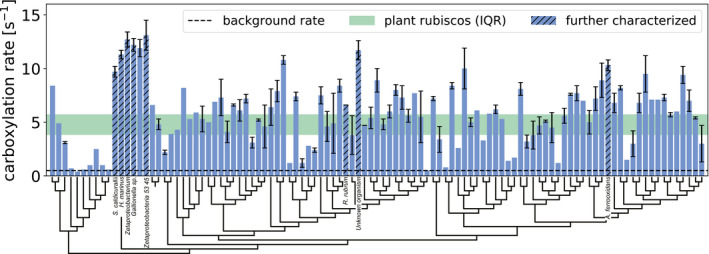
CO is converted into biomass almost solely by the enzyme rubisco. The poor carboxylation properties of plant rubiscos have led to efforts that made it the most kinetically characterized enzyme, yet these studies focused on < 5% of its natural diversity. Here, we searched for fast-carboxylating variants by systematically mining genomic and metagenomic data. Approximately 33,000 unique rubisco sequences were identified and clustered into ≈ 1,000 similarity groups. We then synthesized, purified, and biochemically tested the carboxylation rates of 143 representatives, spanning all clusters of form-II and form-II/III rubiscos. Most variants (> 100) were active in vitro, with the fastest having a turnover number of 22 ± 1 s -sixfold faster than the median plant rubisco and nearly twofold faster than the fastest measured rubisco to date. Unlike rubiscos from plants and cyanobacteria, the fastest variants discovered here are homodimers and exhibit a much simpler folding and activation kinetics. Our pipeline can be utilized to explore the kinetic space of other enzymes of interest, allowing us to get a better view of the biosynthetic potential of the biosphere.
CO 几乎完全被酶 rubisco 转化为生物量。植物 rubisco 的羧化性能较差,导致人们努力使它成为最具动力学特征的酶,但这些研究仅集中在其天然多样性的 <5%。在这里,我们通过系统挖掘基因组和宏基因组数据来寻找快速羧化的变体。大约鉴定出 33000 个独特的 rubisco 序列,并将其聚类成 ≈1000 个相似性群。然后,我们合成、纯化并对 143 个代表物的羧化速率进行了生化测试,这些代表物涵盖了所有形式 II 和形式 II/III rubisco 的聚类。大多数变体(>100 个)在体外具有活性,最快的变体周转率为 22 ± 1 s -1,比中位数植物 rubisco 快六倍,比迄今为止测量到的最快的 rubisco 快近两倍。与来自植物和蓝细菌的 rubiscos 不同,这里发现的最快变体是同源二聚体,表现出更简单的折叠和激活动力学。我们的流水线可用于探索其他感兴趣的酶的动力学空间,使我们能够更好地了解生物圈的生物合成潜力。