Allergy Immunology and Cell Biology Unit, Department of Immunology and Molecular Medicine, University of Sri Jayewardenepura, Nugegoda, Sri Lanka.
National Institute of Infectious Diseases, Angoda, Sri Lanka.
Virol J. 2024 Nov 26;21(1):304. doi: 10.1186/s12985-024-02555-z.
Influenza A has been named as a priority pathogen by the WHO due to the potential to cause pandemics. Genomic sequencing of influenza strains is important to understand the evolution of the influenza strains and also to select the appropriate influenza vaccines to be used in the different influenza seasons in Sri Lanka. Therefore, we sought to understand the molecular epidemiology of the influenza viruses in the Western Province of Sri Lanka, including mutational analysis to investigate the evolutionary dynamics.
A total of 349 individuals presenting with fever and respiratory symptoms were enrolled in this study from November 2022 to May 2024. Nasopharyngeal and oropharyngeal specimens were collected and screened using quantitative PCR to detect Influenza A, Influenza B, and SARS-CoV-2. Subtyping and genomic sequencing was carried out on influenza A strains using Oxford Nanopore Technology.
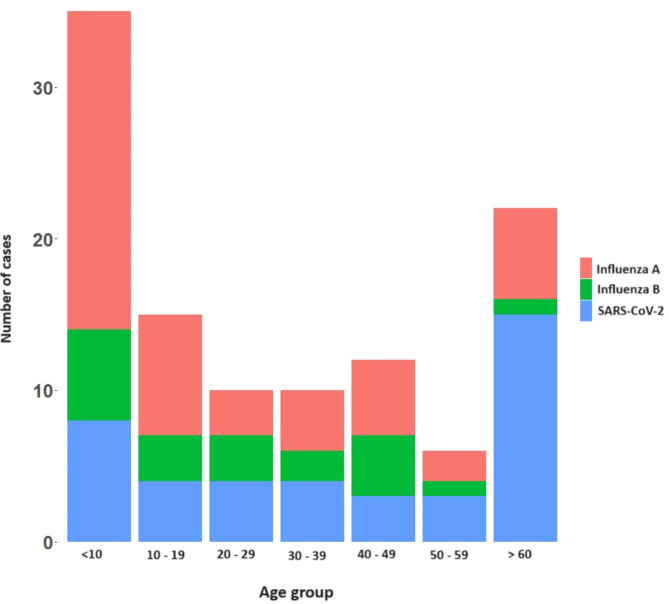
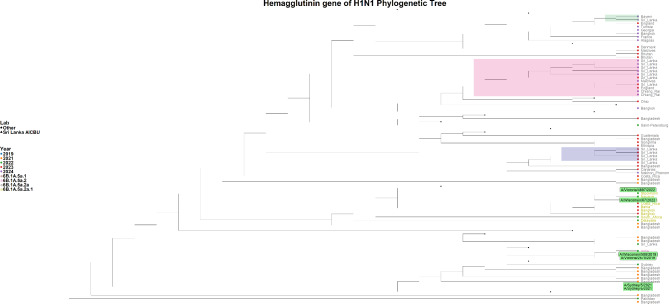
Influenza A was detected in 49 (14%) patients, influenza B in 20 (5.7%) and SARS-CoV-2 in 41 (11.7%). Co-infections were observed in five participants. The phylogenetic analysis assigned the H1N1 HA gene sequences within the 6B.1 A.5a.2a clade. The HA gene of the H1N1 sequences in 2023 were assigned as belonging to the subclades C.1, C.1.2, and C.1.8, while the 2024 sequences were assigned to subclades C.1.8 and C.1.9. The H3N2 sequences from 2023 were assigned to the 3 C.2a1b.2a.2a.1b clade and subclade G.1.1.2, while the 2024 sequences were assigned to the 3 C.2a1b.2a.2a.3a.1 clade and subclade J.2. The K54Q, A186T, Q189E, E224A, R259K, K308R, I418V, and X215A amino acid substitutions were seen in the H1N1 in the 2023 and 2024 sequences. The 2024 H1N1 sequences additionally exhibited further substitutions, such as V47I, I96T, T120A, A139D, G339X, K156X, and T278S.
In this first study using genomic sequencing to characterize the influenza A strains in Sri Lanka, which showed different influenza A viruses circulating in an 18-month period. As the Sri Lankan strains also had certain mutations of unknown significance, it would be important to continue detailed surveillance of the influenza strains in Sri Lanka to choose the most suitable vaccines for the population and the timing of vaccine administration.
由于流感 A 有引发大流行的潜力,世界卫生组织已将其列为优先病原体。对流感株进行基因组测序对于了解流感株的进化以及选择在斯里兰卡不同流感季节使用的适当流感疫苗非常重要。因此,我们试图了解斯里兰卡西部的流感病毒的分子流行病学,包括突变分析以研究其进化动态。
本研究共纳入了 2022 年 11 月至 2024 年 5 月期间出现发热和呼吸道症状的 349 名患者。采集鼻咽和口咽标本,使用定量 PCR 进行检测,以检测甲型流感、乙型流感和 SARS-CoV-2。使用牛津纳米孔技术对甲型流感株进行亚分型和基因组测序。
共检出 49 例(14%)甲型流感、20 例(5.7%)乙型流感和 41 例(11.7%)SARS-CoV-2。有 5 名患者发生合并感染。系统发育分析将 H1N1 的 HA 基因序列分配到 6B.1 A.5a.2a 分支内。2023 年 H1N1 的 HA 基因序列分为 C.1、C.1.2 和 C.1.8 亚分支,而 2024 年的序列分为 C.1.8 和 C.1.9 亚分支。2023 年的 H3N2 序列分配到 3C.2a1b.2a.2a.1b 分支和 G.1.1.2 亚分支,而 2024 年的序列分配到 3C.2a1b.2a.2a.3a.1 分支和 J.2 亚分支。在 2023 年和 2024 年的序列中观察到 H1N1 的 K54Q、A186T、Q189E、E224A、R259K、K308R、I418V 和 X215A 氨基酸取代。2024 年的 H1N1 序列还表现出进一步的取代,如 V47I、I96T、T120A、A139D、G339X、K156X 和 T278S。
这是斯里兰卡首次使用基因组测序来描述流感 A 株的研究,结果显示在 18 个月的时间内存在不同的流感 A 病毒。由于斯里兰卡株还存在某些未知意义的突变,因此继续对斯里兰卡的流感株进行详细监测,选择最适合人群和接种时机的疫苗非常重要。