Research and Development Laboratory for Biochemical, Molecular and Cellular Applications in Ophthalmological Science, IRCCS-Fondazione Bietti, 00184 Rome, Italy.
Surgical Retina Research Unit, IRCCS-Fondazione Bietti, 00184 Rome, Italy.
Cells. 2024 Nov 6;13(22):1837. doi: 10.3390/cells13221837.
Hyalocytes are the main vitreal cell types with critical functions in health and vitreoretinal diseases. Our aim was to develop cultures of human hyalocytes and verify the retention of their initial cellular features after 3 and 6 days of culturing (3 d and 6 d) by analyzing and comparing a few morphological and functional parameters.
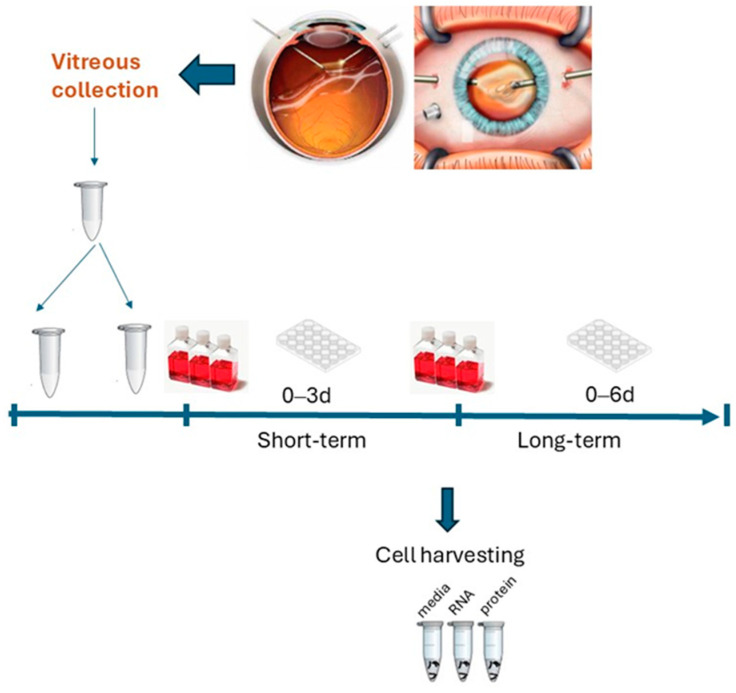
Vitreous samples (n = 22) were collected and vitreous cells and bead-enriched hyalocytes were developed and compared (3 d vs. 6 d cultures). Vitreous and conditioned media were tested for collagen, vascular endothelial growth factor (VEGF), transforming growth factor β1 (TGFβ1), nerve growth factor (NGF), matrix metalloproteinases (MMPs)/tissue inhibitors of metalloproteinases (TIMPs) and alpha-smooth muscle actin (αSMA) expression (ELISA, array/IP/WB, RT-PCR). Cells were observed at light and fluorescent microscopy (phenotypical properties) and tested for their 3D collagen gel contraction abilities.
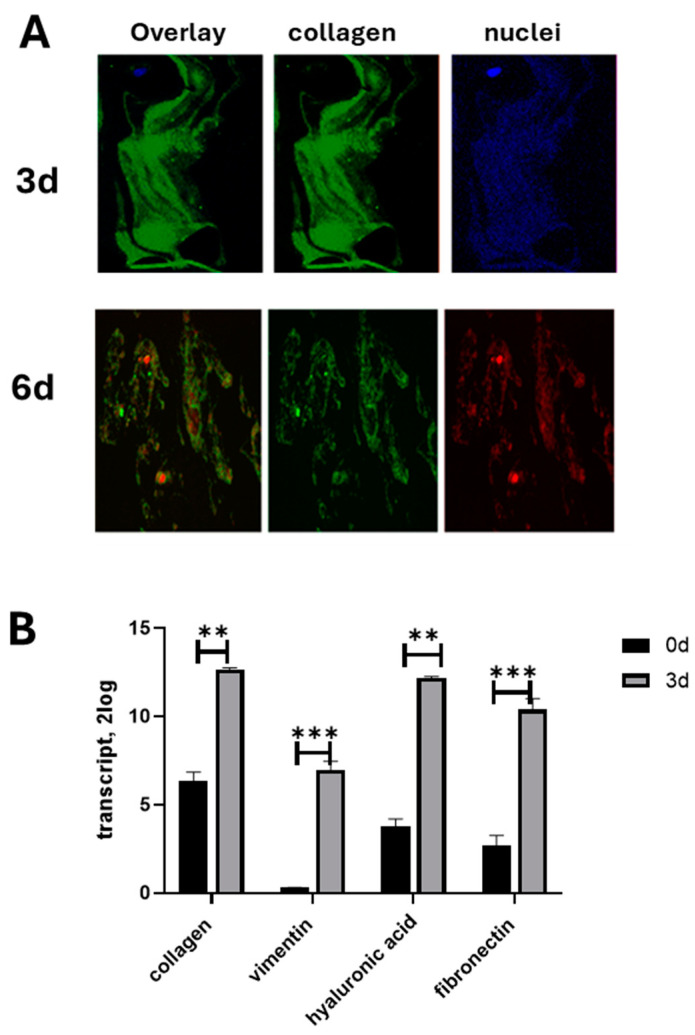
An increased expression of collagens, vimentin, fibronectin, and the MMP9/TIMP1 ratio were observed in vitreous tissues. In 3 d cultures, collagens and MMP9 were upregulated while the related tissue-enzymes were deregulated. Vitreous samples also showed high levels of TGFβ1, VEGF, and NGF, and this protein signature was retained at 3 d while decreased at 6 d. The original phenotype (low αSMA) was retained at 3 d from seeding while an increased αSMA expression was observed at 6 d; NGF/trkA was expressed in cultured hyalocytes and partially drives the collagen retraction.
The vitreous print comparison between untouched and cultured hyalocytes allowed us, on one side, to select 3 d cultures and, on the other, to highlight the neuroprotective/contractile NGF in vitro hyalocytes effects. The possibility of scoring reactive hyalocytes would represent an interesting aspect of screening the vitreoretinal interface severity.
玻璃体细胞是主要的玻璃体细胞类型,在健康和玻璃体视网膜疾病中具有关键功能。我们的目的是培养人眼玻璃体细胞,并通过分析和比较一些形态和功能参数,验证在培养 3 天和 6 天后(3d 和 6d)它们是否保留了最初的细胞特征。
收集玻璃体样本(n=22),并开发玻璃体细胞和珠富集的玻璃体细胞,并进行比较(3d 与 6d 培养)。测试玻璃体和条件培养基中胶原蛋白、血管内皮生长因子(VEGF)、转化生长因子β1(TGFβ1)、神经生长因子(NGF)、基质金属蛋白酶(MMPs)/金属蛋白酶组织抑制剂(TIMPs)和α-平滑肌肌动蛋白(αSMA)的表达(ELISA、阵列/免疫沉淀/WB、RT-PCR)。通过荧光显微镜观察细胞(表型特性),并测试其 3D 胶原凝胶收缩能力。
在玻璃体组织中观察到胶原蛋白、波形蛋白、纤维连接蛋白和 MMP9/TIMP1 比值的表达增加。在 3d 培养物中,胶原蛋白和 MMP9 上调,而相关的组织酶则失调。玻璃体样本还显示出高水平的 TGFβ1、VEGF 和 NGF,这种蛋白质特征在 3d 时保留,而在 6d 时降低。在接种后 3d,原始表型(低αSMA)得以保留,而在 6d 时观察到αSMA 表达增加;培养的玻璃体细胞中表达了 NGF/trkA,并部分驱动胶原收缩。
未经处理和培养的玻璃体细胞之间的玻璃体印迹比较,使我们一方面能够选择 3d 培养物,另一方面突出体外玻璃体细胞的神经保护/收缩作用的 NGF。对反应性玻璃体细胞进行评分的可能性将是评估玻璃体视网膜界面严重程度的一个有趣方面。