Chen Jiaxin, Duan Chunhui, Yue Sicong, Liu Xiaona, Li Jinhui, Zhang Yingjie, Liu Yueqin
College of Animal Science and Technology, Hebei Agricultural University, Baoding 071000, China.
Animals (Basel). 2024 Nov 19;14(22):3326. doi: 10.3390/ani14223326.
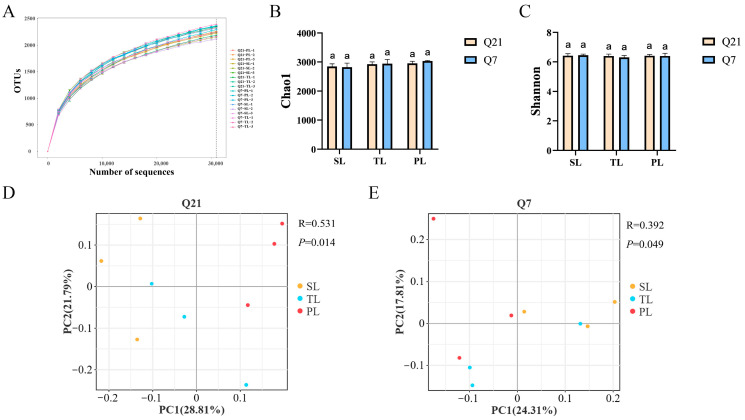
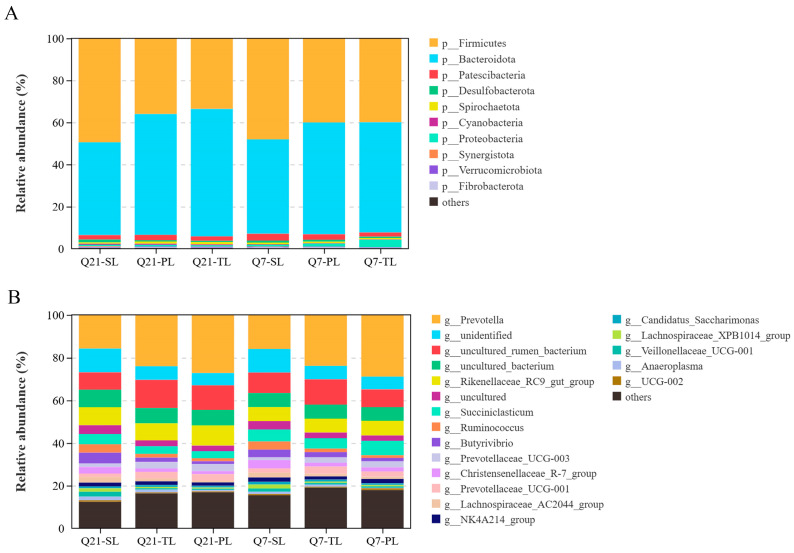
The objective of this study was to investigate the differences in the energy metabolites, immunity, antioxidant capacity, and rumen microbiota of ewes with different numbers of fetuses. Thirty healthy ewes were selected and divided into single- (SL, = 10), twin- (TL, = 10), and triplet-fetal (PL, = 10) ewes according to the number of fetuses. Sampling was carried out on days 21 (Q21) and 7 (Q7) before lambing. The results show no differences ( > 0.05) in the DMI and BW of ewes with different numbers of fetuses, and the body condition score (BCS) of PL ewes was lower ( < 0.05) than that of SL ewes. The concentrations of β-hydroxybutyric acid (BHBA), non-esterified fatty acids (NEFA), interleukin-2 (IL-2), interleukin-6 (IL-6), and tumor necrosis factor α (TNF-α) in the PL ewes were higher ( < 0.05), while the glucose (Glu), triglyceride (TG), total cholesterol (TC), superoxide dismutase (SOD), glutathione peroxidase (GSH-Px), and total antioxidant capacity (T-AOC) values were lower ( < 0.05) than those of the SL ewes. ANOSIM analysis showed that the rumen bacterial structure of the SL, TL, and PL ewes was different on days Q21 and Q7. The relative abundance of Firmicutes and Bacteroidota in the rumen was affected ( < 0.05) by the number of fetuses: the relative abundance of Firmicutes (, , , , , and ) was higher ( < 0.05), while that of Bacteroidota (, , and ) was lower ( < 0.05) in the SL ewes than in the PL ewes. In summary, the rumen microbial structure and energy metabolites of ewes in late gestation with different numbers of fetuses were different. Triplet-fetal ewes were characterized by lower BCS and antioxidant capacity and were prone to the triggering of inflammatory responses.
本研究的目的是调查不同胎儿数母羊在能量代谢产物、免疫力、抗氧化能力和瘤胃微生物群方面的差异。选取30只健康母羊,根据胎儿数量分为单胎(SL,n = 10)、双胎(TL,n = 10)和三胎(PL,n = 10)母羊。在产羔前21天(Q21)和7天(Q7)进行采样。结果显示,不同胎儿数母羊的干物质采食量(DMI)和体重(BW)无差异(P > 0.05),且PL母羊的体况评分(BCS)低于SL母羊(P < 0.05)。PL母羊中β-羟基丁酸(BHBA)、非酯化脂肪酸(NEFA)、白细胞介素-2(IL-2)、白细胞介素-6(IL-6)和肿瘤坏死因子α(TNF-α)的浓度较高(P < 0.05),而葡萄糖(Glu)、甘油三酯(TG)、总胆固醇(TC)、超氧化物歧化酶(SOD)、谷胱甘肽过氧化物酶(GSH-Px)和总抗氧化能力(T-AOC)值低于SL母羊(P < 0.05)。ANOSIM分析表明,在Q21和Q7时,SL、TL和PL母羊的瘤胃细菌结构不同。瘤胃中厚壁菌门和拟杆菌门的相对丰度受胎儿数量影响(P < 0.05):SL母羊中厚壁菌门的相对丰度(P = 0.001、0.002、0.003、0.004、0.005和0.006)较高(P < 0.05),而拟杆菌门的相对丰度(P = 0.001、0.002和0.003)低于PL母羊(P < 0.05)。综上所述,不同胎儿数的妊娠后期母羊瘤胃微生物结构和能量代谢产物存在差异。三胎母羊的特点是BCS和抗氧化能力较低,容易引发炎症反应。