R&D Center, NA Vaccine Institute, Seoul, 05854, Republic of Korea.
Interdisciplinary Program in Genetic Engineering, College of Natural Sciences, Seoul National University, Seoul, 08826, Republic of Korea.
Nat Commun. 2024 Nov 29;15(1):10368. doi: 10.1038/s41467-024-54620-4.
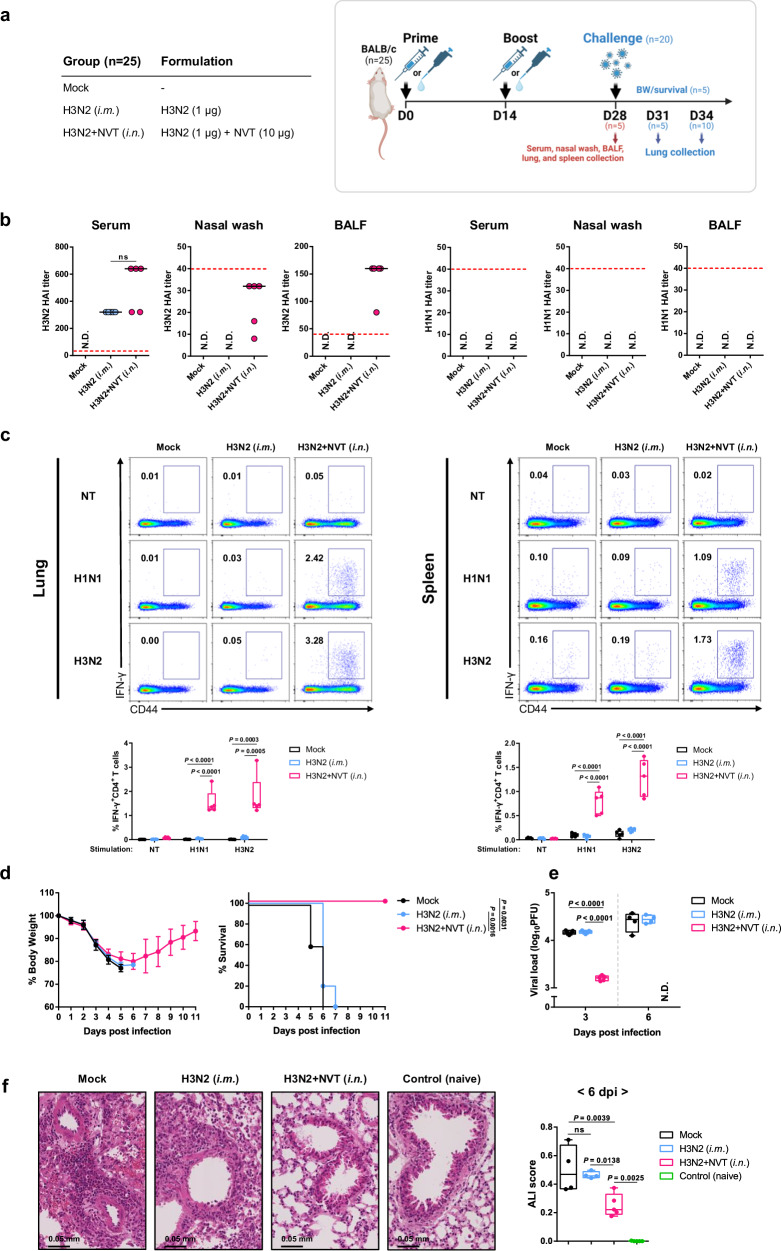
Lung tissue-resident memory T (T) cells induced by influenza vaccination are crucial for heterosubtypic immunity upon re-exposure to the influenza virus, enabling rapid and robust responses upon reactivation. To enhance the efficacy of influenza vaccines, we induce the generation of lung T cells following intranasal vaccination with a commercial influenza vaccine adjuvanted with NexaVant (NVT), a TLR3 agonist-based adjuvant. We demonstrate that intranasal immunization with the NVT-adjuvanted vaccine provides improved protection against influenza virus infections by inducing the generation of CD4 T cells in the lungs in a type I interferon-dependent manner. These pulmonary CD4 T cells provide potent mucosal immunity and cross-protection against heterosubtypic infections in both mouse and ferret models. This vaccine platform has the potential to significantly improve conventional intramuscular influenza vaccines by providing broader protection.
流感疫苗诱导的肺组织驻留记忆 T(T)细胞对于再次接触流感病毒时的异源免疫至关重要,使其在重新激活后能够快速产生强烈的反应。为了提高流感疫苗的效果,我们通过鼻腔内接种含有 NexaVant(NVT)的商业流感疫苗佐剂来诱导 T 细胞的产生,NVT 是一种基于 TLR3 激动剂的佐剂。我们证明,通过以 I 型干扰素依赖的方式诱导肺中 CD4 T 细胞的产生,鼻腔内免疫接种 NVT 佐剂疫苗可提供针对流感病毒感染的改善保护。这些肺 CD4 T 细胞在小鼠和雪貂模型中提供了有效的黏膜免疫和针对异源感染的交叉保护。这种疫苗平台有可能通过提供更广泛的保护来显著改善传统的肌肉内流感疫苗。