QIMR Berghofer Medical Research Institute, Brisbane, Australia.
IntiQuan GmbH, Basel, Switzerland.
BMC Med. 2024 Nov 28;22(1):563. doi: 10.1186/s12916-024-03787-0.
The combination antimalarial artefenomel-piperaquine failed to achieve target efficacy in a phase 2b study in Africa and Vietnam. We retrospectively evaluated whether characterizing the pharmacological interaction of this antimalarial combination in a volunteer infection study (VIS) would have enabled prediction of the phase 2b study results.
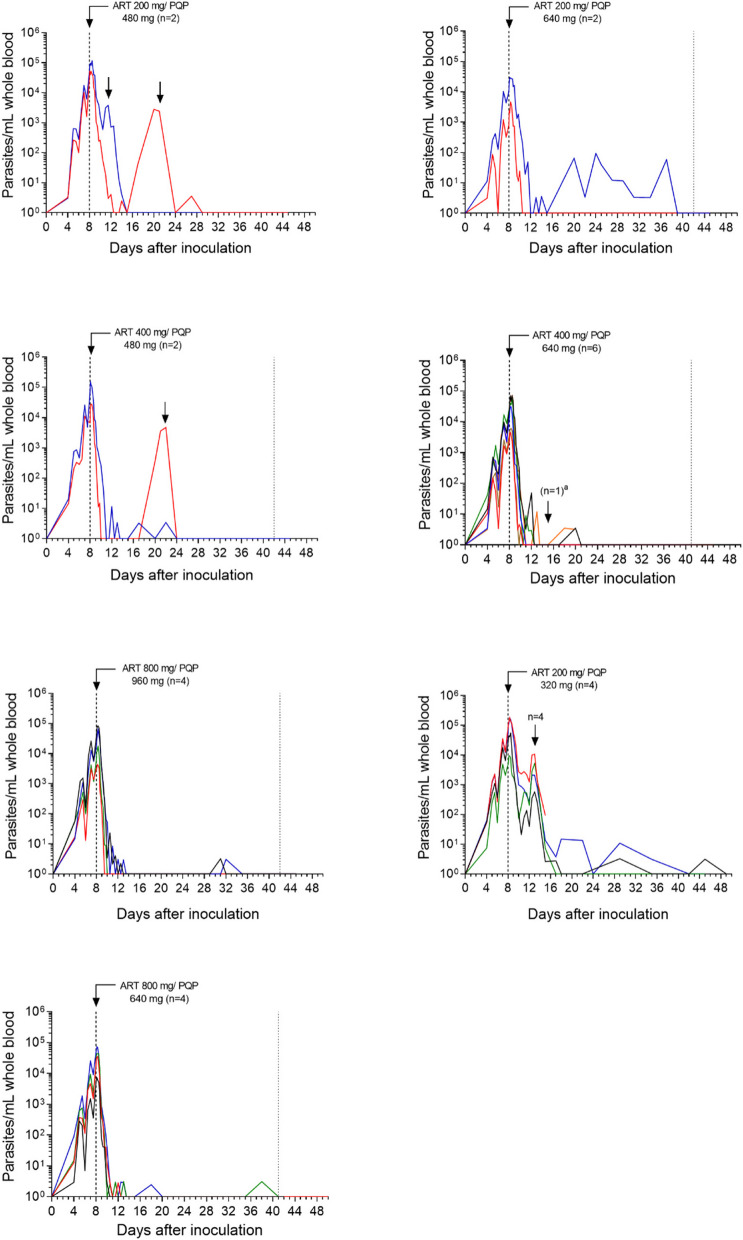
Twenty-four healthy adults enrolled over three consecutive cohorts were inoculated with Plasmodium falciparum-infected erythrocytes on day 0. Participants were randomized within each cohort to one of seven dose combination groups and administered a single oral dose of artefenomel-piperaquine on day 8. Participants received definitive antimalarial treatment with artemether-lumefantrine upon parasite regrowth or on day 42 ± 2. The general pharmacodynamic interaction (GPDI) model implemented in the Bliss Independence additivity criterion was developed to characterize the pharmacological interaction between artefenomel and piperaquine. Simulations based on the model were performed to predict the outcomes of the phase 2b combination study.
For a dose of 800 mg artefenomel administered with 640 mg, 960 mg, or 1440 mg piperaquine, the simulated adequate parasitological response at day 28 (APR), incorporating actual patient pharmacokinetic (PK) data from the phase 2b trial, was 69.4%, 63.9%, and 74.8%, respectively. These results closely matched the observed APR in the phase 2b trial of 67.0%, 65.5%, and 75.4%, respectively.
These results indicate that VIS offer an efficient means for informing antimalarial combination trials conducted in the field, potentially expediting clinical development.
This study was registered on ClinicalTrials.gov on 11 May 2018 with registration number NCT03542149.
在非洲和越南进行的 2b 期研究中,联合抗疟药物 artefenomel-哌喹未能达到目标疗效。我们回顾性评估了在志愿者感染研究(VIS)中对这种抗疟组合药物的药理相互作用进行特征描述是否能够预测 2b 期研究结果。
连续三批共招募了 24 名健康成年人,在第 0 天接种感染疟原虫的红细胞。在每批中,参与者按照 7 种剂量组合组之一进行随机分组,并在第 8 天口服单次剂量的 artefenomel-哌喹。当寄生虫再次生长或在第 42 天±2 天时,参与者接受青蒿琥酯-甲氟喹的确定性抗疟治疗。 Bliss 独立性加性标准中实施的通用药效学相互作用(GPDI)模型用于描述 artefenomel 和哌喹之间的药理相互作用。基于该模型进行了模拟,以预测 2b 期组合研究的结果。
对于给予 800mg artefenomel 与 640mg、960mg 或 1440mg 哌喹的剂量,在纳入实际患者来自 2b 期试验的药代动力学(PK)数据后,第 28 天的模拟充分寄生虫学反应(APR)分别为 69.4%、63.9%和 74.8%。这些结果与 2b 期试验中观察到的 APR 分别为 67.0%、65.5%和 75.4%非常吻合。
这些结果表明,VIS 为在现场进行的抗疟药物组合试验提供了一种有效的方法,可能会加速临床开发。
这项研究于 2018 年 5 月 11 日在 ClinicalTrials.gov 上注册,注册号为 NCT03542149。