The First Clinical Medical College of Lanzhou University, Lanzhou, 730000, China.
Department of Orthopedics, The First Hospital of Lanzhou University, Lanzhou, 730000, China.
Stem Cell Res Ther. 2024 Nov 28;15(1):457. doi: 10.1186/s13287-024-04077-5.
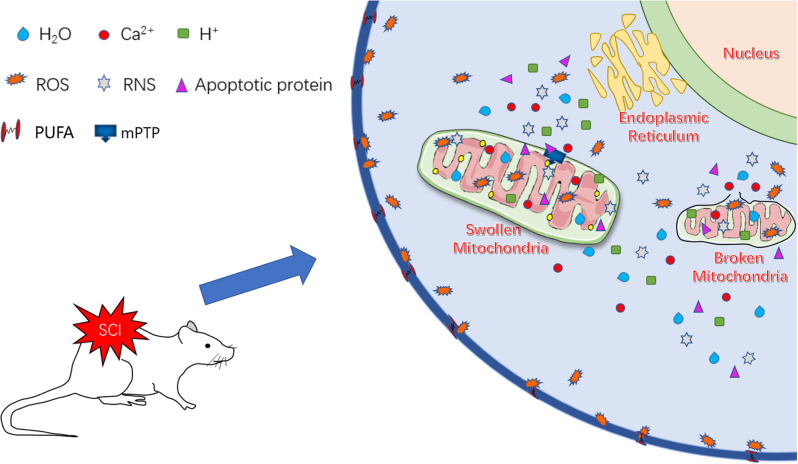
Spinal cord injury (SCI) involves a continuous and dynamic cascade of complex reactions, with mitochondrial damage and dysfunction-induced energy metabolism disorders playing a central role throughout the process. These disorders not only determine the severity of secondary injuries but also influence the potential for axonal regeneration. Given the critical role of energy metabolism disturbances in the pathology of SCI, strategies such as enhancing mitochondrial transport within axons to alleviate local energy deficits, or transplanting autologous or allogeneic mitochondria to restore energy supply to damaged tissues, have emerged as potential approaches for SCI repair. These strategies also aim to modulate local inflammatory responses and apoptosis. Preclinical studies have initially demonstrated that mitochondrial transplantation (MT) significantly reduces neuronal death and promotes axonal regeneration following spinal cord injury. MT achieves this by regulating signaling pathways such as MAPK/ERK and PI3K/Akt, promoting the expression of growth-associated protein-43 (GAP-43) in neurons, and inhibiting the expression of apoptosis-related proteins like Grp78, Chop, and P-Akt, thereby enhancing the survival and regeneration of damaged neurons. Additionally, MT plays a role in promoting the expression of vascular endothelial growth factor, facilitating tissue repair, and reducing the secretion of pro-inflammatory cytokines such as TNF-α, IL-1β, and IL-6. Furthermore, MT modulates neuronal apoptosis and inflammatory responses by decreasing the expression of p-JNK, a member of the MAPK family. In summary, by reviewing the detailed mechanisms underlying the cascade of pathological processes in SCI, we emphasize the changes in endogenous mitochondria post-SCI and the potential of exogenous MT in SCI repair. This review aims to provide insights and a basis for developing more effective clinical treatments for SCI.
脊髓损伤(SCI)涉及一系列连续且动态的复杂反应,其中线粒体损伤和功能障碍诱导的能量代谢紊乱在整个过程中起着核心作用。这些紊乱不仅决定了继发性损伤的严重程度,还影响了轴突再生的潜力。鉴于能量代谢紊乱在 SCI 病理中的关键作用,一些策略如增强轴突内的线粒体转运以缓解局部能量不足,或移植自体或同种异体线粒体以恢复受损组织的能量供应,已成为 SCI 修复的潜在方法。这些策略还旨在调节局部炎症反应和细胞凋亡。临床前研究初步表明,线粒体移植(MT)可显著减少神经元死亡并促进脊髓损伤后的轴突再生。MT 通过调节 MAPK/ERK 和 PI3K/Akt 等信号通路来实现这一点,促进神经元中生长相关蛋白-43(GAP-43)的表达,并抑制 Grp78、Chop 和 P-Akt 等凋亡相关蛋白的表达,从而增强受损神经元的存活和再生。此外,MT 通过促进血管内皮生长因子的表达、促进组织修复以及减少 TNF-α、IL-1β 和 IL-6 等促炎细胞因子的分泌来发挥作用。此外,MT 通过降低 MAPK 家族成员 p-JNK 的表达来调节神经元凋亡和炎症反应。总之,通过详细审查 SCI 病理过程级联中的详细机制,我们强调了 SCI 后内源性线粒体的变化和外源性 MT 在 SCI 修复中的潜力。本综述旨在为开发更有效的 SCI 临床治疗方法提供见解和基础。