School of Optometry, Indiana University, Bloomington, IN, USA.
Discoveries in Sight Research Laboratories, Devers Eye Institute, Legacy Research Institute, Legacy Health, Portland, OR, USA.
Nat Commun. 2024 Nov 29;15(1):10409. doi: 10.1038/s41467-024-54687-z.
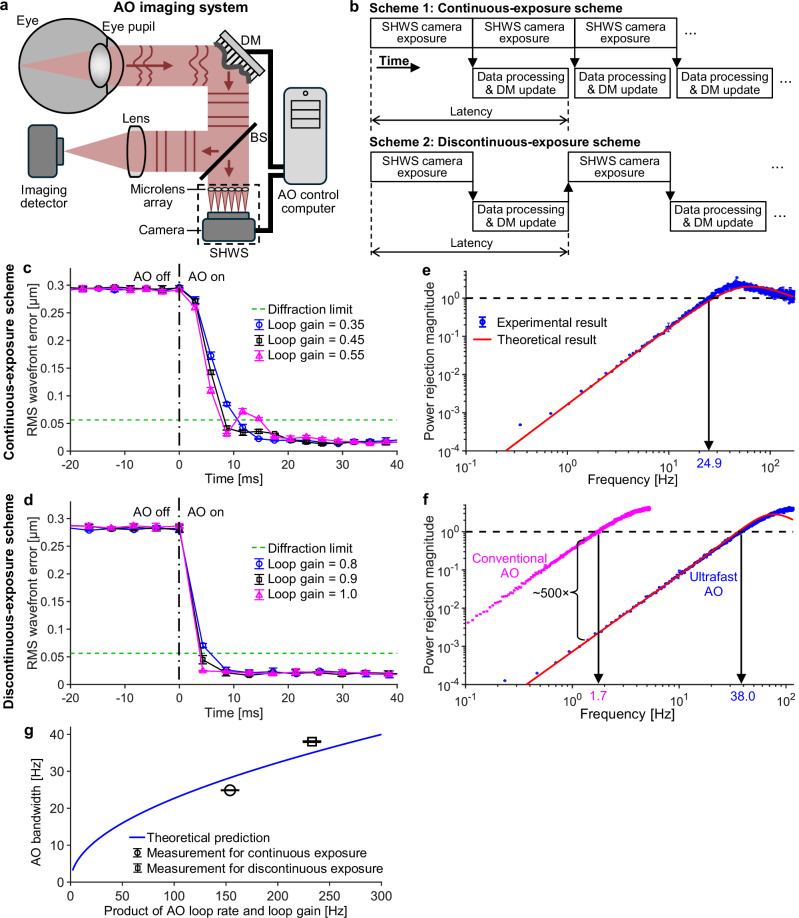
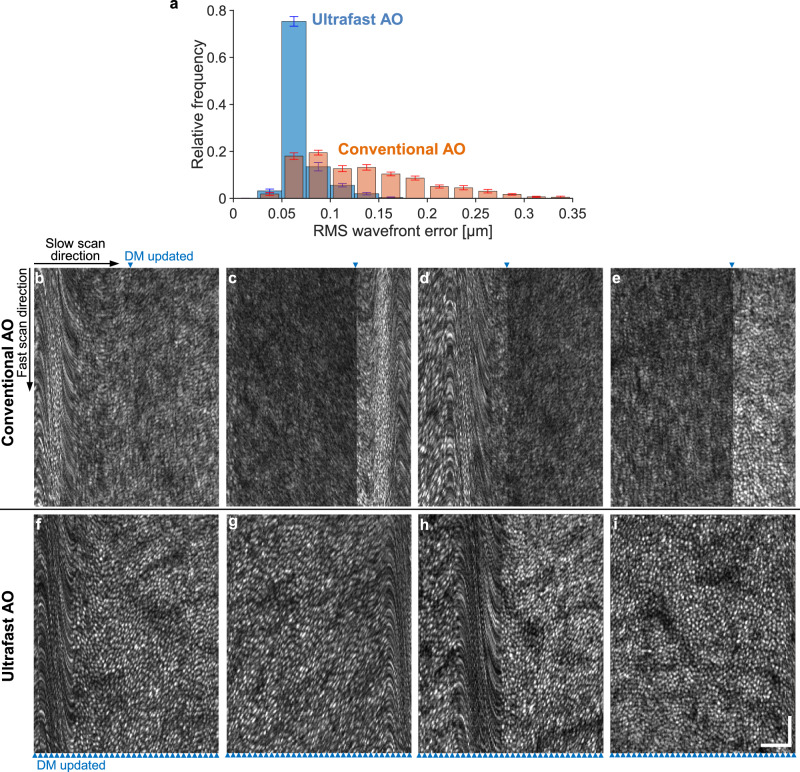
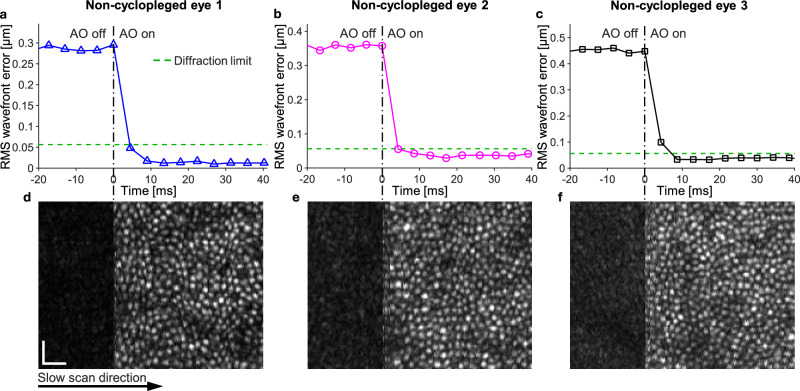
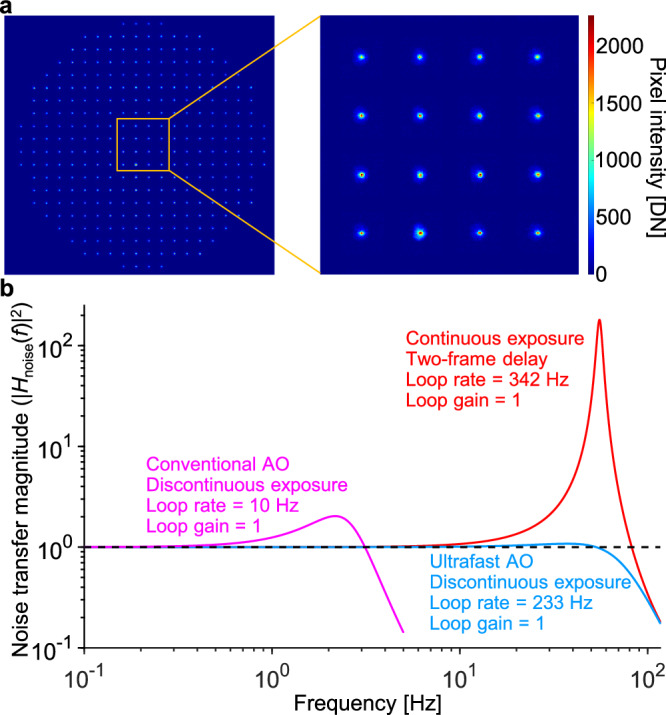
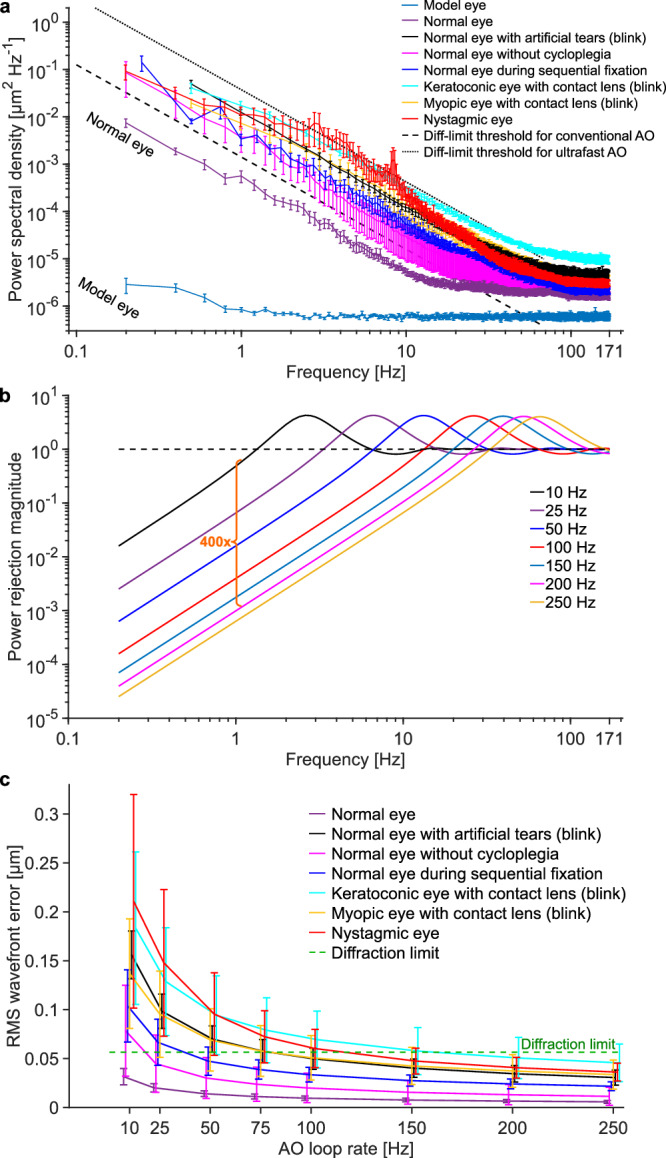
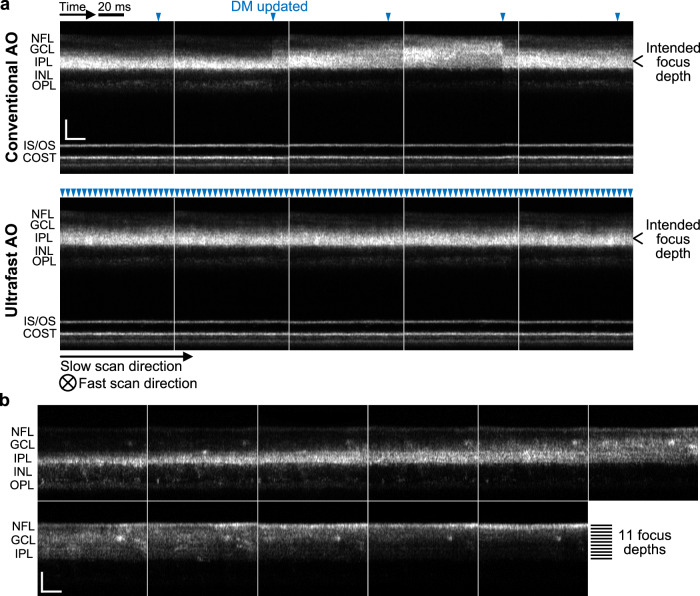
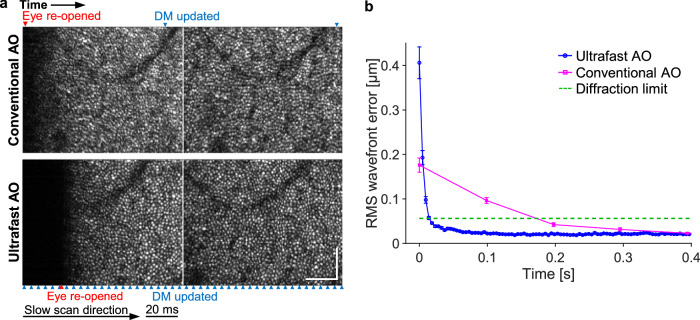
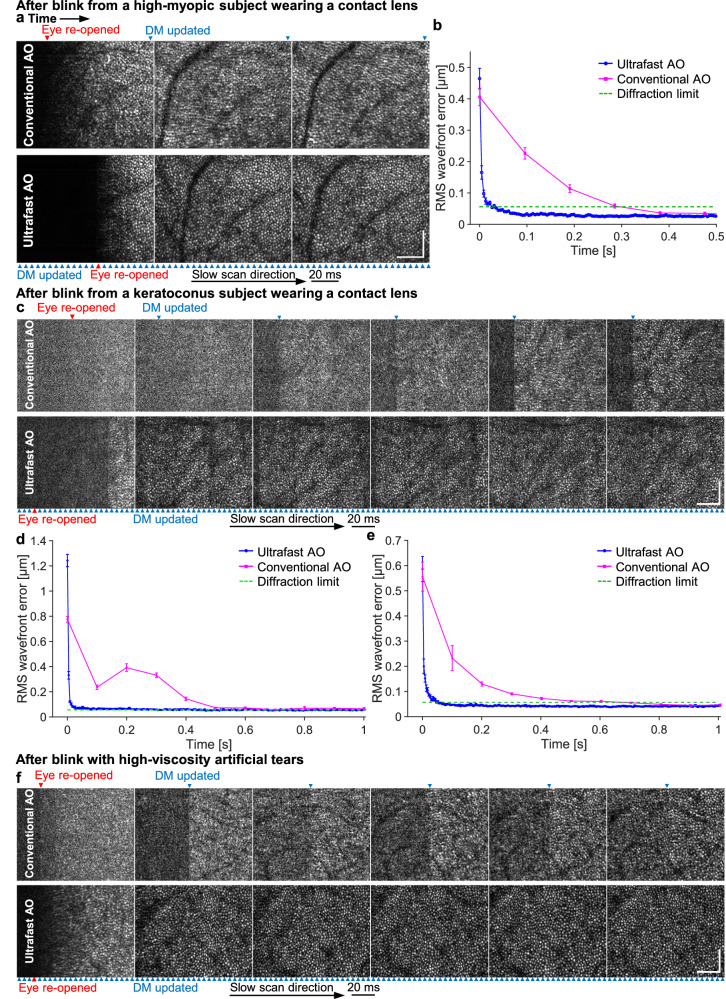
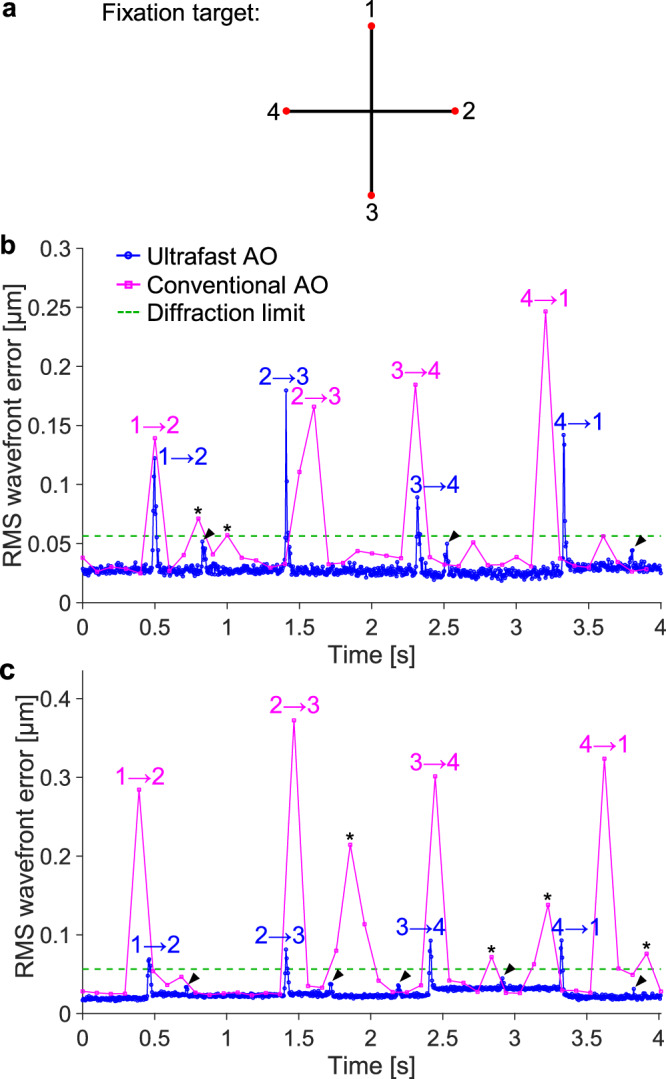
Adaptive optics (AO) is a powerful method for correcting dynamic aberrations in numerous applications. When applied to the eye, it enables cellular-resolution retinal imaging and enhanced visual performance and stimulation. Most ophthalmic AO systems correct dynamic aberrations up to 1-2 Hz, the commonly-known cutoff frequency for correcting ocular aberrations. However, this frequency may be grossly underestimated for more clinically relevant scenarios where the medical impact of AO will be greatest. Unfortunately, little is known about the aberration dynamics in these scenarios. A major bottleneck has been the lack of sufficiently fast AO systems to measure and correct them. We develop an ultrafast ophthalmic AO system that increases AO bandwidth by ~30× and improves aberration power rejection magnitude by 500×. We demonstrate that this much faster ophthalmic AO is possible without sacrificing other system performances. We find that the discontinuous-exposure AO-control scheme runs 32% slower yet achieves 53% larger AO bandwidth than the commonly used continuous-exposure scheme. Using the ultrafast system, we characterize ocular aberration dynamics in six clinically-relevant scenarios and find their power spectra to be 10-100× larger than normal. We show that ultrafast AO substantially improves aberration correction and retinal imaging performance in these scenarios compared with conventional AO.
自适应光学(AO)是一种强大的方法,可用于校正许多应用中的动态像差。当应用于眼睛时,它可以实现细胞分辨率的视网膜成像以及增强的视觉性能和刺激。大多数眼科 AO 系统可以校正 1-2 Hz 以内的动态像差,这是校正眼像差的常用截止频率。然而,对于更具临床相关性的场景,这一频率可能被严重低估,因为在这些场景中,AO 的医学影响最大。不幸的是,对于这些场景中的像差动态,人们知之甚少。一个主要的瓶颈是缺乏足够快的 AO 系统来测量和校正它们。我们开发了一种超快眼科 AO 系统,将 AO 带宽提高了约 30 倍,并将像差功率抑制幅度提高了 500 倍。我们证明,这种更快的眼科 AO 是有可能的,而不会牺牲其他系统性能。我们发现,不连续曝光的 AO 控制方案运行速度慢 32%,但比常用的连续曝光方案具有 53%更大的 AO 带宽。使用超快系统,我们在六个具有临床相关性的场景中对眼像差动态进行了表征,并发现它们的功率谱比正常情况大 10-100 倍。我们表明,与传统的 AO 相比,超快 AO 可显著改善这些场景中的像差校正和视网膜成像性能。