Department of Applied Biology and Biochemistry, Faculty of Applied Science, National University of Science and Technology, Bulawayo, Zimbabwe.
Biological Sciences and Biotechnology Department, Faculty of Sciences, Botswana International University of Science and Technology, Palapye, Botswana.
BMC Microbiol. 2024 Nov 29;24(1):510. doi: 10.1186/s12866-024-03655-0.
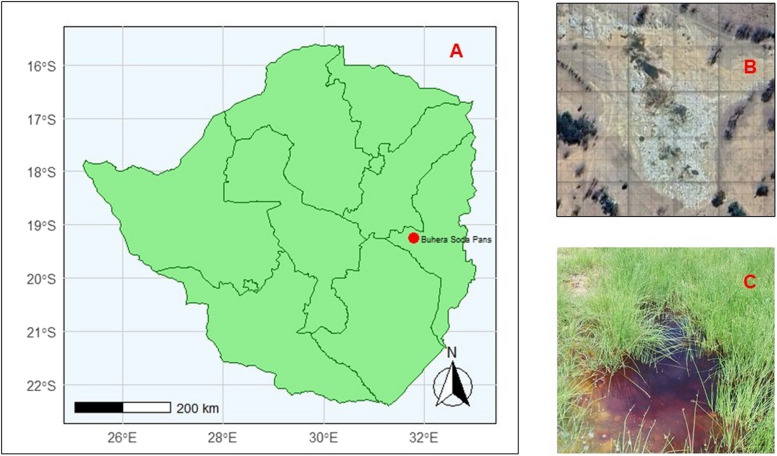
Soda pans are unique, natural aquatic environments characterised by elevated salinity and alkalinity, creating a distinctive and often extreme geochemistry. The microbiomes of soda pans are unique, with extremophiles such as halophiles, alkaliphiles and haloalkaliphiles being important. Despite being dominated by mostly unculturable inhabitants, soda pans hold immense biotechnological potential. The application of modern "omics-based" techniques helps us better understand the ecology and true extend of the biotechnological potential of soda pan microbiomes. In this study, we used a shotgun metagenomic approach to determine the microbial diversity and functional profile of previously unexplored soda pans located in Buhera, Eastern Zimbabwe. A combination of titrimetry and inductively coupled plasma optical emission spectroscopy (ICP‒OES) was used to perform physico-chemical analysis of the soda pan water.
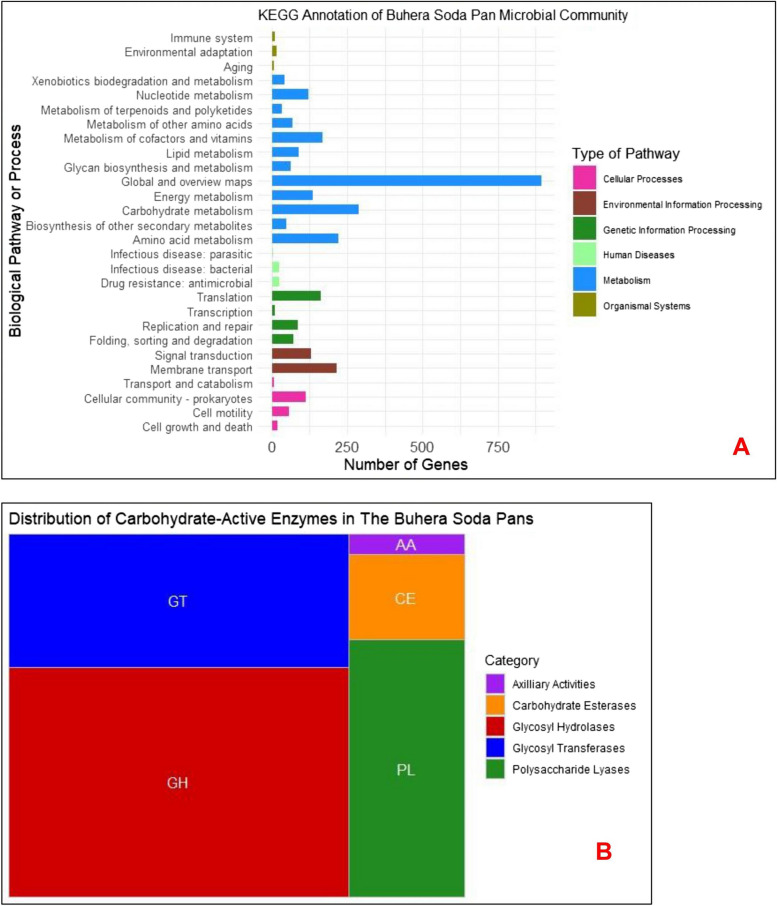
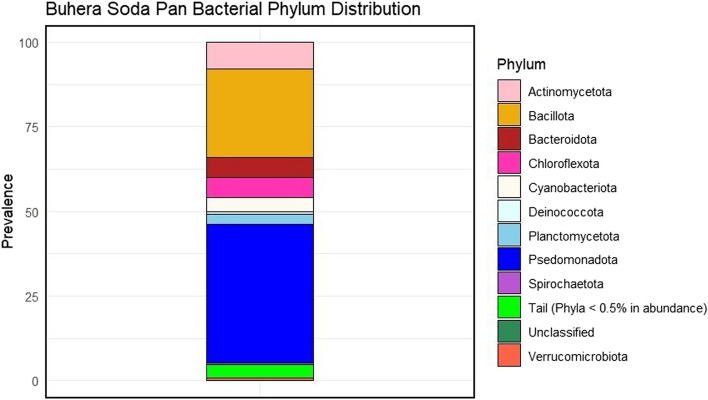
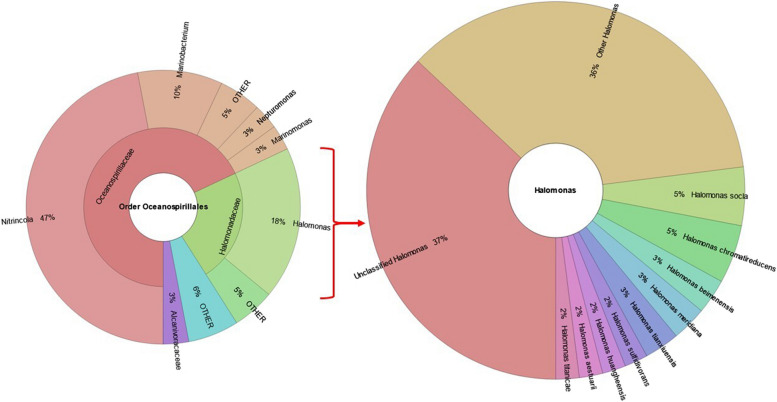
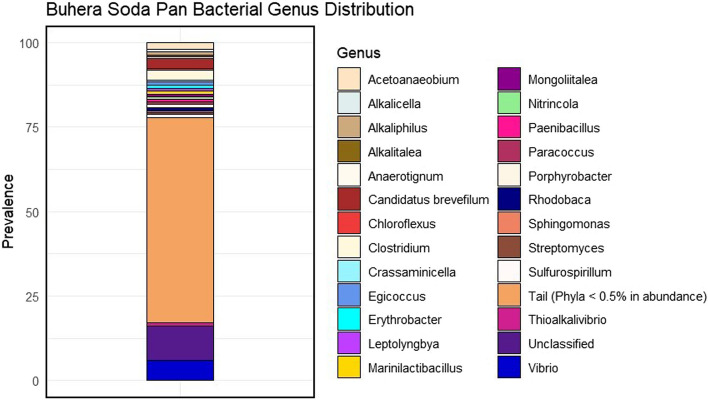
Physicochemical analysis revealed that the Buhera soda pans are highly alkaline, with a pH range of 8.74 to 11.03, moderately saline (2.94 - 7.55 g/L), and have high carbonate (3625 mg/L) and bicarbonate ion (1325 mg/L) alkalinity. High levels of sulphate, phosphate, chloride and fluoride ions were detected. Metagenomic analysis revealed that domain Bacteria dominated the soda pan microbial community, with Pseudomonadota and Bacillota being the dominant phyla. Vibrio was shown to be the predominant genus, followed by Clostridium, Candidatus Brevefilum, Acetoanaerobium, Thioalkalivibrio and Marinilactibacillus. Archaea were also detected, albeit at a low prevalence of 1%. Functional profiling revealed that the Buhera soda pan microbiome is functionally diverse, has hydrolytic-enzyme production potential and is capable of supporting a variety of geochemical cycles.
The results of this pioneering study showed that despite their extreme alkalinity and moderate salinity, the Buhera soda pans harbour a taxonomically and functionally diverse microbiome dominated by bacteria. Future work will aim towards establishing the full extent of the soda pan's biotechnological potential, with a particular emphasis on potential enzyme production.
苏打锅是独特的天然水生环境,其特点是盐度和碱度升高,形成独特且通常极为极端的地球化学性质。苏打锅的微生物组是独特的,其中嗜盐菌、嗜碱菌和嗜盐-嗜碱菌等极端微生物很重要。尽管主要由大多不可培养的生物组成,但苏打锅具有巨大的生物技术潜力。现代“组学”技术的应用有助于我们更好地了解苏打锅微生物组的生态学和真正的生物技术潜力。在这项研究中,我们使用鸟枪法宏基因组学方法来确定位于津巴布韦东部布赫拉的先前未探索的苏打锅的微生物多样性和功能特征。滴定法和电感耦合等离子体光学发射光谱法(ICP-OES)的组合用于对苏打锅水进行理化分析。
理化分析表明,布赫拉苏打锅的碱性很强,pH 值范围为 8.74 至 11.03,中等盐度(2.94-7.55 g/L),碳酸根(3625mg/L)和重碳酸根离子(1325mg/L)碱度很高。检测到高浓度的硫酸盐、磷酸盐、氯化物和氟化物离子。宏基因组分析表明,域细菌主导了苏打锅微生物群落,假单胞菌和芽孢杆菌是主要的门。弧菌被证明是主要的属,其次是梭菌、短状双歧杆菌、乙酰厌氧杆菌、硫代碱杆菌和海洋乳杆菌。也检测到古菌,尽管其丰度较低,为 1%。功能分析表明,布赫拉苏打锅微生物组具有功能多样性,具有水解酶产生潜力,能够支持多种地球化学循环。
这项开创性研究的结果表明,尽管布赫拉苏打锅的碱性很强,盐度适中,但它们仍拥有由细菌主导的分类和功能多样化的微生物组。未来的工作将致力于确定苏打锅的生物技术潜力的全部范围,特别强调潜在的酶生产。