Department of Mental Health, Bloomberg School of Public Health, Johns Hopkins University, Baltimore, MD, USA.
Spatial Science for Public Health Center, Johns Hopkins University, Baltimore, MD, USA; Department of Epidemiology, Bloomberg School of Public Health, Johns Hopkins University, Baltimore, MD, USA.
Spat Spatiotemporal Epidemiol. 2024 Nov;51:100680. doi: 10.1016/j.sste.2024.100680. Epub 2024 Aug 8.
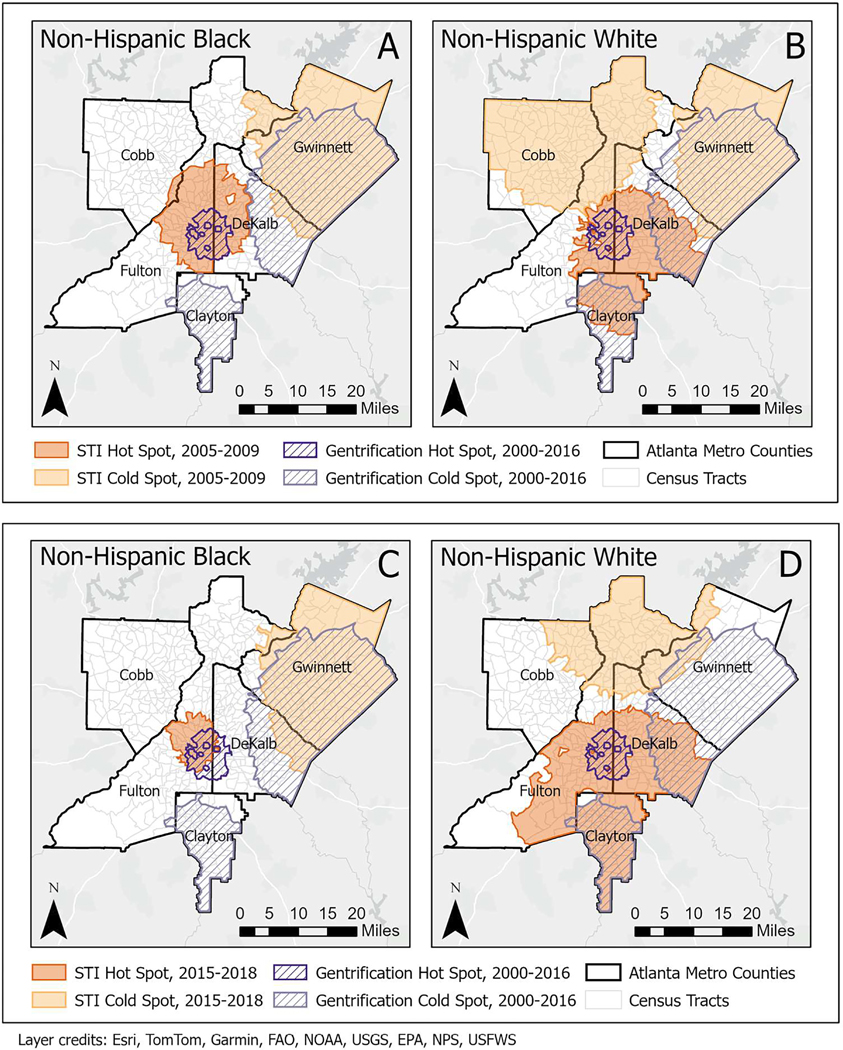
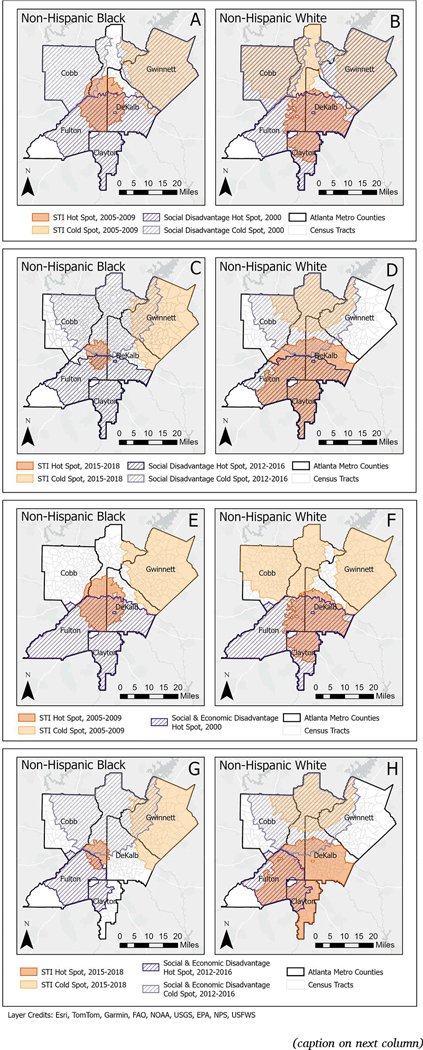
Racial disparities in sexually transmitted infections (STIs) in the United States have been linked to social inequities. Gentrification instigates population-level shifts in housing markets and neighborhood racial/ethnic composition in ways that may impact the spatial distribution of STIs. This study assessed overlap in clusters of STIs, gentrification, social and economic disadvantage, and rental cost burden in Atlanta, Georgia, between 2005 and 2018. Overlap between gentrification and STIs among Black people was greater than that observed for the overlap between gentrification and STIs among White people. Overlap of STIs with social disadvantage and rental cost burden was more prominent among White people than Black people over time. Additional investigation into the factors behind the spatial dynamics observed in this study, and explanations for their variation by race, are necessary to inform where place-based efforts are targeted to reduce racial disparities in STI transmission in gentrifying cities.
美国性传播感染(STIs)方面的种族差异与社会不平等有关。高档化以可能影响 STI 空间分布的方式引发住房市场和邻里种族/族裔构成的人口水平变化。本研究评估了 2005 年至 2018 年期间,佐治亚州亚特兰大市 STIs、高档化、社会经济劣势和租金负担负担之间的集群重叠情况。高档化与黑人 STIs 之间的重叠程度大于高档化与白人 STIs 之间的重叠程度。随着时间的推移,STIs 与社会劣势和租金负担负担之间的重叠在白人中比黑人中更为明显。需要进一步调查造成这种研究中观察到的空间动态的因素,以及其因种族而异的解释,以便为在高档化城市减少 STI 传播方面的种族差异提供依据,确定基于地点的努力的目标。