Verveen Anouk, Nugroho Fajar Agung, Bucur Ioan Gabriel, Wynberg Elke, van Willigen Hugo D G, Davidovich Udi, Lok Anja, Moll van Charante Eric P, de Bree Godelieve J, de Jong Menno D, Kootstra Neeltje, Claassen Tom, de Jonge Marien I, Heskes Tom, Prins Maria, Knoop Hans, Nieuwkerk Pythia T
Department of Medical Psychology, Amsterdam UMC, Amsterdam Public Health Research Institute, University of Amsterdam, Amsterdam, the Netherlands.
Department of Data Science, Institute for Computing and Information Sciences, Radboud University, Nijmegen, the Netherlands.
Psychol Med. 2024 Dec 2;54(15):1-11. doi: 10.1017/S0033291724002721.
Severe fatigue and cognitive complaints are frequently reported after SARS-CoV-2 infection and may be accompanied by depressive symptoms and/or limitations in physical functioning. The long-term sequelae of COVID-19 may be influenced by biomedical, psychological, and social factors, the interplay of which is largely understudied over time. We aimed to investigate how the interplay of these factors contribute to the persistence of symptoms after COVID-19.
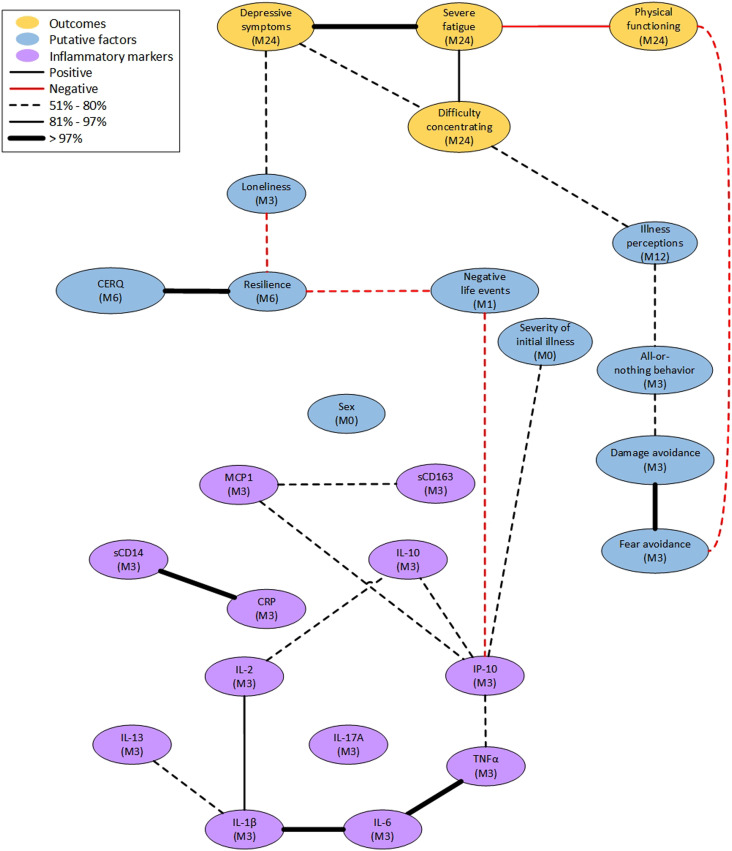
RECoVERED, a prospective cohort study in Amsterdam, the Netherlands, enrolled participants aged⩾16 years after SARS-CoV-2 diagnosis. We used a structural network analysis to assess relationships between biomedical (initial COVID-19 severity, inflammation markers), psychological (illness perceptions, coping, resilience), and social factors (loneliness, negative life events) and persistent symptoms 24 months after initial disease (severe fatigue, difficulty concentrating, depressive symptoms and limitations in physical functioning). Causal discovery, an explorative data-driven approach testing all possible associations and retaining the most likely model, was performed.
Data from 235/303 participants (77.6%) who completed the month 24 study visit were analysed. The structural model revealed associations between the putative factors and outcomes. The outcomes clustered together with severe fatigue as its central point. Loneliness, fear avoidance in response to symptoms, and illness perceptions were directly linked to the outcomes. Biological (inflammatory markers) and clinical (severity of initial illness) variables were connected to the outcomes only via psychological or social variables.
Our findings support a model where biomedical, psychological, and social factors contribute to the development of long-term sequelae of SARS-CoV-2 infection.
严重疲劳和认知问题在新型冠状病毒2(SARS-CoV-2)感染后经常被报道,并且可能伴有抑郁症状和/或身体功能受限。2019冠状病毒病(COVID-19)的长期后遗症可能受到生物医学、心理和社会因素的影响,随着时间的推移,这些因素之间的相互作用在很大程度上尚未得到充分研究。我们旨在研究这些因素之间的相互作用如何导致COVID-19后症状的持续存在。
“康复(RECoVERED)”是一项在荷兰阿姆斯特丹进行的前瞻性队列研究,纳入了SARS-CoV-2诊断后年龄≥16岁的参与者。我们使用结构网络分析来评估生物医学因素(初始COVID-19严重程度、炎症标志物)、心理因素(疾病认知、应对方式、恢复力)和社会因素(孤独感、负面生活事件)与疾病初始后24个月的持续症状(严重疲劳、注意力不集中、抑郁症状和身体功能受限)之间的关系。采用因果发现法,这是一种探索性的数据驱动方法,测试所有可能的关联并保留最可能的模型。
分析了235/303名(77.6%)完成第24个月研究访视的参与者的数据。结构模型揭示了假定因素与结果之间的关联。这些结果以严重疲劳为中心点聚集在一起。孤独感、对症状的恐惧回避和疾病认知与这些结果直接相关。生物学(炎症标志物)和临床(初始疾病严重程度)变量仅通过心理或社会变量与结果相关。
我们的研究结果支持这样一种模型,即生物医学、心理和社会因素导致了SARS-CoV-2感染长期后遗症的发展。