Li Na, Maimaitireyimu Ayinuer, Shi Tian, Feng Yan, Liu Weidong, Xue Shenglong, Gao Feng
Xinjiang Medical University, Xinjiang Uygur Autonomous Region, Urumqi, China.
Department of Gastroenterology, People's Hospital of Xinjiang Uygur Autonomous Region, Xinjiang Uygur Autonomous Region, Urumqi, China.
Sci Rep. 2024 Dec 2;14(1):29872. doi: 10.1038/s41598-024-80391-5.
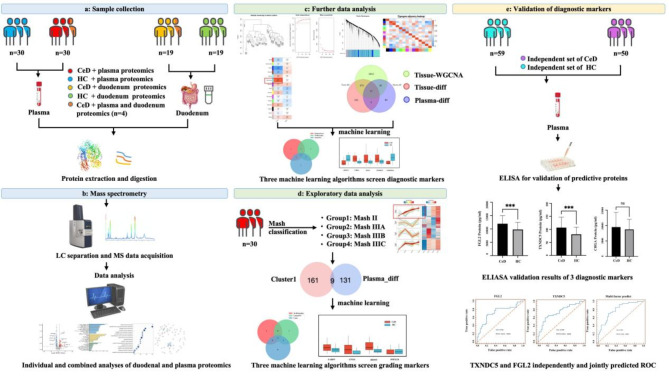
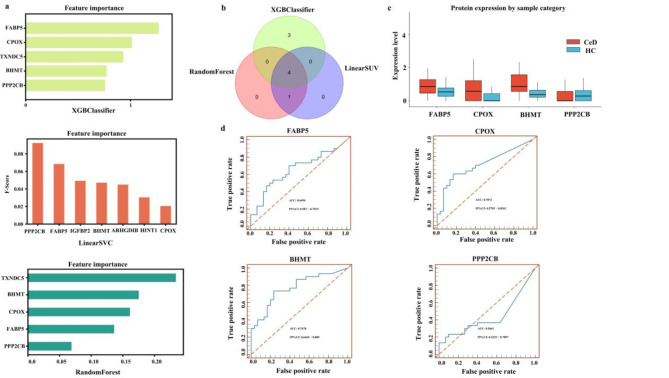
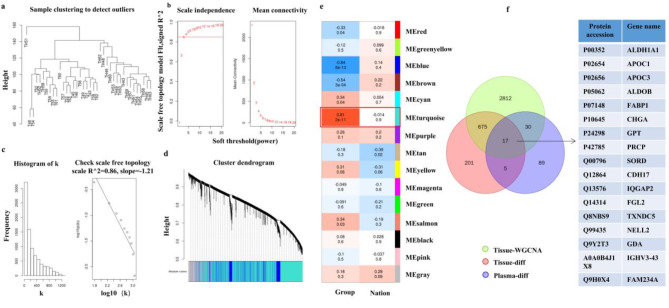
The pathogenesis of celiac disease (CeD) remains incompletely understood. Traditional diagnostic techniques for CeD include serological testing and endoscopic examination; however, they have limitations. Therefore, there is a need to identify novel noninvasive biomarkers for CeD diagnosis. We analyzed duodenal and plasma samples from CeD patients by four-dimensional data-dependent acquisition (4D-DIA) proteomics. Differentially expressed proteins (DEPs) were identified for functional analysis and to propose blood biomarkers associated with CeD diagnosis. In duodenal and plasma samples, respectively, 897 and 140 DEPs were identified. Combining weighted gene co-expression network analysis(WGCNA) with the DEPs, five key proteins were identified across three machine learning methods. FGL2 and TXNDC5 were significantly elevated in the CeD group, while CHGA expression showed an increasing trend, but without statistical significance. The receiver operating characteristic curve results indicated an area under the curve (AUC) of 0.7711 for FGL2 and 0.6978 for TXNDC5, with a combined AUC of 0.8944. Exploratory analysis using Mfuzz and three machine learning methods identified four plasma proteins potentially associated with CeD pathological grading (Marsh classification): FABP, CPOX, BHMT, and PPP2CB. We conclude that FGL2 and TXNDC5 deserve exploration as potential sensitive, noninvasive diagnostic biomarkers for CeD.
乳糜泻(CeD)的发病机制仍未完全明确。CeD的传统诊断技术包括血清学检测和内镜检查;然而,它们存在局限性。因此,需要鉴定用于CeD诊断的新型非侵入性生物标志物。我们通过四维数据依赖采集(4D-DIA)蛋白质组学分析了CeD患者的十二指肠和血浆样本。鉴定出差异表达蛋白(DEPs)用于功能分析,并提出与CeD诊断相关的血液生物标志物。在十二指肠和血浆样本中,分别鉴定出897个和140个DEPs。将加权基因共表达网络分析(WGCNA)与DEPs相结合,通过三种机器学习方法鉴定出五个关键蛋白。FGL2和TXNDC5在CeD组中显著升高,而CHGA表达呈上升趋势,但无统计学意义。受试者工作特征曲线结果表明,FGL2的曲线下面积(AUC)为0.7711,TXNDC5的AUC为0.6978,联合AUC为0.8944。使用Mfuzz和三种机器学习方法进行的探索性分析确定了四种可能与CeD病理分级(马什分类)相关的血浆蛋白:FABP、CPOX、BHMT和PPP2CB。我们得出结论,FGL2和TXNDC5值得作为CeD潜在的敏感、非侵入性诊断生物标志物进行探索。