Mohamed Ahmed Allam, Sahin Cennet, Berres Marie-Luise, Beetz Oliver, Websky Martin von, Vogel Thomas, Vondran Florian W R, Bruners Philipp, Imöhl Matthias, Frank Katharina, Vogt Edith, Singh Binney Pal, Eble Michael J
Radiation Oncology Department, University Hospital RWTH Aachen, Aachen, Germany.
Center for Integrated Oncology Aachen, Bonn, Cologne and Duesseldorf (CIO ABCD), Aachen, Germany.
Clin Transl Radiat Oncol. 2024 Nov 12;50:100887. doi: 10.1016/j.ctro.2024.100887. eCollection 2025 Jan.
Hepatocellular carcinoma (HCC) poses a significant challenge for patients ineligible for surgical resection or liver transplantation. Local therapies like Stereotactic Body Radiotherapy (SBRT) are crucial for those with liver-limited disease. Insulin-like growth factor-1 (IGF-1) is a potential biomarker for liver function. This study evaluates IGF-1's prognostic value in predicting survival outcomes in HCC patients undergoing SBRT.
We analyzed 42 HCC patients treated with SBRT between May 2021 and January 2024, with IGF-1 levels measured within four weeks before SBRT. Patient demographics, tumor metrics, and clinical outcomes were examined. The prognostic significance of IGF-1 was assessed using Cox proportional hazards and ROC curve analysis to determine optimal IGF-1 cutoffs for survival prediction. A nomogram predicting 1-year and 2-year survival was constructed using a multivariate Cox model.
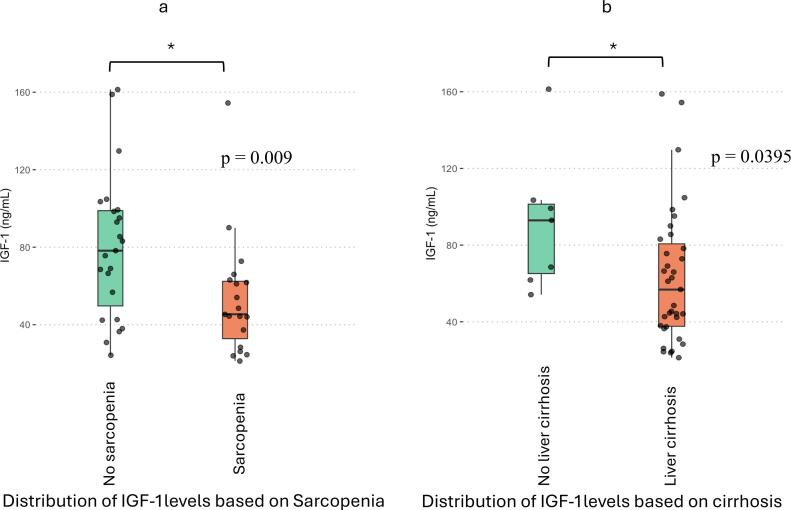
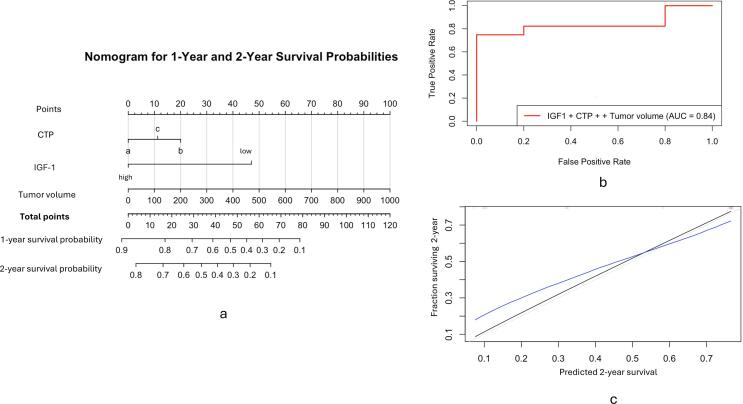
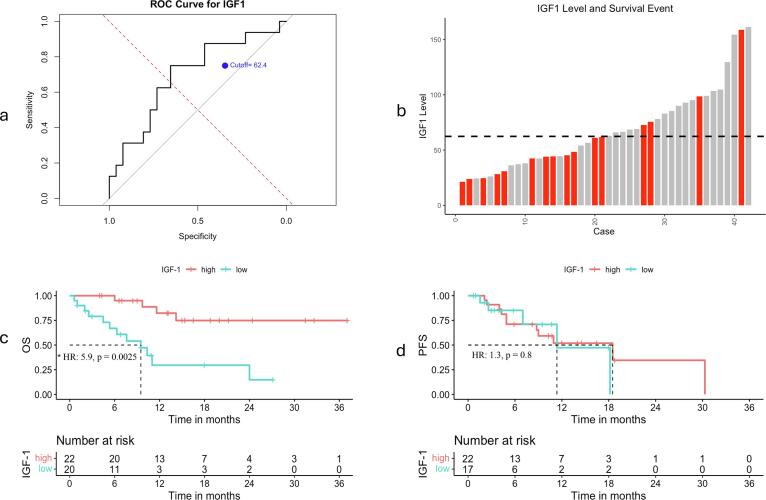
IGF-1 levels were significantly lower in patients with cirrhosis or sarcopenia. Median overall survival (OS) was 24 months, with a significant survival difference favoring patients with IGF-1 levels above 62.4 ng/ml (Hazard Ratio [HR]: 5.9, P = 0.0025). A multivariable Cox model including Child-Turcotte-Pugh (CTP) score, IGF-1, and tumor volume effectively predicted survival. IGF-1 and tumor volume significantly impacted OS (HR: 6.9 and 1.004, p = 0.014 and 0.0022, respectively). Integrating IGF-1 with CTP score improved predictive accuracy (c-index 0.66 to 0.75, p = 0.052).The nomogram, integrating IGF-1 with the CTP and tumour volume, exhibited robust predictive accuracy with an area under the curve (AUC) of 0.84 for 2-year survival.
IGF-1 is a reliable biomarker for liver function and survival prediction in HCC patients undergoing SBRT. Higher IGF-1 levels indicate better prognosis. The developed nomogram, incorporating IGF-1, enhances clinical decision-making for SBRT management. Further validation in larger cohorts is needed.
肝细胞癌(HCC)对不符合手术切除或肝移植条件的患者构成重大挑战。立体定向体部放射治疗(SBRT)等局部治疗方法对肝脏局限性疾病患者至关重要。胰岛素样生长因子-1(IGF-1)是肝功能的潜在生物标志物。本研究评估IGF-1在预测接受SBRT的HCC患者生存结局方面的预后价值。
我们分析了2021年5月至2024年1月期间接受SBRT治疗的42例HCC患者,在SBRT前四周内测量了IGF-1水平。检查了患者的人口统计学、肿瘤指标和临床结局。使用Cox比例风险模型和ROC曲线分析评估IGF-1的预后意义,以确定用于生存预测的最佳IGF-1临界值。使用多变量Cox模型构建了预测1年和2年生存率的列线图。
肝硬化或肌肉减少症患者的IGF-1水平显著较低。中位总生存期(OS)为24个月,IGF-1水平高于62.4 ng/ml的患者生存差异显著(风险比[HR]:5.9,P = 0.0025)。包括Child-Turcotte-Pugh(CTP)评分、IGF-1和肿瘤体积的多变量Cox模型有效预测了生存情况。IGF-1和肿瘤体积对OS有显著影响(HR:6.9和1.004,p分别为0.014和0.0022)。将IGF-1与CTP评分相结合提高了预测准确性(c指数从0.66提高到0.75,p = 0.052)。将IGF-1与CTP和肿瘤体积相结合的列线图在2年生存率预测方面具有强大的预测准确性,曲线下面积(AUC)为0.84。
IGF-1是接受SBRT的HCC患者肝功能和生存预测的可靠生物标志物。较高的IGF-1水平表明预后较好。所开发的包含IGF-1的列线图增强了SBRT治疗管理的临床决策。需要在更大的队列中进行进一步验证。