Zhang Jie, Guan Ming, Wu Suling, Sheng Wenbin
Department of Pediatrics, Hangzhou Children's Hospital, Hangzhou, Zhejiang 310014, P.R. China.
Department of Otolaryngology, Affiliated Hangzhou First People's Hospital, School of Medicine, Westlake University, Hangzhou, Zhejiang 310006, P.R. China.
Biomed Rep. 2024 Nov 13;22(1):12. doi: 10.3892/br.2024.1890. eCollection 2025 Jan.
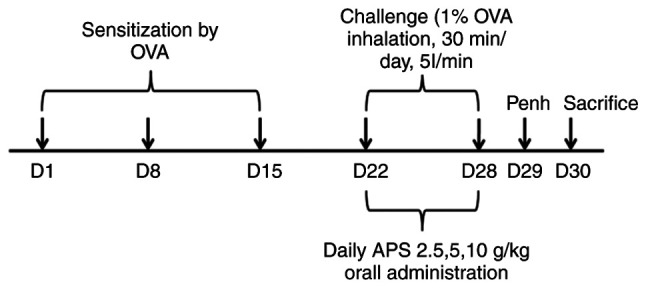
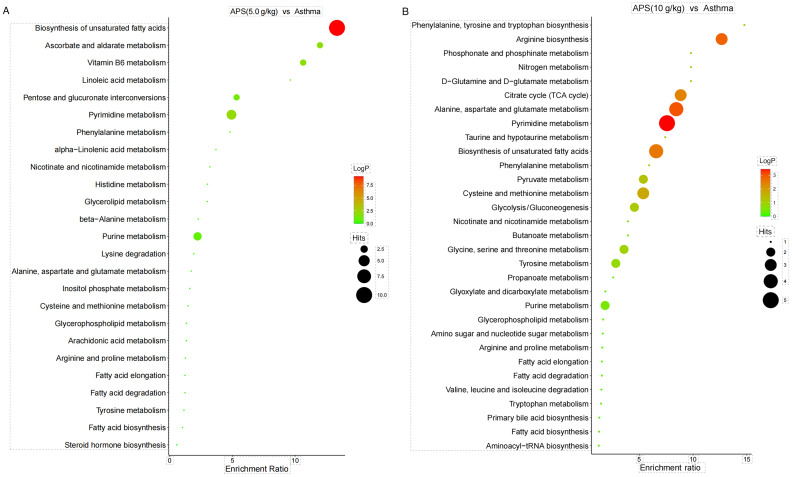
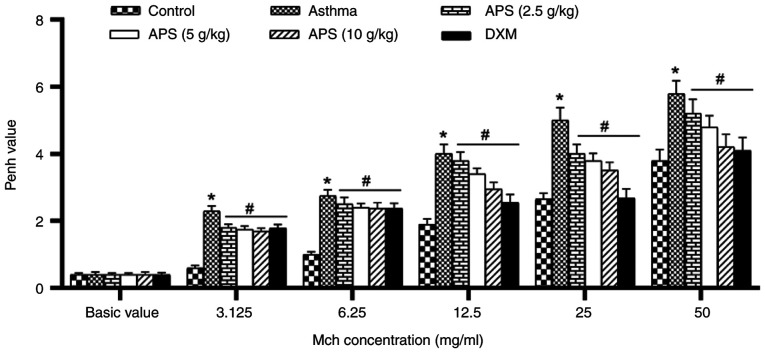
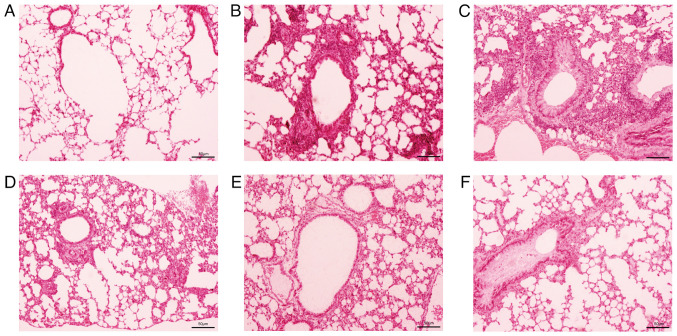
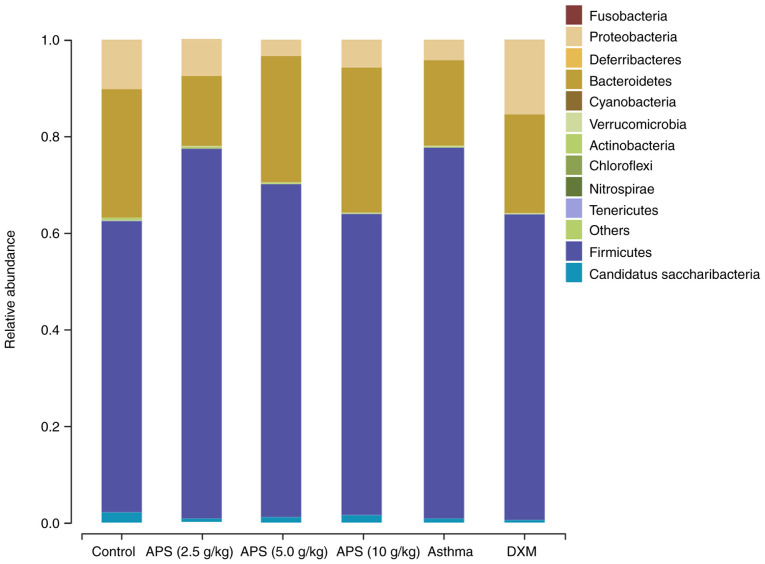
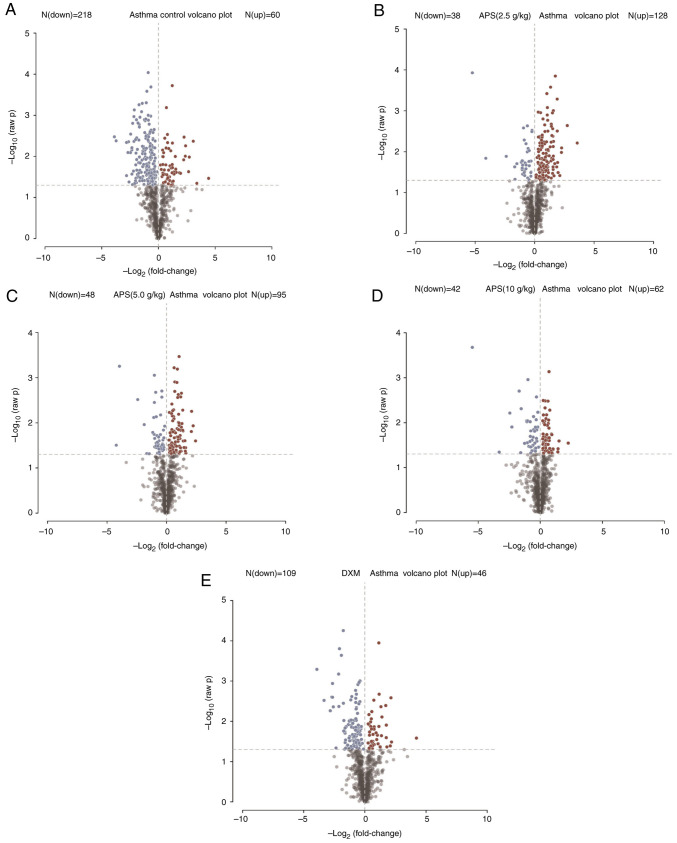
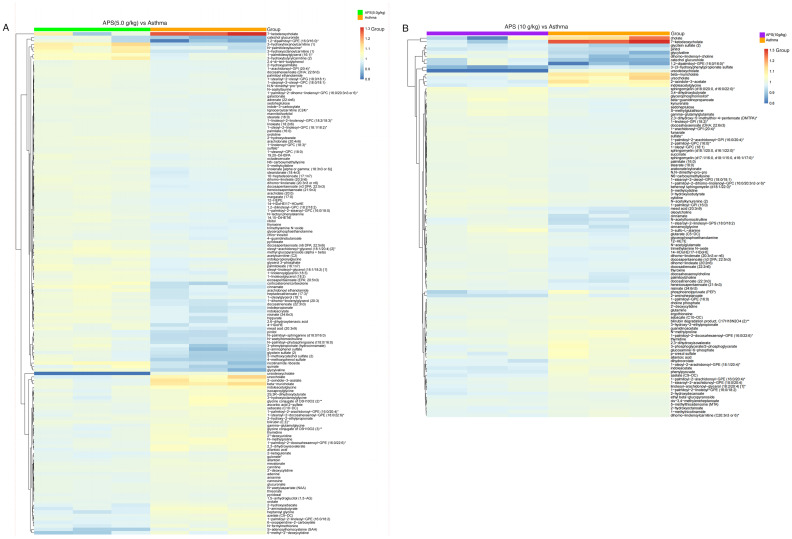
The aim of the present study was to examine the effects of polysaccharide (APS) on gut microbiota and serum metabolites in asthmatic mice. For this purpose, a total of 36 BALB/c female mice were selected and randomly classified into the following groups: i) The normal control group sensitized with phosphate-buffered saline; ii) the asthma group sensitized and challenged with ovalbumin (OVA); iii) the OVA + APS (2.5 g/kg) treatment group; iv) the OVA + APS (5.0 g/kg) treatment group; v) the OVA + APS (10 g/kg) treatment group; and vi) the OVA + dexamethasone (2 mg/kg) treatment group, with 6 mice in each group. OVA was used to establish the mouse model of asthma. In the APS group, the asthmatic mice were intragastrically administered APS at various doses at 1 h prior to each OVA stimulation. The airway hyperreactivity (AHR) was measured, and hematoxylin and eosin staining was employed to evaluate pulmonary inflammatory infiltration. In addition, 16S rRNA sequencing and ultra-performance liquid chromatography-tandem mass spectrometry were used to detect the changes in the mouse gut microbiota and serum metabolites. The results revealed that compared with the asthma model group, APS improved airway inflammation and eosinophil infiltration in asthmatic mice. In asthmatic mice, the gut microbial imbalance mainly manifested as a low abundance of Bacteroidetes and a high abundance of Firmicutes, yielding an increased F/B ratio. In the high-dose APS group, the abundance of Firmicutes was reduced, and the abundance of Bacteroidetes was increased, which thereby decreased the F/B ratio and corrected the gut microbial imbalance. Through blood metabolomics, 145 and 105 significantly differential metabolites were detected in the medium- and high-dose APS groups, respectively. Moreover, Kyoto Encyclopedia of Genes and Genomes pathway enrichment analysis demonstrated that the metabolic pathways in the medium-dose APS group included the biosynthesis of unsaturated fatty acids and the biosynthesis of arginine. On the other hand, the metabolic pathways enriched in high-dose APS group were the biosynthesis of unsaturated fatty acids, and pyrimidine metabolism. On the whole, the present study demonstrates that APS may regulate the gut microbiota and the metabolites to improve airway inflammation and AHR in asthmatic mice.
本研究旨在探讨多糖(APS)对哮喘小鼠肠道微生物群和血清代谢产物的影响。为此,共选取36只BALB/c雌性小鼠,并随机分为以下几组:i)用磷酸盐缓冲盐水致敏的正常对照组;ii)用卵清蛋白(OVA)致敏和激发的哮喘组;iii)OVA + APS(2.5 g/kg)治疗组;iv)OVA + APS(5.0 g/kg)治疗组;v)OVA + APS(10 g/kg)治疗组;以及vi)OVA + 地塞米松(2 mg/kg)治疗组,每组6只小鼠。使用OVA建立哮喘小鼠模型。在APS组中,哮喘小鼠在每次OVA刺激前1小时经胃内给予不同剂量的APS。测量气道高反应性(AHR),并采用苏木精和伊红染色评估肺部炎症浸润。此外,使用16S rRNA测序和超高效液相色谱 - 串联质谱法检测小鼠肠道微生物群和血清代谢产物的变化。结果显示,与哮喘模型组相比,APS改善了哮喘小鼠的气道炎症和嗜酸性粒细胞浸润。在哮喘小鼠中,肠道微生物失衡主要表现为拟杆菌门丰度低和厚壁菌门丰度高,导致F/B比值增加。在高剂量APS组中,厚壁菌门的丰度降低,拟杆菌门的丰度增加,从而降低了F/B比值并纠正了肠道微生物失衡。通过血液代谢组学,在中剂量和高剂量APS组中分别检测到145种和105种显著差异代谢产物。此外,京都基因与基因组百科全书通路富集分析表明,中剂量APS组的代谢途径包括不饱和脂肪酸的生物合成和精氨酸的生物合成。另一方面,高剂量APS组富集的代谢途径是不饱和脂肪酸的生物合成和嘧啶代谢。总体而言,本研究表明APS可能通过调节肠道微生物群和代谢产物来改善哮喘小鼠的气道炎症和AHR。