Kostandova Natalya, Schluth Catherine, Arambepola Rohan, Atuhaire Fatumah, Bérubé Sophie, Chin Taylor, Cleary Eimear, Cortes-Azuero Oscar, García-Carreras Bernardo, Grantz Kyra H, Hitchings Matt D T, Huang Angkana T, Kishore Nishant, Lai Shengjie, Larsen Sophie L, Loisate Stacie, Martinez Pamela, Meredith Hannah R, Purbey Ritika, Ramiadantsoa Tanjona, Read Jonathan, Rice Benjamin L, Rosman Lori, Ruktanonchai Nick, Salje Henrik, Schaber Kathryn L, Tatem Andrew J, Wang Jasmine, Cummings Derek A T, Wesolowski Amy
Department of Epidemiology, Bloomberg School of Public Health, Johns Hopkins University, Baltimore, MD, USA.
WorldPop, School of Geography and Environmental Science, University of Southampton, Southampton, SO17 1BJ, UK.
Nat Commun. 2024 Dec 3;15(1):10504. doi: 10.1038/s41467-024-54895-7.
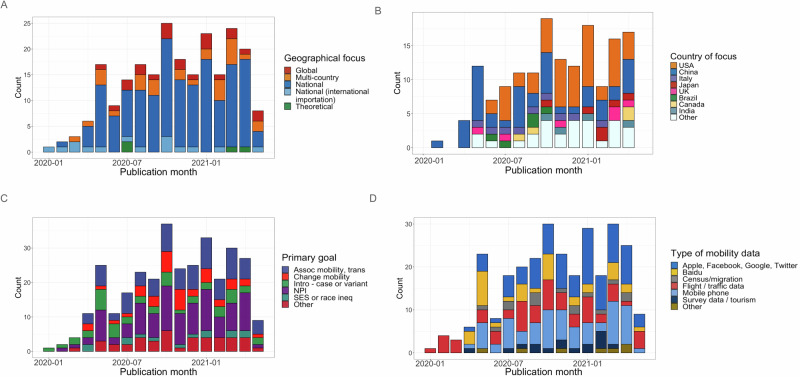
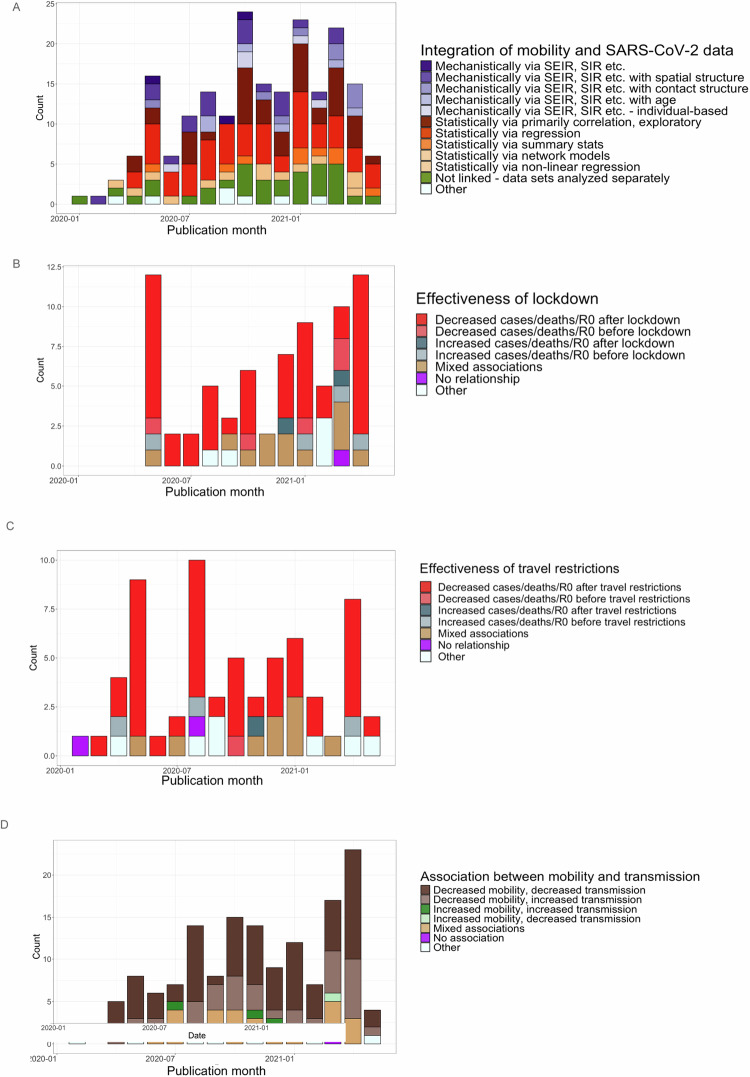
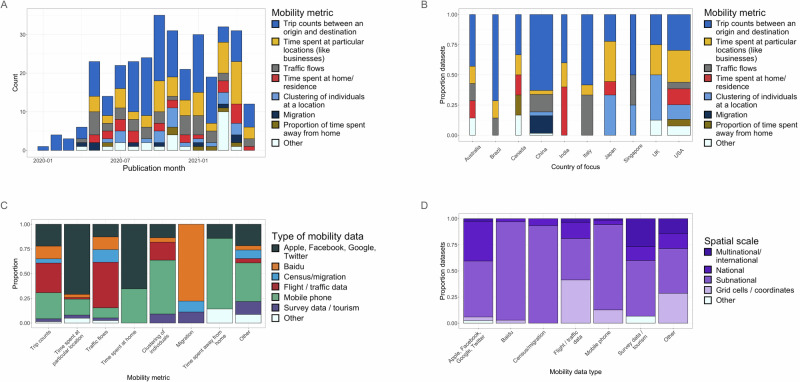
The emergence of SARS-CoV-2 into a highly susceptible global population was primarily driven by human mobility-induced introduction events. Especially in the early stages, understanding mobility was vital to mitigating the pandemic prior to widespread vaccine availability. We conducted a systematic review of studies published from January 1, 2020, to May 9, 2021, that used population-level human mobility data to understand SARS-CoV-2 transmission. Of the 5505 papers with abstracts screened, 232 were included in the analysis. These papers focused on a range of specific questions but were dominated by analyses focusing on the USA and China. The majority included mobile phone data, followed by Google Community Mobility Reports, and few included any adjustments to account for potential biases in population sampling processes. There was no clear relationship between methods used to integrate mobility and SARS-CoV-2 data and goals of analysis. When considering papers focused only on the estimation of the effective reproductive number within the US, there was no clear relationship identified between this measure and changes in mobility patterns. Our findings underscore the need for standardized, systematic ways to identify the source of mobility data, select an appropriate approach to using it in analysis, and reporting.
严重急性呼吸综合征冠状病毒2(SARS-CoV-2)在全球高度易感人群中的出现,主要是由人类流动引发的引入事件所驱动。特别是在早期阶段,在广泛提供疫苗之前,了解人员流动对于缓解疫情至关重要。我们对2020年1月1日至2021年5月9日发表的利用人群层面人类流动数据来了解SARS-CoV-2传播情况的研究进行了系统综述。在筛选摘要的5505篇论文中,有232篇被纳入分析。这些论文关注一系列具体问题,但以聚焦美国和中国的分析为主。大多数研究纳入了手机数据,其次是谷歌社区流动报告,很少有研究对人群抽样过程中的潜在偏差进行任何调整。整合流动数据和SARS-CoV-2数据所采用的方法与分析目标之间没有明确的关系。在仅考虑聚焦于美国有效再生数估计的论文时,该指标与流动模式变化之间未发现明确关系。我们的研究结果强调,需要采用标准化、系统化的方法来确定流动数据的来源,选择合适的方法在分析中使用该数据,并进行报告。