Arnold Daniel P, Takatori Sho C
Department of Chemical Engineering, University of California, Santa Barbara, Santa Barbara, California 93106, United States.
Langmuir. 2024 Dec 17;40(50):26570-26578. doi: 10.1021/acs.langmuir.4c03463. Epub 2024 Dec 4.
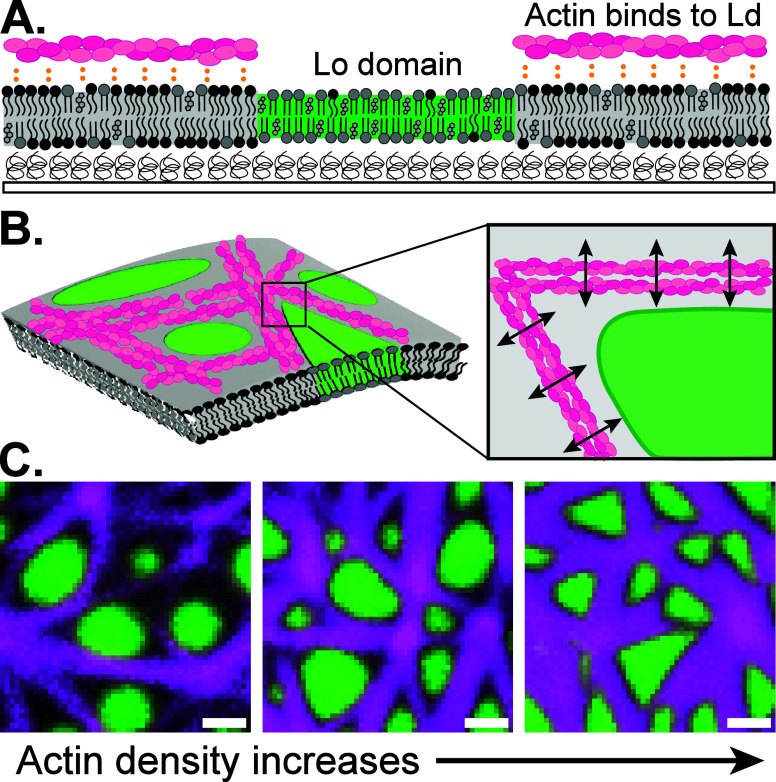
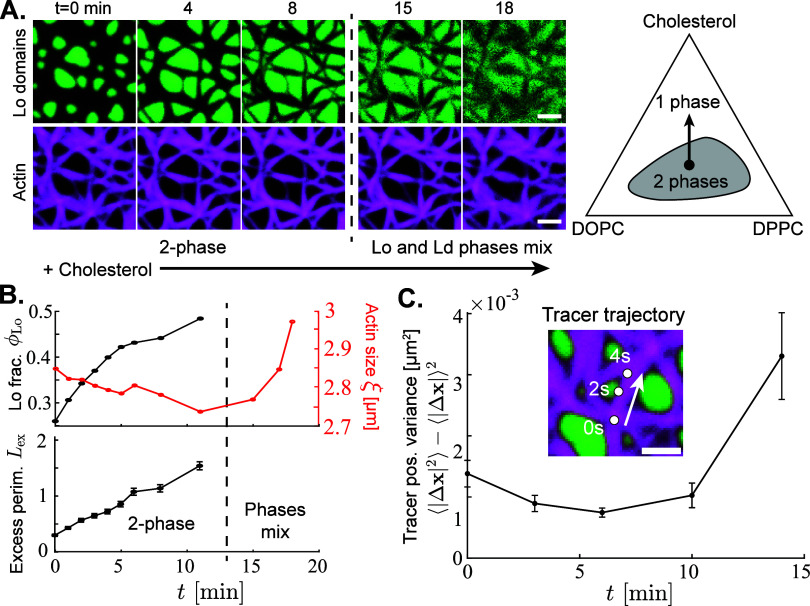
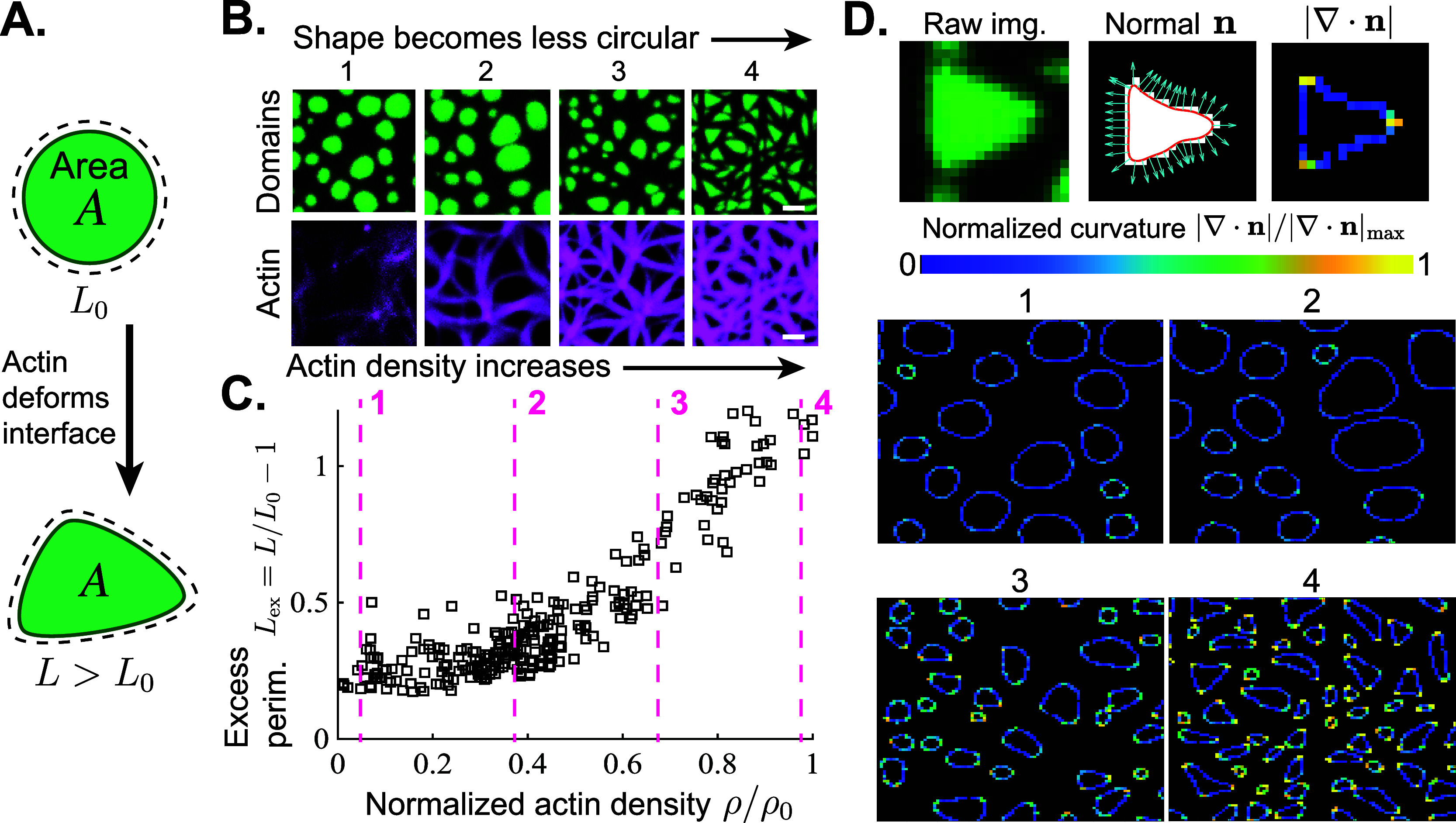
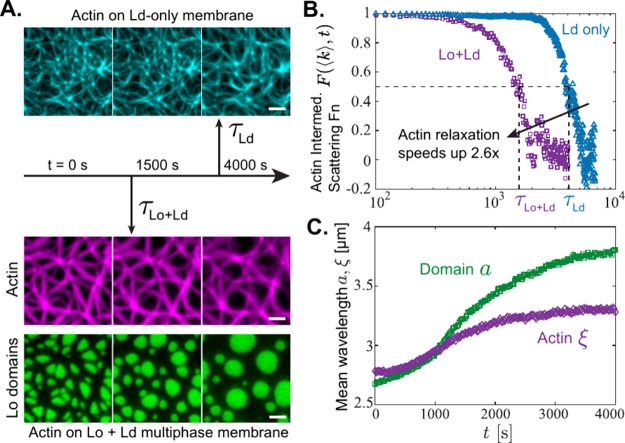
The mammalian cell membrane is embedded with biomolecular condensates of protein and lipid clusters, which interact with an underlying viscoelastic cytoskeleton network to organize the cell surface and mechanically interact with the extracellular environment. However, the mechanical and thermodynamic interplay between the viscoelastic network and liquid-liquid phase separation of 2-dimensional (2D) lipid condensates remains poorly understood. Here, we engineer materials composed of 2D lipid membrane condensates embedded within a thin viscoelastic actin network. The network generates localized anisotropic stresses that deform lipid condensates into triangular morphologies with sharp edges and corners, shapes unseen in many 3D composite gels. Kinetic coarsening of phase-separating lipid condensates accelerates the viscoelastic relaxation of the network, leading to an effectively softer composite material over intermediate time scales. We dynamically manipulate the membrane composition to control the elastic-to-viscous crossover of the network. Such viscoelastic composite membranes may enable the development of coatings, catalytic surfaces, separation membranes, and other interfaces with tunable spatial organization and plasticity mechanisms.
哺乳动物细胞膜嵌入了蛋白质和脂质簇的生物分子凝聚物,这些凝聚物与底层的粘弹性细胞骨架网络相互作用,以组织细胞表面并与细胞外环境进行机械相互作用。然而,粘弹性网络与二维(2D)脂质凝聚物的液-液相分离之间的机械和热力学相互作用仍知之甚少。在这里,我们设计了由嵌入薄粘弹性肌动蛋白网络中的二维脂质膜凝聚物组成的材料。该网络产生局部各向异性应力,使脂质凝聚物变形为具有尖锐边缘和角的三角形形态,这种形状在许多三维复合凝胶中未见。相分离脂质凝聚物的动力学粗化加速了网络的粘弹性松弛,导致在中间时间尺度上复合材料有效地变软。我们动态地操纵膜组成以控制网络的弹性-粘性转变。这种粘弹性复合膜可能有助于开发具有可调空间组织和可塑性机制的涂层、催化表面、分离膜和其他界面。