Metanmo Salvatore, Finbråten Hanne Søberg, Bøggild Henrik, Nowak Peter, Griebler Robert, Guttersrud Øystein, Bíró Éva, Unim Brigid, Charafeddine Rana, Griese Lennert, Kucera Zdenek, Le Christopher, Schaeffer Doris, Vrdelja Mitja, Mancini Julien
INSERM, IRD, ISSPAM, SESSTIM, Cancer, Biomedicine & Society Group, Ligue 2019 Accredited Team, Aix Marseille Univ, 13009, Marseille, France.
Department of Health and Nursing Sciences, Faculty of Social and Health Sciences, Inland Norway University of Applied Sciences, P.O. Box 400, 2418, Elverum, Norway.
Sci Rep. 2024 Dec 4;14(1):30245. doi: 10.1038/s41598-024-79327-w.
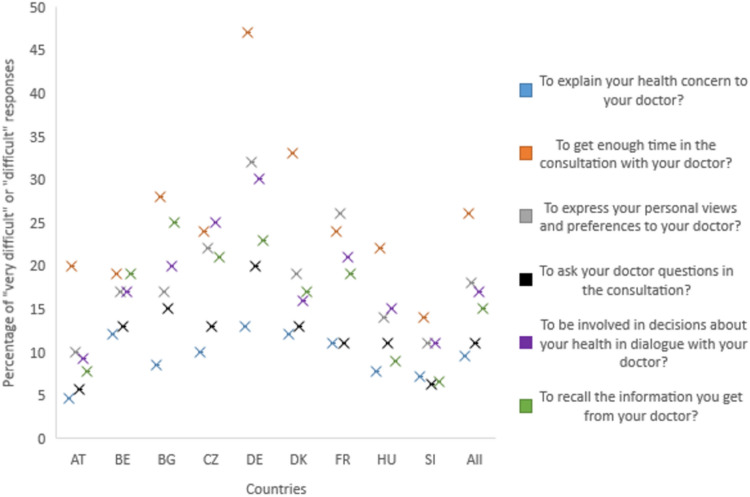
Our study aimed to report on variables associated with communicative health literacy (COM-HL) in European adults. The HLS survey was conducted in 2019-2021 including nine countries which measured COM-HL by using a validated questionnaire (HLS-COM-P-Q6 with a score ranging from 0 to 100). Linear regression models were used to study variables associated with COM-HL globally (multilevel model with random intercepts and slopes and at country level) and in each country. Additional models studied each of the HLS-COM-P-Q6 items separately. The mean COM-HL score ranged between 62.5 and 76.6 across countries. Among the 18,137 pooled participants, COM-HL was positively associated with age, a higher self-perceived social status, previous training in healthcare, an increasing number of general practitioner visits; and negatively associated with female sex, reported financial difficulties, having a chronic condition and an increasing number of specialist visits. These effects were heterogeneous from one country to another, and from one item to another when analysing the different COM-HL items separately. However, there was a consistent statistically significant association between COM-HL (score and each item) and financial difficulties as well as self-perceived social status in all countries. Interventions to improve communication between patients and physicians should be a high priority to limit communication disparities.
我们的研究旨在报告与欧洲成年人沟通健康素养(COM-HL)相关的变量。健康素养调查于2019年至2021年进行,涵盖九个国家,通过使用经过验证的问卷(HLS-COM-P-Q6,分数范围为0至100)来衡量COM-HL。线性回归模型用于研究全球范围内(具有随机截距和斜率的多层次模型以及国家层面)以及每个国家与COM-HL相关的变量。额外的模型分别研究了HLS-COM-P-Q6的每个项目。各国的COM-HL平均得分在62.5至76.6之间。在18137名汇总参与者中,COM-HL与年龄、较高的自我感知社会地位、先前的医疗保健培训、全科医生就诊次数增加呈正相关;与女性性别、报告的经济困难、患有慢性病以及专科医生就诊次数增加呈负相关。当分别分析不同的COM-HL项目时,这些影响在不同国家之间以及不同项目之间存在差异。然而,在所有国家,COM-HL(得分和每个项目)与经济困难以及自我感知社会地位之间存在一致的统计学显著关联。改善患者与医生之间沟通的干预措施应作为限制沟通差距的高度优先事项。