Natarajan Vignesh Prasanna, Jayapal Senthil
Department of Electronics and Communication Engineering, Vel Tech Rangarajan Dr. Sagunthala R&D Institute of Science and Technology, Avadi, Chennai, Tamil Nadu, India.
College of Computing and Information Sciences, University of Technology and Applied Sciences, Muscat, Oman.
Sci Rep. 2024 Dec 4;14(1):30210. doi: 10.1038/s41598-024-80976-0.
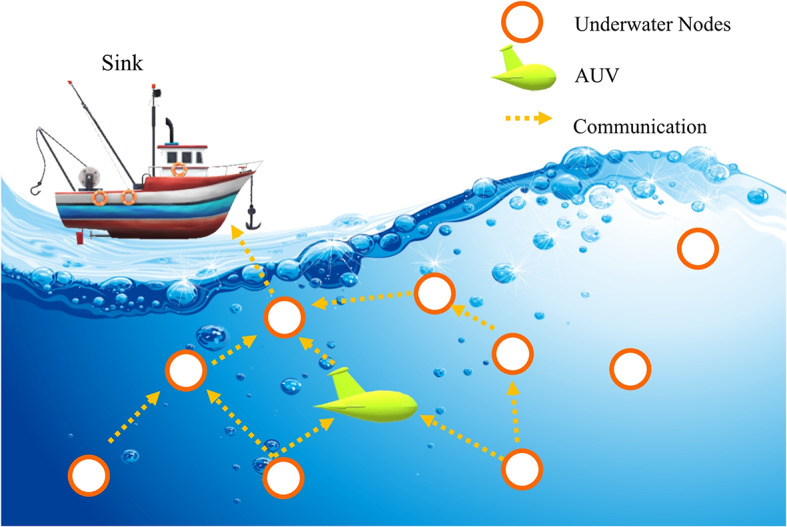
The Underwater Sensor Network (UWSN) comprises sensor nodes with sensing, data processing, and communication capabilities. Due to the limitation of underwater radio wave propagation, nodes rely on acoustic signals to communicate. The data gathered by these nodes is transmitted to coordinating nodes or ground stations for additional processing and analysis. The characteristics of UWSN with underwater channels make them vulnerable to malicious attacks. UWSN communication networks are particularly susceptible to malicious attacks owing to high bit error rates, significant propagation delay variations, and low bandwidth. Moreover, because of the challenging and erratic underwater conditions, limited bandwidth, slow data transmission speed, and power constraints of underwater sensor nodes establishing secure communication in UWSN presents a significant challenge. To address the issues mentioned above, we have introduced the Multipath Malicious Avoidance Routing Protocol (M2ARP) and Foldable Matrix based Padding Rail Fence Encryption Scheme (FM-PRFES) methods to enhance secure communication in UWSNs. The proposed FM-PRFES method encrypts the input data to prevent unauthorized access during transmission within the network. Subsequently, the proposed Energy Efficiency Node Selection (EENS) method is used to identify the significant nodes in the network. Additionally, the Cuckoo Search Optimization (CSO) method is utilized to select the Cluster Head (CH) for data transmission. Subsequently, M2ARP is employed to analyze various routes and avoid adversarial nodes in the network. As a result, the proposed experimental analysis yields more efficient results regarding security, Packet Delivery Ratio (PDR), and throughput performance than traditional approaches.
水下传感器网络(UWSN)由具有传感、数据处理和通信能力的传感器节点组成。由于水下无线电波传播的限制,节点依靠声学信号进行通信。这些节点收集的数据被传输到协调节点或地面站进行进一步的处理和分析。具有水下信道的UWSN的特性使其容易受到恶意攻击。由于高误码率、显著的传播延迟变化和低带宽,UWSN通信网络特别容易受到恶意攻击。此外,由于具有挑战性且不稳定的水下环境、有限的带宽、缓慢的数据传输速度以及水下传感器节点的功率限制,在UWSN中建立安全通信面临重大挑战。为了解决上述问题,我们引入了多路径恶意规避路由协议(M2ARP)和基于可折叠矩阵的填充栅栏加密方案(FM-PRFES)方法,以增强UWSN中的安全通信。所提出的FM-PRFES方法对输入数据进行加密,以防止在网络内传输期间未经授权的访问。随后,所提出的能效节点选择(EENS)方法用于识别网络中的重要节点。此外,利用布谷鸟搜索优化(CSO)方法选择簇头(CH)进行数据传输。随后,采用M2ARP分析各种路由并避免网络中的敌对节点。结果,与传统方法相比,所提出的实验分析在安全性、数据包交付率(PDR)和吞吐量性能方面产生了更有效的结果。