Bedingfield Kalun, Elliott Eoin, Gisdakis Arsenios, Kongsuwan Nuttawut, Baumberg Jeremy J, Demetriadou Angela
School of Physics and Astronomy, University of Birmingham, Edgbaston, Birmingham, B15 2TT, UK.
NanoPhotonics Centre, Cavendish Laboratory, University of Cambridge, Cambridge CB3 0HE, UK.
Nanophotonics. 2023 Oct 4;12(20):3931-3944. doi: 10.1515/nanoph-2023-0392. eCollection 2023 Oct.
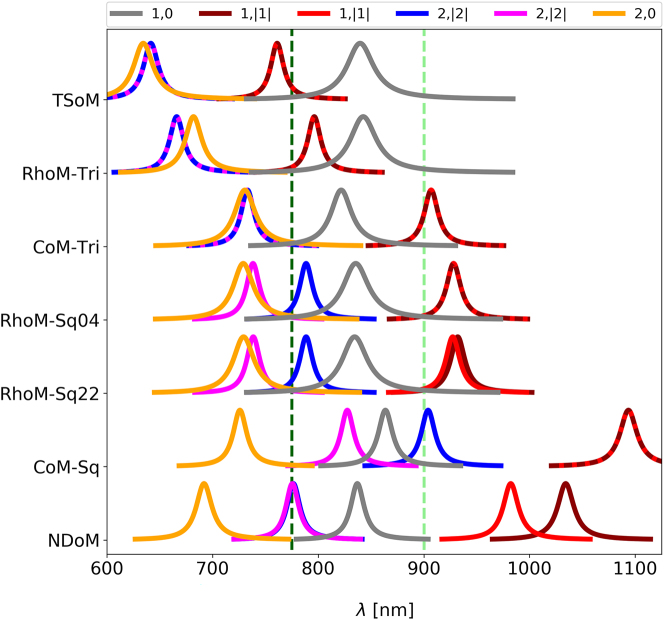
Plasmonic nanocavities form very robust sub-nanometer gaps between nanometallic structures and confine light within deep subwavelength volumes to enable unprecedented control of light-matter interactions. However, spherical nanoparticles acquire various polyhedral shapes during their synthesis, which has a significant impact in controlling many light-matter interactions, such as photocatalytic reactions. Here, we focus on nanoparticle-on-mirror nanocavities built from three polyhedral nanoparticles (cuboctahedron, rhombicuboctahedron, decahedron) that commonly occur during the synthesis. Their photonic modes have a very intricate and rich optical behaviour, both in the near- and far-field. Through a recombination technique, we obtain the total far-field produced by a molecule placed within these nanocavities, to reveal how energy couples in and out of the system. This work paves the way towards understanding and controlling light-matter interactions, such as photocatalytic reactions and non-linear vibrational pumping, in such extreme environments.
等离子体纳米腔在纳米金属结构之间形成非常稳固的亚纳米间隙,并将光限制在深亚波长体积内,从而实现对光与物质相互作用前所未有的控制。然而,球形纳米粒子在合成过程中会呈现出各种多面体形状,这对控制许多光与物质的相互作用(如光催化反应)有重大影响。在此,我们聚焦于由合成过程中常见的三种多面体纳米粒子(立方八面体、菱形立方八面体、十面体)构建的镜上纳米粒子纳米腔。它们的光子模式在近场和远场都具有非常复杂且丰富的光学行为。通过一种复合技术,我们获得了置于这些纳米腔内的分子产生的总远场,以揭示能量如何进出该系统。这项工作为在如此极端环境下理解和控制光与物质的相互作用(如光催化反应和非线性振动泵浦)铺平了道路。