Wagle Swapnil, Merz Pascal T, Ge Yunhui, Bayly Christopher I, Mobley David L
Department of Pharmaceutical Sciences, University of California, Irvine, California 92697, United States.
PM Scientific Consulting, 4000 Basel, Switzerland.
J Chem Theory Comput. 2024 Dec 24;20(24):11013-11031. doi: 10.1021/acs.jctc.4c01145. Epub 2024 Dec 9.
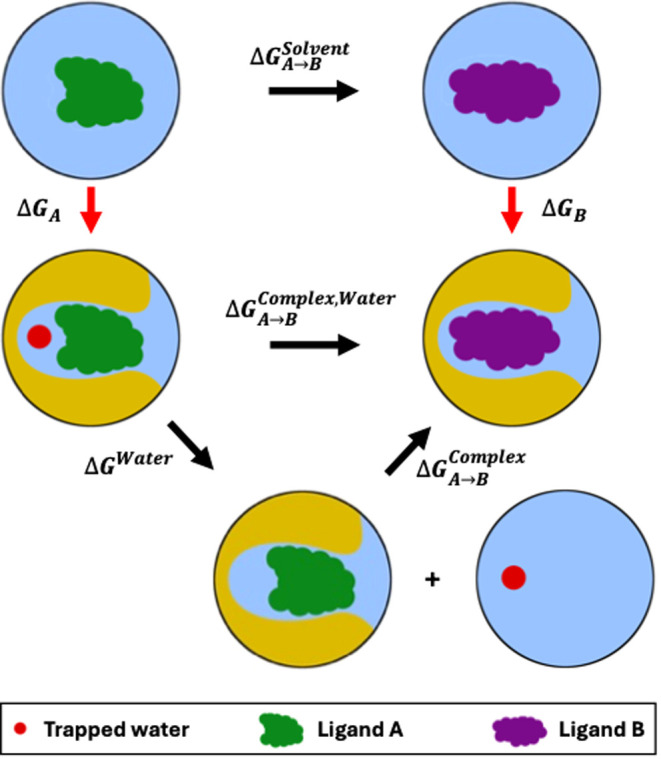
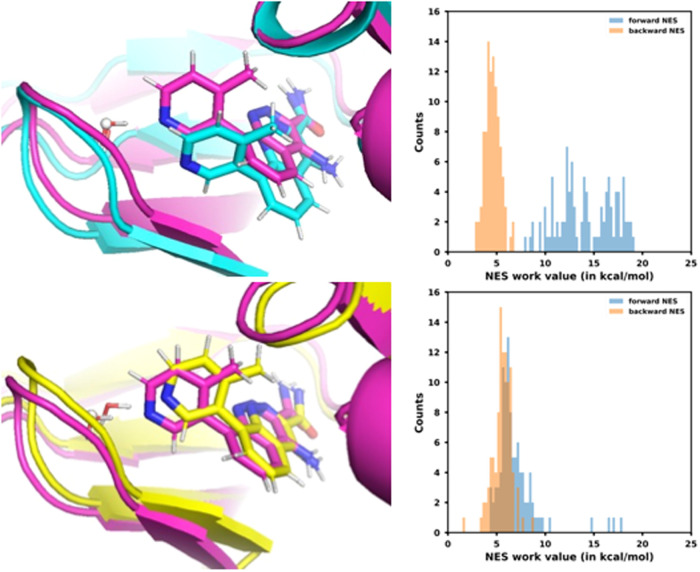
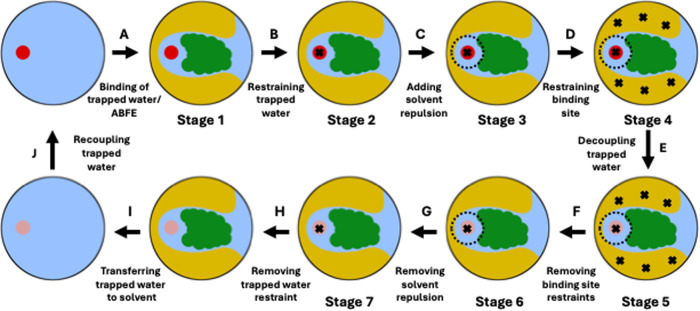
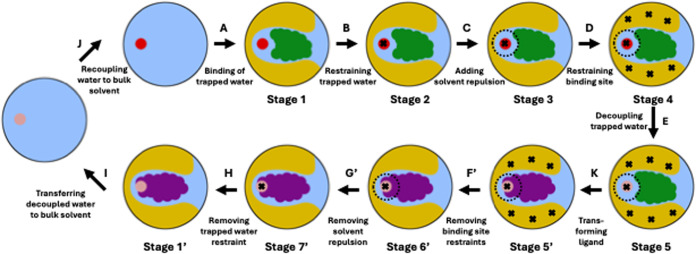
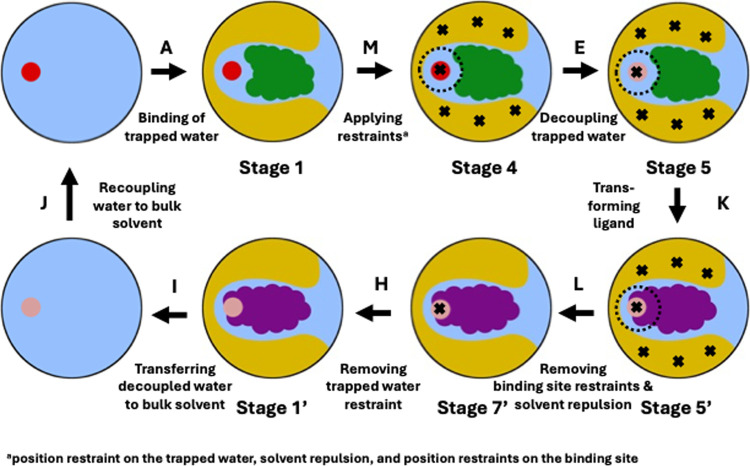
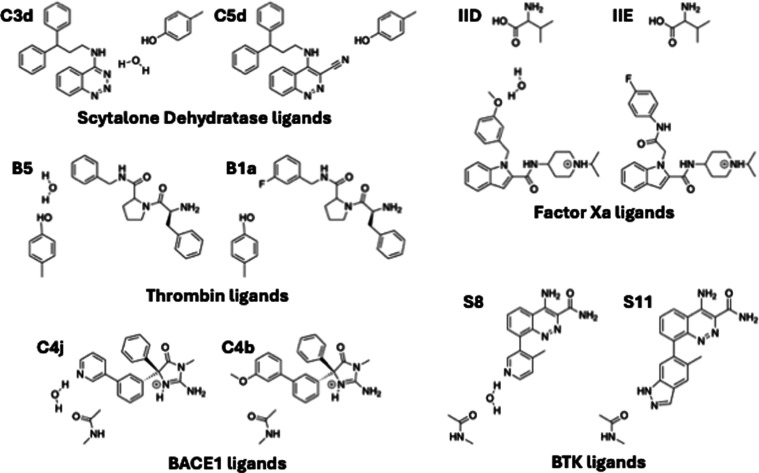
Methods for calculating the relative binding free energy (RBFE) between ligands to a target protein are gaining importance in the structure-based drug discovery domain, especially as methodological advances and automation improve accuracy and ease of use. In an RBFE calculation, the difference between the binding affinities of two ligands to a protein is calculated by transforming one ligand into another, in the protein-ligand complex, and in solvent. Alchemical binding free energy calculations are often used for such ligand transformations. Such calculations are not without challenges, however; for example, it can be challenging to handle interfacial waters when these play a crucial role in mediating protein-ligand binding. In some cases, the exchange of the interfacial waters with solvent water might be very infrequent in the course of typical molecular simulations, and such interfacial waters can be considered trapped on the simulation time scale. In these cases, RBFE calculation between two ligands, where one ligand binds with a trapped water while the other ligand displaces it, can result in inaccuracies if the surrounding water structure is not sampled adequately for both ligands. So far, a popular choice for treating the trapped waters in RBFE calculations is to combine free energy calculations with enhanced sampling methods that insert/delete waters in the binding site. Despite recent developments in the enhanced sampling methods, they can result in hysteresis in the RBFE estimate, depending on whether the simulations were started with or without the trapped waters. In this study, we introduce an alternative method, separation of states, to calculate the RBFE between ligand pairs where the ligands bind to the protein with different numbers/positions of trapped waters. The separation of states approach treats the sampling of the trapped waters separately from the free energy calculation of the ligand transformation. In our method, a trapped water in protein's binding site is decoupled from the system first, and the cavity created by its decoupling is stabilized. We then grow a larger ligand into this cavity- a ligand that is known to displace the trapped water. In this study, we show that our method results in precise and accurate estimates of RBFEs for ligand pairs involving the rearrangement of trapped water via RBFE calculations for five such ligand pairs. We have optimized our simulation protocol to be suited for large distributed computational resources and have automated our RBFE calculation workflow.
在基于结构的药物发现领域,计算配体与靶蛋白之间相对结合自由能(RBFE)的方法正变得越来越重要,尤其是随着方法学的进步和自动化提高了准确性和易用性。在RBFE计算中,通过在蛋白质-配体复合物和溶剂中将一种配体转化为另一种配体,来计算两种配体与蛋白质结合亲和力之间的差异。炼金术结合自由能计算常用于此类配体转化。然而,此类计算并非没有挑战;例如,当界面水在介导蛋白质-配体结合中起关键作用时,处理界面水可能具有挑战性。在某些情况下,在典型分子模拟过程中,界面水与溶剂水的交换可能非常罕见,并且此类界面水在模拟时间尺度上可被视为被困住。在这些情况下,如果没有充分采样两种配体周围的水结构,那么在一种配体与被困水结合而另一种配体取代它的两种配体之间进行RBFE计算可能会导致不准确。到目前为止,在RBFE计算中处理被困水的一种流行选择是将自由能计算与在结合位点插入/删除水的增强采样方法相结合。尽管增强采样方法最近有了发展,但根据模拟是否从有或没有被困水开始,它们可能会导致RBFE估计中的滞后现象。在本研究中,我们引入了一种替代方法——状态分离,以计算配体对之间的RBFE,其中配体以不同数量/位置的被困水与蛋白质结合。状态分离方法将被困水的采样与配体转化的自由能计算分开处理。在我们的方法中,首先将蛋白质结合位点中的被困水与系统解耦,并稳定由其解耦产生的空腔。然后,我们将一个更大的配体生长到这个空腔中——一个已知会取代被困水的配体。在本研究中,我们表明,通过对五个此类配体对进行RBFE计算,我们的方法能够精确准确地估计涉及被困水重排的配体对的RBFE。我们已经优化了我们的模拟协议以适用于大型分布式计算资源,并实现了RBFE计算工作流程的自动化。