Higuchi Ryo, Uemura Keisuke, Kono Sotaro, Mae Hirokazu, Takashima Kazuma, Abe Hirohito, Imagama Takashi, Sakai Takashi, Okada Seiji, Hamada Hidetoshi
Department of Orthopaedics, Osaka University Graduate School of Medicine, 2-2 Yamadaoka, Suita, Osaka, 565-0871, Japan.
Department of Orthopaedic Medical Engineering, Osaka University Graduate School of Medicine, 2-2 Yamadaoka, Suita, Osaka, 565-0871, Japan.
J Bone Miner Metab. 2025 Mar;43(2):158-165. doi: 10.1007/s00774-024-01569-5. Epub 2024 Dec 10.
As many patients with osteoporosis remain undiagnosed, we aimed to develop a simple method to efficiently screen for osteoporosis using a combination of anteroposterior hip X-ray assessment and the Osteoporosis Self-Assessment Tool for Asians (OSTA), which is calculated as (body weight - age) × 0.2.
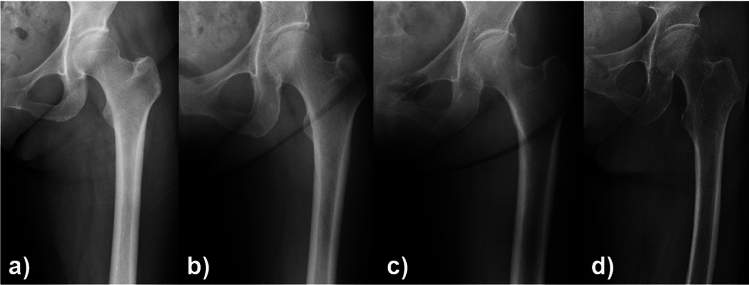
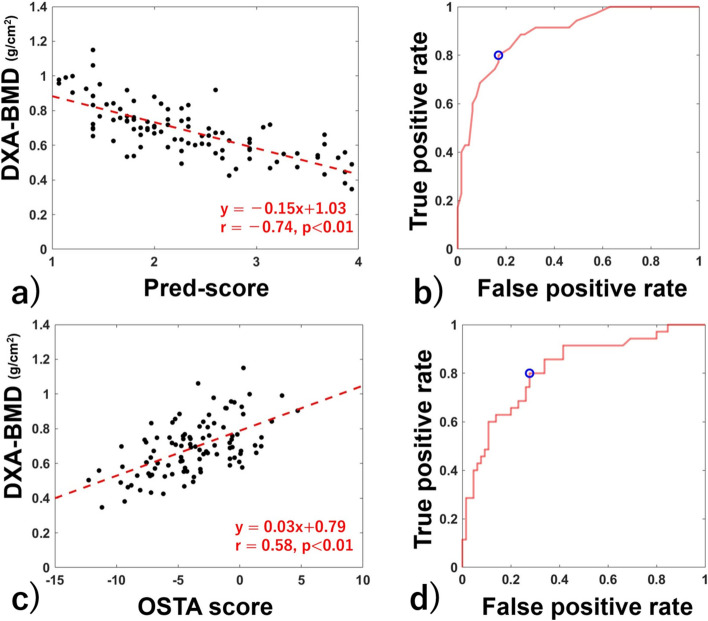
One hundred Japanese women (age: 73 ± 11 years, body weight: 54.4 ± 11.1 kg) who underwent hip surgery, anteroposterior hip X-ray, and DXA were included. Based on the DXA results of the total proximal femur, 35 cases were diagnosed with osteoporosis. Fifteen orthopaedic surgeons visually inspected the hip X-ray images and scored the suspicion of osteoporosis on a scale of 1-4 (1: very unlikely, 4: very suspicious), which is referred to as "pred-score." In addition, OSTA was calculated as a continuous variable (OSTA score). Osteoporosis was screened using the pred-score and OSTA score, and both scores were analyzed using the receiver operating characteristic curves.
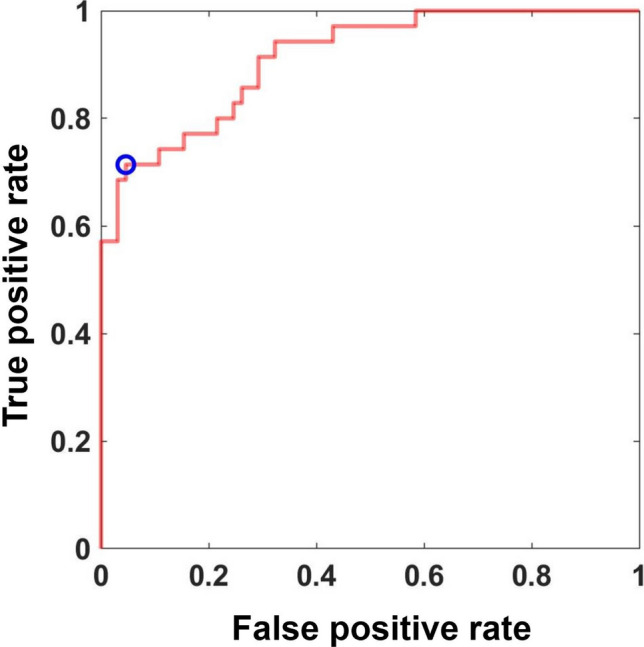
The area under the curves (AUCs) of the pred-score and OSTA score were 0.626-0.875 and 0.817 across surgeons, respectively. When both scores were used, the AUC for screening osteoporosis ranged from 0.821 to 0.915 across surgeons. Significant improvement from AUCs calculated with the pred-score or OSTA score was found in 11 surgeons (73.3%).
The combination of X-ray assessment and OSTA can be used to screen for osteoporosis and has the potential to be used as a new simple screening tool in daily clinical practice.
由于许多骨质疏松症患者仍未被诊断出来,我们旨在开发一种简单的方法,通过结合前后位髋部X线评估和亚洲人骨质疏松自我评估工具(OSTA)来有效筛查骨质疏松症,OSTA的计算方法为(体重-年龄)×0.2。
纳入100名接受髋部手术、前后位髋部X线检查和双能X线吸收法(DXA)检查的日本女性(年龄:73±11岁,体重:54.4±11.1kg)。根据股骨近端的DXA结果,35例被诊断为骨质疏松症。15名骨科医生对髋部X线图像进行了目视检查,并以1-4分的量表对骨质疏松症的可疑程度进行评分(1分:极不可能,4分:高度可疑),这被称为“预评分”。此外,OSTA被计算为一个连续变量(OSTA评分)。使用预评分和OSTA评分对骨质疏松症进行筛查,并使用受试者工作特征曲线对这两个评分进行分析。
预评分和OSTA评分的曲线下面积(AUC)在不同医生之间分别为0.626-0.875和0.817。当同时使用这两个评分时,不同医生筛查骨质疏松症的AUC范围为0.821至0.915。11名医生(73.3%)发现与使用预评分或OSTA评分计算的AUC相比有显著改善。
X线评估和OSTA的联合应用可用于筛查骨质疏松症,有潜力在日常临床实践中作为一种新的简单筛查工具使用。