Guo Ziyu, Poudel Chetan, Sarfatis Margaret C, Yu Jiangbo, Wong Madeline, Chiu Daniel T, Vaughan Joshua C
Department of Chemistry, University of Washington, Seattle, WA 98195, USA.
Lamprogen Inc., Bothell, WA 98021, USA.
Sci Adv. 2024 Dec 13;10(50):eadk8829. doi: 10.1126/sciadv.adk8829. Epub 2024 Dec 11.
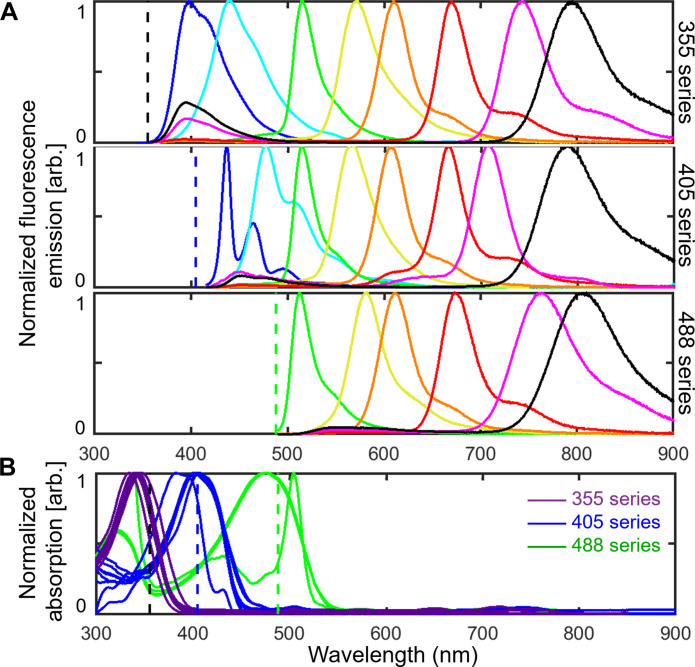
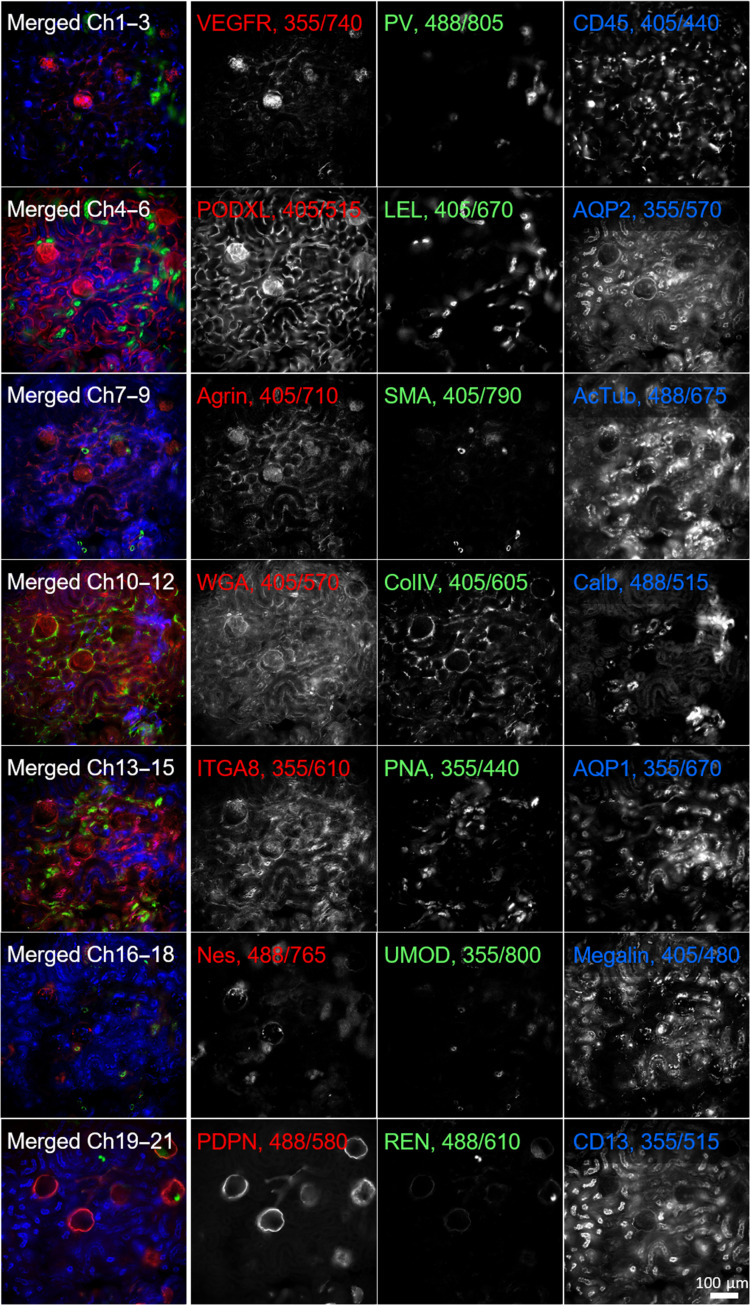
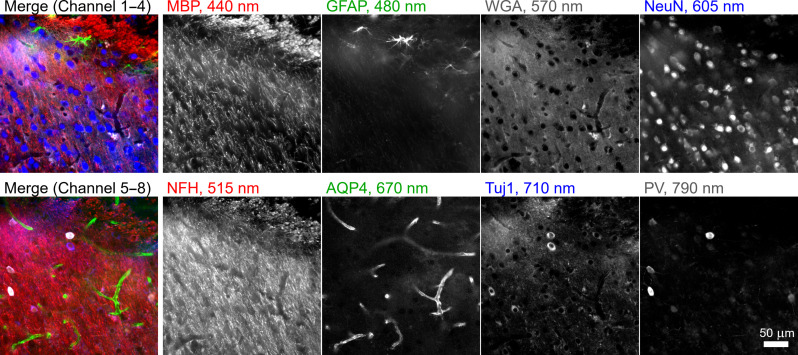
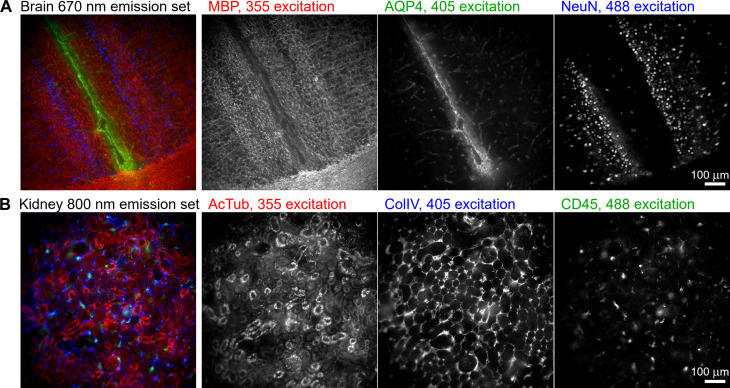
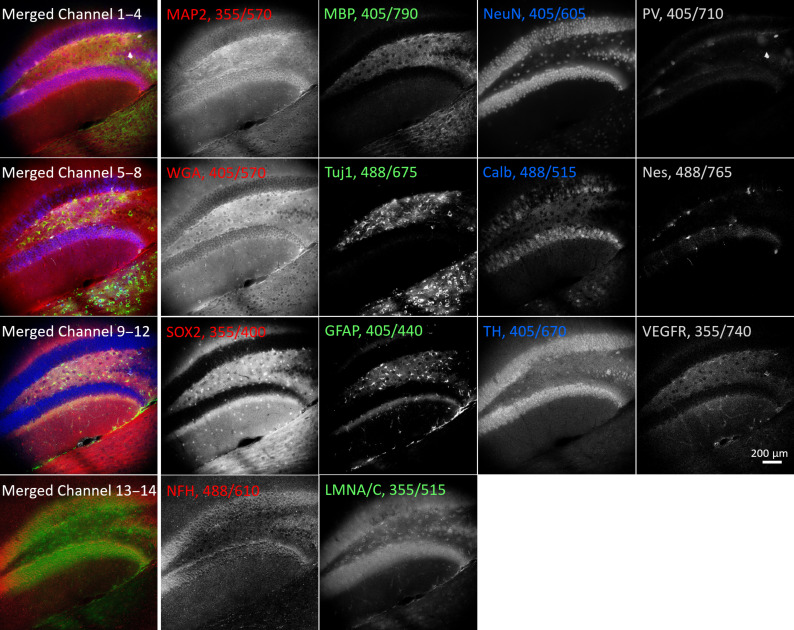
Current studies of biological tissues require visualizing diverse cell types and molecular interactions, creating a growing need for versatile techniques to simultaneously probe numerous targets. Traditional multiplexed imaging is limited to around five targets at once. Emerging methods using sequential rounds of staining, imaging, and signal removal can probe tens of targets but require specialized hardware and time-consuming workflows and face challenges with sample distortion and artifacts. We present a highly multiplexed fluorescence microscopy method using semiconducting polymer dots (Pdots) in a single round of staining and imaging. Pdots are small, bright, and photostable fluorescent probes with a wide range of tunable Stokes shifts (20 to 450 nanometers). Multiple series of Pdots with varying excitation wavelengths allow for fast (<1 minute) and single-round imaging of up to 21 targets in the brain and kidney. This method is based on a simple immunofluorescence workflow, efficient use of spectral space, standard hardware, and straightforward analysis, making it widely applicable for bioimaging laboratories.
目前对生物组织的研究需要可视化多种细胞类型和分子相互作用,这使得对能够同时探测众多靶点的通用技术的需求日益增长。传统的多重成像一次只能检测大约五个靶点。新兴的方法通过多轮染色、成像和信号去除,可以探测数十个靶点,但需要专门的硬件和耗时的工作流程,并且面临样本失真和伪影的挑战。我们提出了一种高度多重荧光显微镜方法,在单轮染色和成像中使用半导体聚合物点(Pdots)。Pdots是小而亮且光稳定的荧光探针,具有广泛可调的斯托克斯位移(20至450纳米)。多系列具有不同激发波长的Pdots能够在大脑和肾脏中对多达21个靶点进行快速(<1分钟)单轮成像。该方法基于简单的免疫荧光工作流程、对光谱空间的有效利用、标准硬件和直接的分析,使其广泛适用于生物成像实验室。