Avanzi Quentin, Lisart Léon, Detrain Claire
Unit of Social Ecology, Université Libre de Bruxelles, Brussels, Belgium.
R Soc Open Sci. 2024 Dec 11;11(12):240764. doi: 10.1098/rsos.240764. eCollection 2024 Dec.
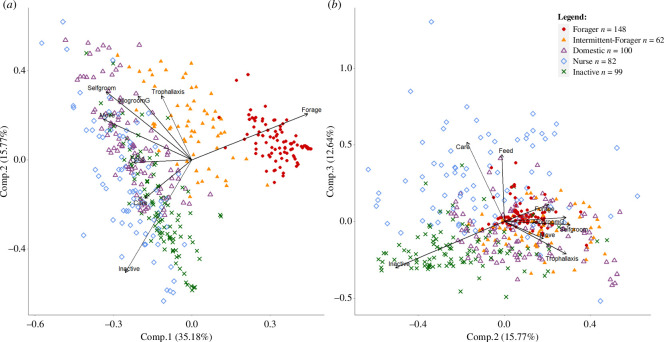
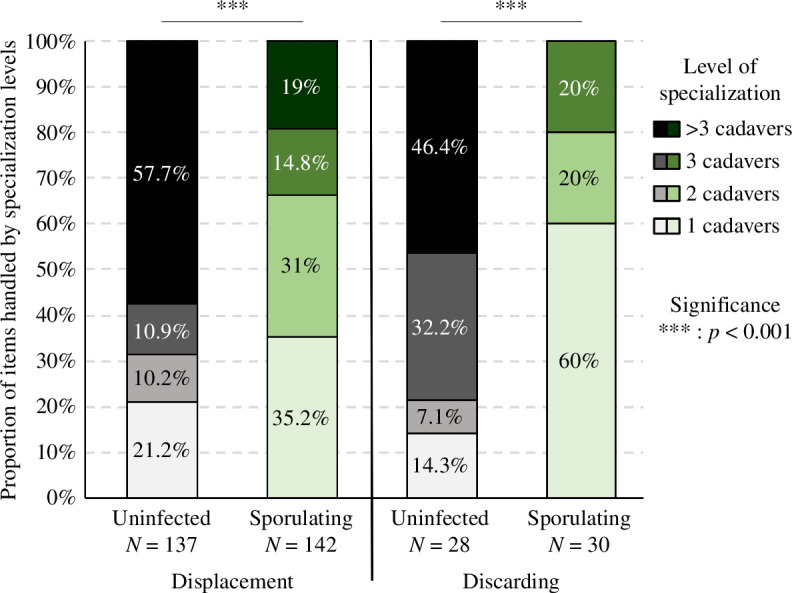
Insect societies, which are at a high risk of disease outbreaks, have evolved sanitary strategies that contribute to their social immunity. Here, we investigated in the red ant how the discarding of nestmate cadavers is socially organized depending on the associated pathogenicity. We examined whether necrophoresis is carried out by a specific functional group of workers or by any nestmates that may become short-term specialists. By observing the behavioural profiles of tagged individuals, we assigned half of the colony members to functional groups (foragers, intermittent-foragers, domestics, nurses and inactives). Following the introduction of uninfected or sporulating corpses into the nest, intermittent-foragers were the functional group most involved in necrophoresis, as they touched, moved and discarded more cadavers. Interestingly, sporulating corpses induced a more generalized response in workers from all functional groups, thereby accelerating their rejection from the nest. The individuals contacting corpses were also prophylactically engaged in more grooming behaviour, suggesting the existence of hygienist workers within ant colonies. These findings raise questions about a trade-off existing between concentrating health risks on a few workers who are highly specialized in necrophoresis and exposing a larger population of nestmates who cooperate to speed up nest sanitization.
昆虫群体面临着疾病爆发的高风险,它们进化出了有助于群体免疫的卫生策略。在此,我们以红蚁为研究对象,探究了根据巢伴尸体的致病相关程度,其尸体丢弃行为是如何进行社会分工组织的。我们研究了尸体搬运行为是由特定功能组的工蚁执行,还是由可能成为短期专家的任何巢伴执行。通过观察标记个体的行为特征,我们将蚁群成员的一半分配到功能组(觅食者、间歇性觅食者、内勤蚁、护理蚁和不活跃者)。在将未感染或带有孢子的尸体引入蚁巢后,间歇性觅食者是参与尸体搬运行为最多的功能组,因为它们触碰、移动和丢弃的尸体更多。有趣的是,带有孢子的尸体在所有功能组的工蚁中引发了更广泛的反应,从而加速了它们将尸体从蚁巢中移除。接触尸体的个体也预防性地增加了清洁行为,这表明蚁群中存在卫生员工蚁。这些发现引发了一个问题,即在将健康风险集中于少数高度专业化执行尸体搬运行为的工蚁,与让更多合作以加速蚁巢卫生清理的巢伴暴露于风险之间,是否存在权衡取舍。