Beuse Ansgar, Wenzel Daniel Alexander, Spitzer Martin Stephan, Bartz-Schmidt Karl Ulrich, Schultheiss Maximilian, Poli Sven, Grohmann Carsten
Department of Ophthalmology, University Medical Center Hamburg-Eppendorf, Hamburg, Germany.
University Eye Hospital, Centre for Ophthalmology, University Hospital Tübingen, Tübingen, Germany.
Ophthalmol Sci. 2024 Oct 16;5(2):100630. doi: 10.1016/j.xops.2024.100630. eCollection 2025 Mar-Apr.
To demonstrate the capability of a deep learning model to detect central retinal artery occlusion (CRAO), a retinal pathology with significant clinical urgency, using OCT data.
Retrospective, external validation study analyzing OCT and clinical baseline data of 2 institutions via deep learning classification analysis.
Patients presenting to the University Medical Center Tübingen and the University Medical Center Hamburg-Eppendorf in Germany.
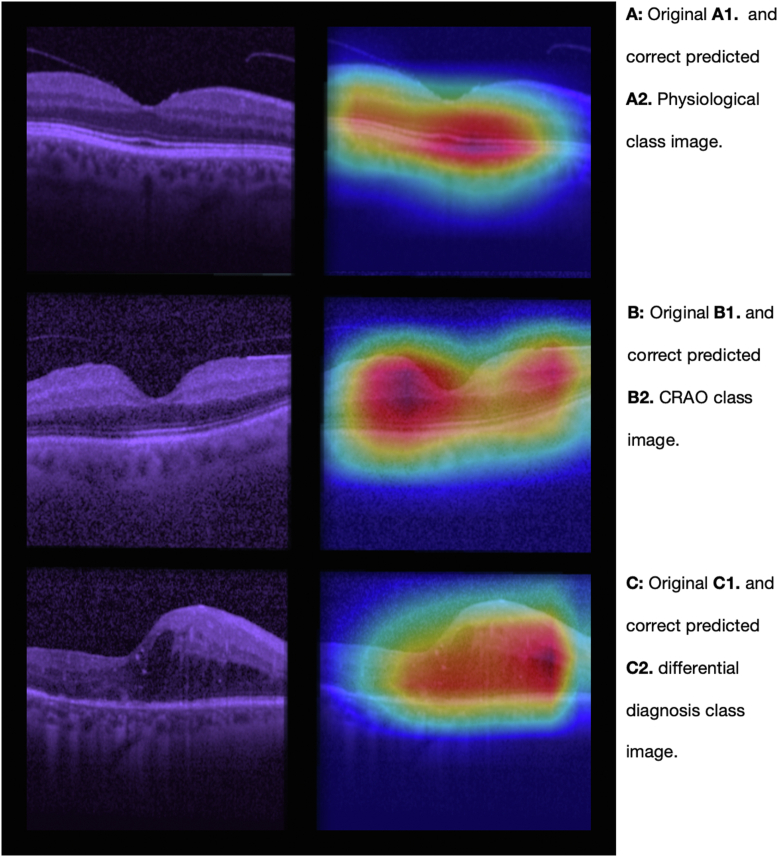
OCT data of patients suffering from CRAO, differential diagnosis with (sub) acute visual loss (central retinal vein occlusion, diabetic macular edema, nonarteritic ischemic optic neuropathy), and from controls were expertly graded and distinguished into 3 groups. Our methodological approach involved a nested multiclass five fold cross-validation classification scheme.
Area under the curve (AUC).
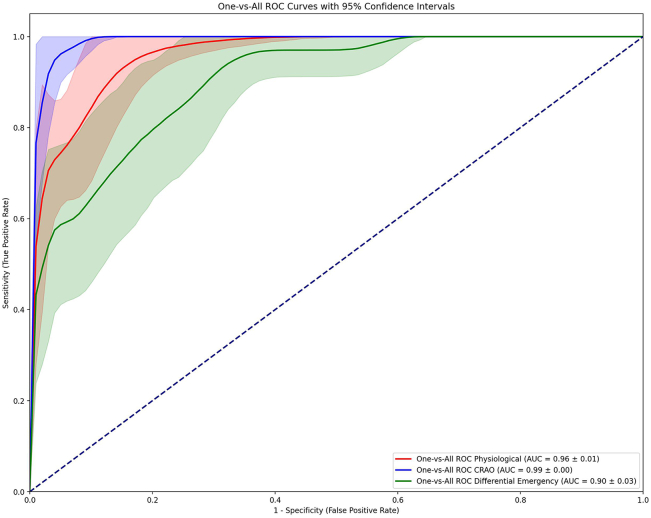
The optimal performance of our algorithm was observed using 30 epochs, complemented by an early stopping mechanism to prevent overfitting. Our model followed a multiclass approach, distinguishing among the 3 different classes: control, CRAO, and differential diagnoses. The evaluation was conducted by the "one vs. all" area under the receiver operating characteristics curve (AUC) method. The results demonstrated AUC of 0.96 (95% confidence interval [CI], ± 0.01); 0.99 (95% CI, ± 0.00); and 0.90 (95% CI, ± 0.03) for each class, respectively.
Our machine learning algorithm (MLA) exhibited a high AUC, as well as sensitivity and specificity in detecting CRAO and the differential classes, respectively. These findings underscore the potential for deploying MLAs in the identification of less common etiologies within an acute emergency clinical setting.
Proprietary or commercial disclosure may be found in the Footnotes and Disclosures at the end of this article.
利用光学相干断层扫描(OCT)数据,证明深度学习模型检测视网膜中央动脉阻塞(CRAO)的能力,CRAO是一种具有重大临床紧迫性的视网膜病变。
通过深度学习分类分析对两个机构的OCT和临床基线数据进行回顾性外部验证研究。
德国图宾根大学医学中心和汉堡-埃彭多夫大学医学中心的患者。
对患有CRAO、伴有(亚)急性视力丧失的鉴别诊断(视网膜中央静脉阻塞、糖尿病性黄斑水肿、非动脉性缺血性视神经病变)的患者以及对照组的OCT数据进行专业分级,并分为3组。我们的方法采用了嵌套多类五折交叉验证分类方案。
曲线下面积(AUC)。
使用30个轮次观察到我们算法的最佳性能,并辅以早期停止机制以防止过拟合。我们的模型采用多类方法,区分3种不同类别:对照组、CRAO组和鉴别诊断组。通过“一对所有”的受试者操作特征曲线(AUC)下面积方法进行评估。结果显示,每组的AUC分别为0.96(95%置信区间[CI],±0.01);0.99(95%CI,±0.00);和0.90(95%CI,±0.03)。
我们的机器学习算法(MLA)在检测CRAO及其鉴别类别时分别表现出高AUC以及敏感性和特异性。这些发现强调了在急性紧急临床环境中部署MLA以识别罕见病因的潜力。
专有或商业披露信息可在本文末尾的脚注和披露部分中找到。