Dixon Laura E, Hodge Sarah K, van Ooijen Gerben, Troein Carl, Akman Ozgur E, Millar Andrew J
SynthSys, University of Edinburgh, Kings Buildings, Mayfield Road, Edinburgh, EH9 3JD, UK.
Department of Crop Genetics, John Innes Centre, Norwich Research Park, Norwich, NR4 7UH, UK.
New Phytol. 2014 Jul;203(2):568-577. doi: 10.1111/nph.12853. Epub 2014 May 20.
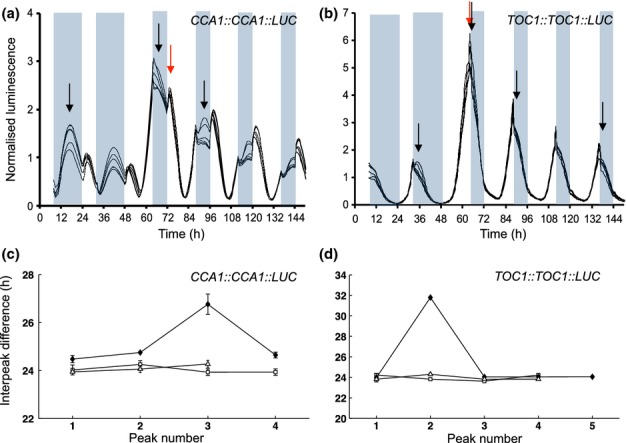
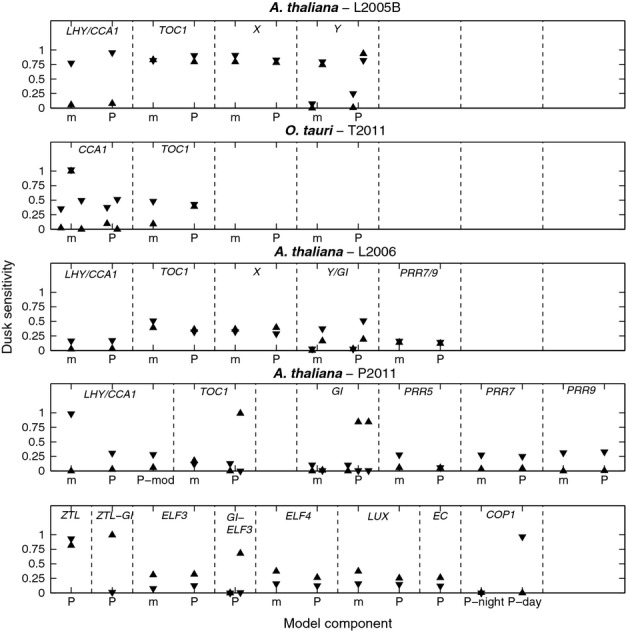
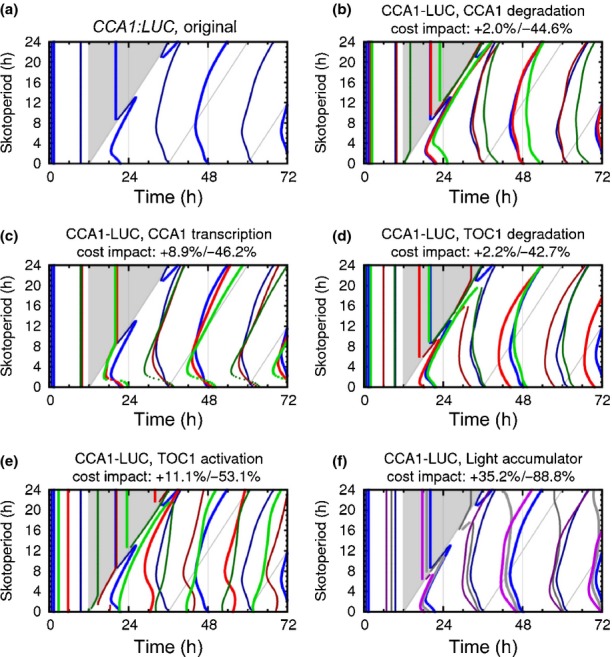
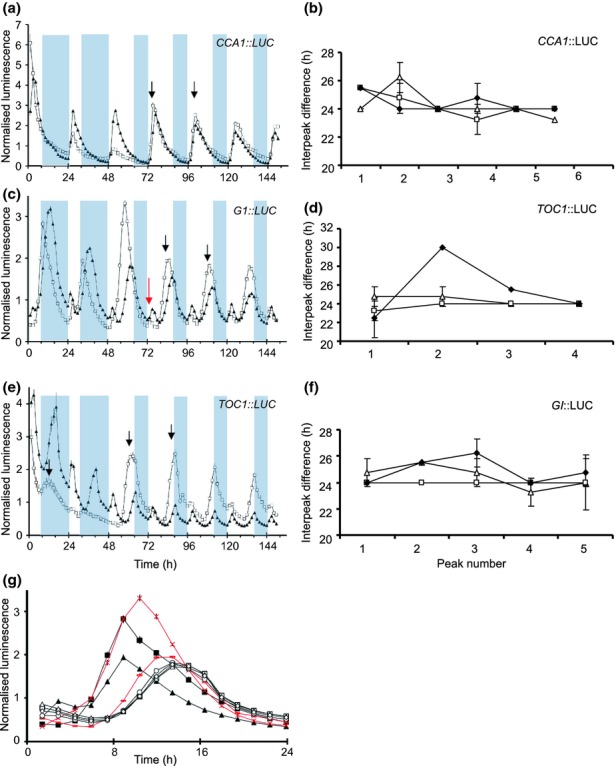
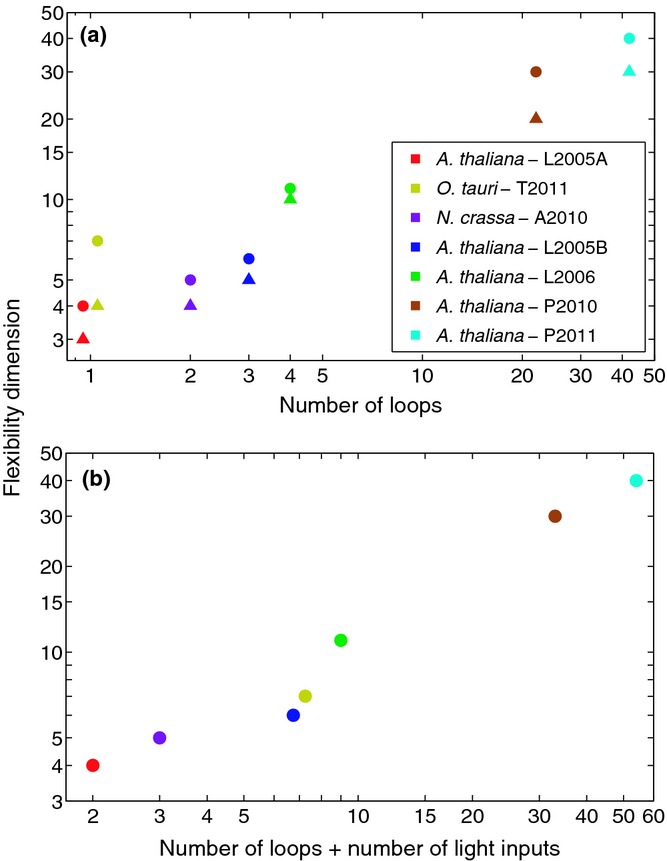
The circadian clock measures time across a 24 h period, increasing fitness by phasing biological processes to the most appropriate time of day. The interlocking feedback loop mechanism of the clock is conserved across species; however, the number of loops varies. Mathematical and computational analyses have suggested that loop complexity affects the overall flexibility of the oscillator, including its responses to entrainment signals. We used a discriminating experimental assay, at the transition between different photoperiods, in order to test this proposal in a minimal circadian network (in Ostreococcus tauri) and a more complex network (in Arabidopsis thaliana). Transcriptional and translational reporters in O. tauri primarily tracked dawn or dusk, whereas in A. thaliana, a wider range of responses were observed, consistent with its more flexible clock. Model analysis supported the requirement for this diversity of responses among the components of the more complex network. However, these and earlier data showed that the O. tauri network retains surprising flexibility, despite its simple circuit. We found that models constructed from experimental data can show flexibility either from multiple loops and/or from multiple light inputs. Our results suggest that O. tauri has adopted the latter strategy, possibly as a consequence of genomic reduction.
昼夜节律时钟以24小时为周期计量时间,通过使生物过程与一天中最合适的时间同步来提高适应性。时钟的连锁反馈回路机制在物种间是保守的;然而,回路的数量有所不同。数学和计算分析表明,回路复杂性会影响振荡器的整体灵活性,包括其对同步信号的响应。我们采用了一种有区分性的实验测定方法,在不同光周期的转换阶段,以便在一个最小的昼夜节律网络(在莱茵衣藻中)和一个更复杂的网络(在拟南芥中)中检验这一假设。莱茵衣藻中的转录和翻译报告基因主要追踪黎明或黄昏,而在拟南芥中,观察到了更广泛的响应,这与其更灵活的时钟一致。模型分析支持了更复杂网络的组成部分之间存在这种多样响应的必要性。然而,这些以及早期的数据表明,尽管莱茵衣藻的网络回路简单,但它仍保留了惊人的灵活性。我们发现,根据实验数据构建的模型可以通过多个回路和/或多个光输入来展现灵活性。我们的结果表明,莱茵衣藻采用了后一种策略,这可能是基因组简化的结果。