Zhang Shuai, Zhao Yanan, Qin Zongshi, Han Ying, He Jiakai, Zhao Bin, Wang Lei, Duan Yuting, Huo Jin, Wang Tuoran, Wang Yu, Rong Peijing
Institute of Acupuncture and Moxibustion, China Academy of Chinese Medical Sciences, Beijing, China.
Department of Geriatrics, Dongzhimen Hospital, Beijing University of Chinese Medicine, Beijing, China.
JAMA Netw Open. 2024 Dec 2;7(12):e2451217. doi: 10.1001/jamanetworkopen.2024.51217.
Evidence from randomized clinical trials of transcutaneous auricular vagus nerve stimulation (taVNS) for chronic insomnia disorder is lacking.
To evaluate the efficacy and safety of taVNS for chronic insomnia compared with the sham taVNS.
DESIGN, SETTING, AND PARTICIPANTS: This randomized clinical trial was conducted from October 2021 to December 2022 at a single center in Beijing, China. Patients with chronic insomnia disorder with a Pittsburgh Sleep Quality Index (PSQI) of at least 8 were enrolled. Statistical analysis was performed from June to September 2023.
Patients were allocated to the active taVNS group or sham taVNS group with a 1:1 ratio. Both groups received the stimulation for 30 minutes each time, twice a day, 5 consecutive days a week, with an 8-week treatment and a 12-week follow-up.
The primary end point was the mean change from baseline through week 8 in PSQI scores. Minimal clinically important difference was 2.5 points. Secondary outcomes included mental health, sleepiness, and fatigue. Safety was also evaluated.
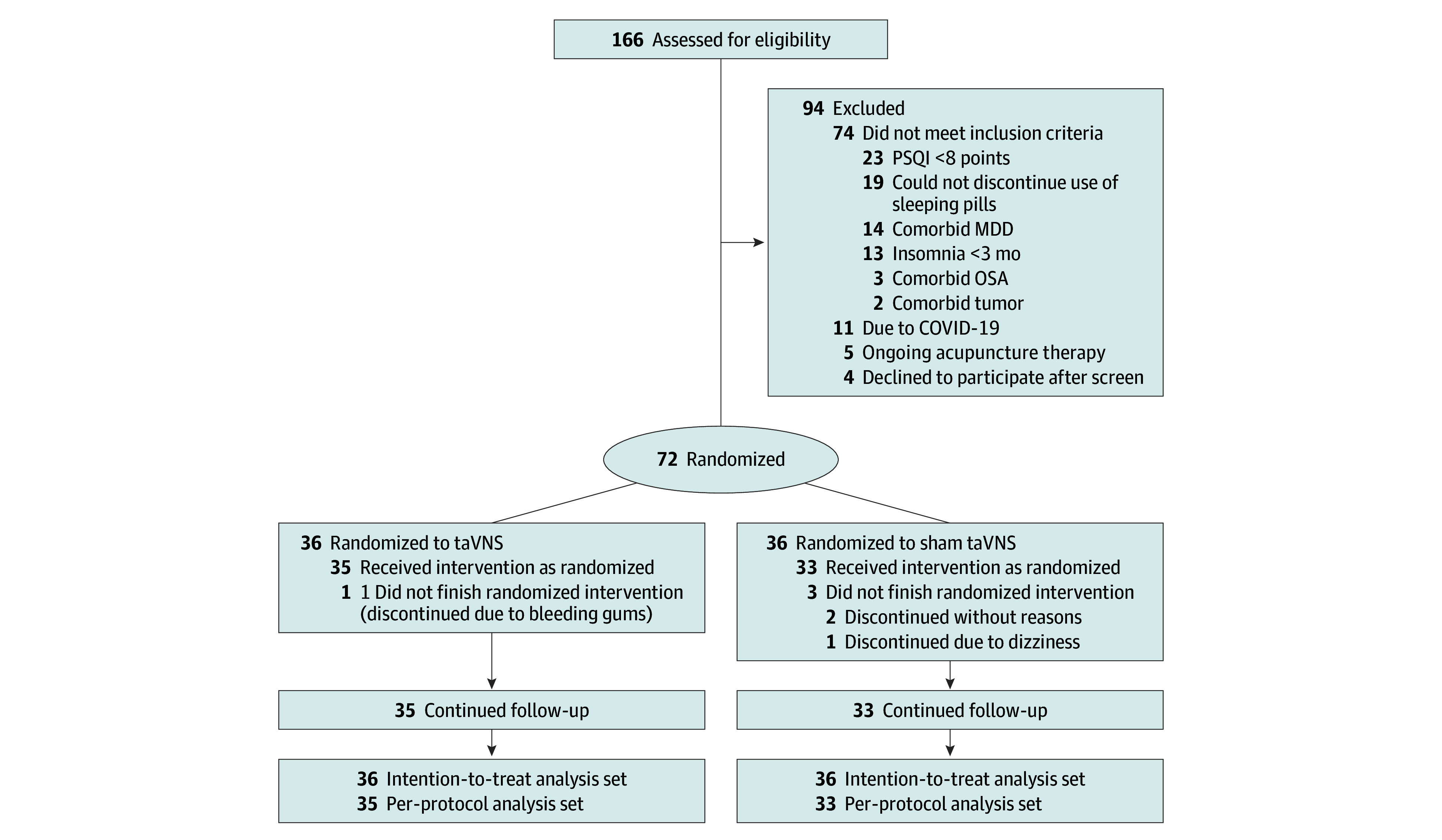
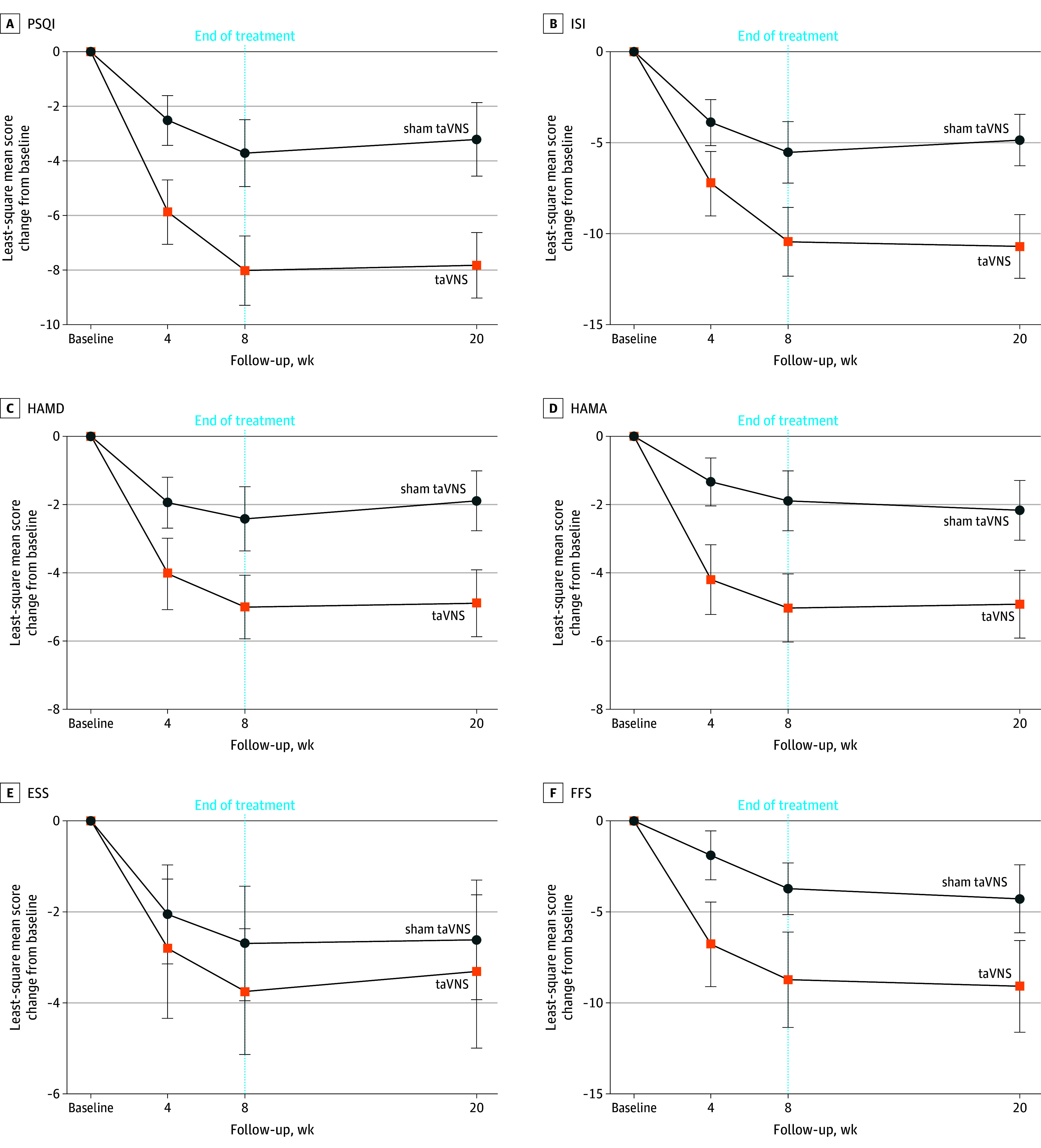
A total of 72 participants were randomized to either active taVNS group (36 participants; mean [SD] age, 45.2 [14.5] years; 27 [75.0%] female) or the sham taVNS group (36 participants; mean [SD] age, 44.6 [13.9] years; 31 [86.1%] female); 68 participants completed the 8-week intervention. The least-square mean changes from baseline to week 8 in PSQI were -8.2 (95% CI, -9.3 to -7.0) points in the taVNS group and -3.9 (95% CI, -5.1 to -2.7) points in the sham group. Both groups experienced statistically significant improvements from before to after the intervention. However, active taVNS showed a clinically meaningful 4.2-point greater reduction (95% CI, -5.9 to -2.6 points; P < .001; Cohen d effect size, 1.2) in PSQI compared with the sham group (minimal clinically important difference = 2.5 points). Secondary outcomes, including mental health and fatigue, showed similar favorable results. The efficacy of taVNS was sustained throughout the 20-week study period.
In this randomized clinical trial, taVNS significantly reduced insomnia severity. Clinically meaningful enhancements in PSQI scores were observed compared with sham stimulation, with the benefits of taVNS sustained over a 20-week period. Future multicenter clinical trials with large sample sizes are needed to validate its effectiveness across diverse populations.
Chinese Clinical Trial Registry: ChiCTR2100051319.
缺乏经皮耳迷走神经刺激(taVNS)治疗慢性失眠症的随机临床试验证据。
评估taVNS与假taVNS相比治疗慢性失眠的疗效和安全性。
设计、地点和参与者:这项随机临床试验于2021年10月至2022年12月在中国北京的一个中心进行。纳入匹兹堡睡眠质量指数(PSQI)至少为8分的慢性失眠症患者。于2023年6月至9月进行统计分析。
患者按1:1的比例被分配到taVNS治疗组或假taVNS组。两组每次接受刺激30分钟,每天两次,每周连续5天,进行为期8周的治疗和12周的随访。
主要终点是从基线到第8周PSQI评分的平均变化。最小临床重要差异为2.5分。次要结局包括心理健康、嗜睡和疲劳。还评估了安全性。
共有72名参与者被随机分为taVNS治疗组(36名参与者;平均[标准差]年龄,45.2[14.5]岁;27名[75.0%]女性)或假taVNS组(36名参与者;平均[标准差]年龄,44.6[13.9]岁;31名[86.1%]女性);68名参与者完成了8周的干预。taVNS组从基线到第8周PSQI的最小二乘平均变化为-8.2(95%CI,-9.3至-7.0)分,假刺激组为-3.9(95%CI,-5.1至-2.7)分。两组干预前后均有统计学意义的改善。然而,与假刺激组相比,taVNS组在PSQI上显示出临床上有意义的4.2分更大幅度的降低(95%CI,-5.9至-2.6分;P < .001;Cohen d效应量,1.2)(最小临床重要差异=2.5分)。包括心理健康和疲劳在内的次要结局显示出类似的良好结果。taVNS的疗效在整个20周的研究期间持续存在。
在这项随机临床试验中,taVNS显著降低了失眠严重程度。与假刺激相比,PSQI评分有临床上有意义的提高,且taVNS的益处持续了20周。未来需要进行多中心大样本临床试验以验证其在不同人群中的有效性。
中国临床试验注册中心:ChiCTR2100051319。