Kumar Randeep, Guleria Niraj, Deeksha Mudagadde G, Kumari Nisha, Kumar Ravendra, Jha Arun Kumar, Parmar Neha, Ganguly Pritam, de Aguiar Andrade Eloisa Helena, Ferreira Oberdan Oliveira, de Oliveira Mozaniel Santana
Department of Soil Science and Agricultural Chemistry, Bihar Agricultural University, Sabour, Bhagalpur 813210, Bihar, India.
Mountain Agricultural Research and Extension Station, CSKHPKV, Salooni 176320, Himachal Pradesh, India.
Int J Mol Sci. 2024 Nov 28;25(23):12788. doi: 10.3390/ijms252312788.
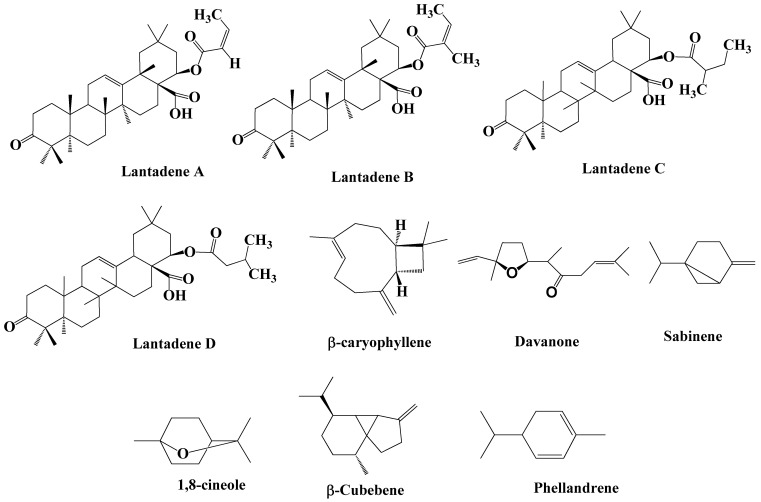
is weed with a wide range of chemical constituents, including primary and secondary metabolites such as alkaloids, flavonoids, tannins, saponins, and terpenoids. These compounds contribute to its medicinal and pesticidal potential. The essential oils and different solvent fractions derived from exhibit notable variations in their respective chemical compositions across various plant parts, spatial distributions, and interspecific comparisons. The principal components, notably lantadene A, lantadene B, lantadene C, lantadene D, β-caryophyllene, α-humulene, and several others, constitute a significant portion of the essential oil derived from the leaves and flowers. Researchers have discovered that oil exhibits potent insecticidal activity against a range of pests, with variations in potency observed across different seasons due to changes in chemical composition. In addition to the essential oils, solvent extracts of , primarily methanolic extracts of the leaves of this species, demonstrate considerable potential as fumigant and contact toxins for stored grain pests. However, these have been comparatively less characterized with respect to their insecticidal properties, particularly in comparison to the essential oils. Molecular docking studies have demonstrated that phytochemical compounds present in the plants interfere with the activity of several enzymes that are responsible for the growth and survival of insects. For example, compounds such as β-caryophyllene and linalool exhibited a high binding affinity to AChE, thereby enhancing its neurotoxic effects. In conclusion, this review identifies as a natural insecticide with a complex set of modes of action attributed to its rich phytochemical profile. The integration of traditional knowledge with modern molecular techniques might expose avenues for the sustainable management of pests and control, ultimately making a key resource for such applications. Further studies are necessary to characterize such bioactive compounds and their uses in controlling pests in agricultural operations.
杂草具有广泛的化学成分,包括生物碱、黄酮类、单宁、皂苷和萜类等主要和次生代谢产物。这些化合物赋予了它药用和杀虫潜力。从该植物提取的精油和不同溶剂提取物在不同植物部位、空间分布以及种间比较中,各自的化学成分存在显著差异。主要成分,特别是兰他定A、兰他定B、兰他定C、兰他定D、β-石竹烯、α-葎草烯等,在从叶和花中提取的精油中占很大比例。研究人员发现,该植物精油对一系列害虫具有强大的杀虫活性,由于化学成分的变化,不同季节的效力有所不同。除了精油外,该植物的溶剂提取物,主要是该物种叶片的甲醇提取物,对储粮害虫显示出作为熏蒸剂和接触毒素的巨大潜力。然而,与精油相比,这些提取物的杀虫特性相对较少被研究。分子对接研究表明,植物中存在的植物化学化合物会干扰几种负责昆虫生长和存活的酶的活性。例如,β-石竹烯和芳樟醇等化合物对乙酰胆碱酯酶具有高结合亲和力,从而增强其神经毒性作用。总之,本综述确定该植物为一种天然杀虫剂,因其丰富的植物化学特征而具有复杂的作用模式。将传统知识与现代分子技术相结合可能会为害虫的可持续管理和控制开辟途径,最终使该植物成为此类应用的关键资源。有必要进一步研究此类生物活性化合物及其在农业生产中控制害虫的用途。