Sasaki Hiraku, Suzuki Yoshio, Morimoto Kodai, Takeda Kazuyoshi, Uchida Koichiro, Iyoda Masayuki, Ishikawa Hiroki
Graduate School of Health and Sports Science, Juntendo University, Chiba 2701695, Japan.
Center for Immune Therapeutics and Diagnosis, Juntendo University, Tokyo 1138421, Japan.
Int J Mol Sci. 2024 Nov 28;25(23):12828. doi: 10.3390/ijms252312828.
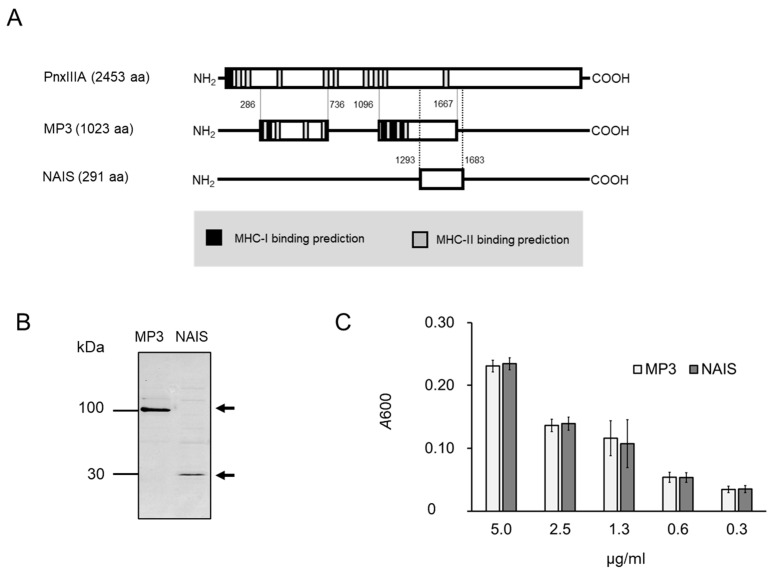
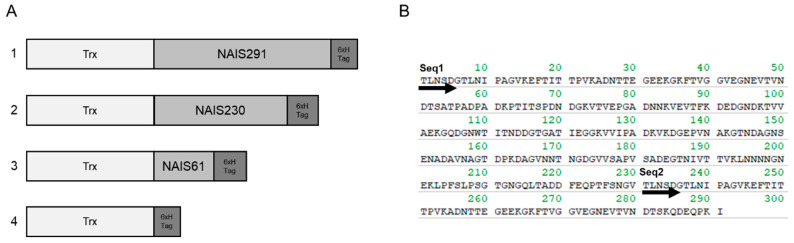
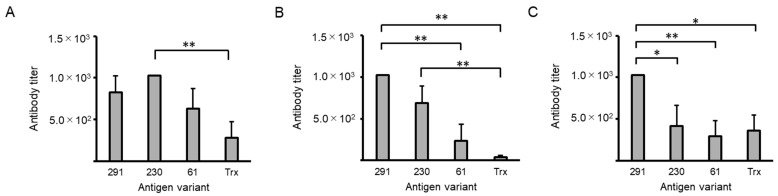
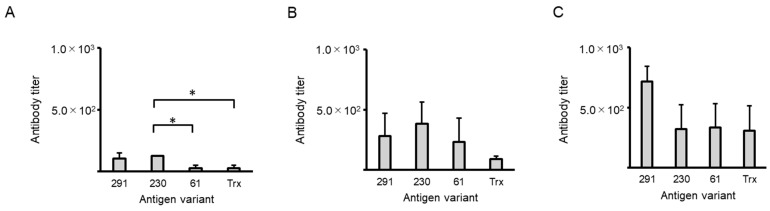
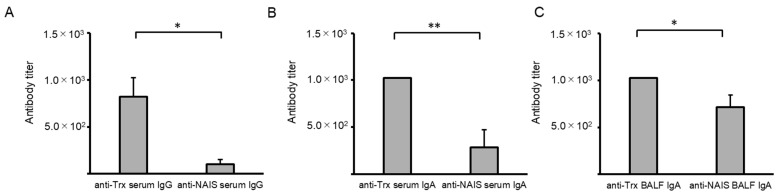
Intranasal immunization is one of the most effective methods for eliciting lung mucosal immunity. Multiple intranasal immunization with bacterial polypeptide, termed as a modified PnxIIIA (MP3) protein, is known to elicit production of a specific antibody in mice. In this study, a nasal immuno-inducible sequence (NAIS) was designed to remove the antigenicity of the MP3 protein that can induce mucosal immunity by intranasal immunization, and was examined to induce antigen-specific antibodies against the fused bacterial thioredoxin (Trx) as a model antigen. A NAIS was modified and generated to remove a large number of predicted MHC (Major Histocompatibility Complex)-I and MHC-II binding sites in parent protein PnxIIIA and MP3 in order to reduce the number of antigen epitope sites. For comparative analysis, full-length NAIS291, NAIS230, and NAIS61 fused with Trx and 6× His tag and Trx-fused 6× His tag were used as antigen variants for the intranasal immunization of BALB/c mice every two weeks for three immunizations. Anti-Trx antibody titers in serum and bronchoalveolar lavage fluid (BALF) IgA obtained from NAIS291-fused Trx-immunized mice were significantly higher than those from Trx-immunized mice. The antibody titers against NAIS alone were significantly lower than those against Trx alone in the serum IgG, serum IgA, and BALF IgA. These results indicate that the NAIS contributes to antibody elicitation of the fused antigen as an immunostimulant in intranasal vaccination vaccines. The results indicate that the NAIS and target inactivated antigen fusions can be applied to intranasal vaccine systems.
鼻内免疫是引发肺部黏膜免疫的最有效方法之一。用细菌多肽(称为修饰的PnxIIIA,即MP3蛋白)进行多次鼻内免疫已知可在小鼠体内引发特异性抗体的产生。在本研究中,设计了一种鼻内免疫诱导序列(NAIS),以去除可通过鼻内免疫诱导黏膜免疫的MP3蛋白的抗原性,并检测其诱导针对融合的细菌硫氧还蛋白(Trx)作为模型抗原的抗原特异性抗体的能力。对NAIS进行修饰和改造,以去除亲本蛋白PnxIIIA和MP3中大量预测的主要组织相容性复合体(MHC)-I和MHC-II结合位点,从而减少抗原表位的数量。为了进行比较分析,将与Trx和6×His标签融合的全长NAIS291、NAIS230和NAIS61以及Trx融合的6×His标签用作抗原变体,每两周对BALB/c小鼠进行一次鼻内免疫,共免疫三次。从用NAIS291融合Trx免疫的小鼠获得的血清和支气管肺泡灌洗液(BALF)IgA中的抗Trx抗体滴度显著高于用Trx免疫的小鼠。在血清IgG、血清IgA和BALF IgA中,单独针对NAIS的抗体滴度显著低于单独针对Trx的抗体滴度。这些结果表明,NAIS作为鼻内疫苗接种中的免疫刺激剂有助于融合抗原的抗体引发。结果表明,NAIS与靶标灭活抗原融合物可应用于鼻内疫苗系统。