Strengell Satu, Larjavaara Suvi, Tenhunen Mikko, Anttonen Anu
Comprehensive Cancer Center, Helsinki University Central Hospital, PL180, 00029 HUS, Finland.
Phys Imaging Radiat Oncol. 2024 Nov 26;32:100682. doi: 10.1016/j.phro.2024.100682. eCollection 2024 Oct.
Radiotherapy (RT) treatment planning is based on a planning computed tomography scan (pCT), while the decision to treat is often already established on a diagnostic CT scan (dCT). The objective of this study was to evaluate the usage of dCT for palliative radiation planning of soft tissue tumoral masses (STTMs), removing the need for a pCT scan and associated attendances.
RT planning was performed retrospectively to 38 STTMs of 7 anatomical sites using volumetric modulated arc therapy techniques in dCT and transferred to pCT. The dose of clinical target volumes (CTV), D(95 %,50 %), were compared between the plans. The patient setup was assessed in cone-beam CT scans.
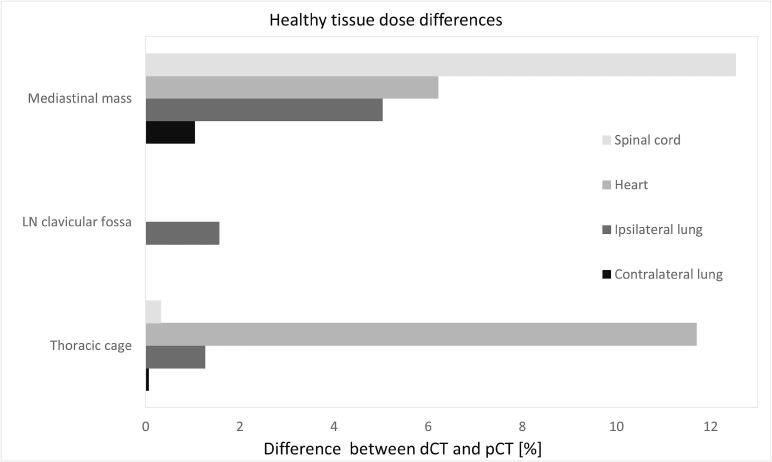
The differences of D(95 %,50 %) between dCT and pCT plans were the lowest in the STTMs of the thoracic cage (0.9 %,0.9 %), STTMs in the inguinal area (0.8 %,1.3 %) and in mediastinal masses associated with superior vena cava syndrome (SVCS) (1.1 %,1.3 %), while the differences increased for other sites. The patient setup was acceptable for 88 % of mediastinal masses associated with SVCS and ≤ 60 % of cases in other sites comparing pCT and CBCT images with a strict margin of 6 mm, but all cases fitted to increased 2 cm margin.
This study demonstrated the possibility of using dCT scans for palliative RT planning of STTMs for mediastinal masses associated with SVCS and for STTMs in the thoracic cage and in the inguinal area, indicating the potential feasibility of this procedure for clinical use.
放射治疗(RT)治疗计划基于计划计算机断层扫描(pCT),而治疗决策通常在诊断CT扫描(dCT)时就已确定。本研究的目的是评估dCT在软组织肿瘤肿块(STTM)姑息性放射治疗计划中的应用,从而无需进行pCT扫描及相关就诊。
回顾性地对7个解剖部位的38个STTM进行RT计划,使用容积调强弧形治疗技术在dCT上进行,并将计划转移至pCT。比较各计划中临床靶体积(CTV)的剂量D(95%,50%)。在锥形束CT扫描中评估患者摆位。
dCT和pCT计划之间D(95%,50%)的差异在胸廓的STTM(0.9%,0.9%)、腹股沟区的STTM(0.8%,1.3%)以及与上腔静脉综合征(SVCS)相关的纵隔肿块中最低(1.1%,1.3%),而其他部位的差异则增大。将pCT和CBCT图像以6mm的严格边界进行比较时,88%与SVCS相关的纵隔肿块患者摆位可接受,其他部位≤60%的病例摆位可接受,但所有病例在边界增加到2cm时均合适。
本研究证明了对于与SVCS相关的纵隔肿块以及胸廓和腹股沟区的STTM,使用dCT扫描进行姑息性RT计划的可能性,表明该程序在临床应用中的潜在可行性。