Mishra SukhDev, Avinash G, Kundu Madan G, Verma Jyotsna, Sheth Ankit, Dutta Abhijit
Department of Biostatistics, Division of Health Sciences, ICMR-National Institute of Occupational Health, Ahmedabad, Gujarat, India.
Department of Biostatistics, Daiichi-Sankyo Inc, Basking Ridge, New Jersey, United States.
J Occup Health. 2024 Jan 4;67(1). doi: 10.1093/joccuh/uiae077.
Work-related musculoskeletal disorders (WMSDs) are among the most common occupational diseases, affecting various sectors such as agriculture, small-scale industries, handicrafts, construction, and banking. These disorders, caused by overexertion and repetitive motion, lead to work absenteeism, productivity loss, and economic impacts. The aim of the study was to determine the magnitude of musculoskeletal disorders among different occupational workers in India.
We identified studies reporting the prevalence of WMSDs using the Nordic Musculoskeletal Questionnaire in different databases between 2005 and 2023 through searches on SCOPUS, PubMed Central, and Google Scholar. The required information was then extracted. A random effects model was used to pool estimates of prevalence with 95% CIs. Publication bias was assessed by applying funnel plots.
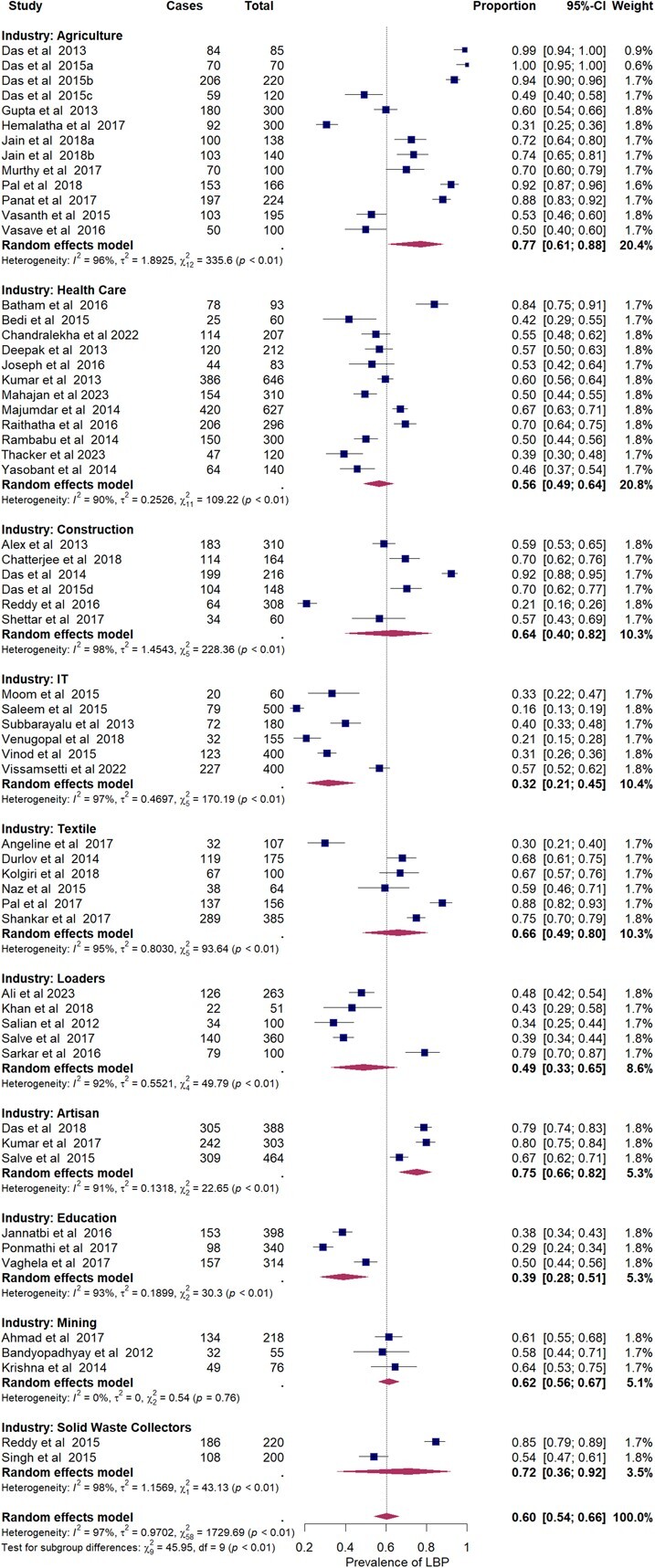
The 12-month prevalence of WMSDs was reported across several occupational groups, and the meta or the pooled prevalence was estimated as 0.76 (95% CI, 0.70 to 0.82) along with substantial variability in the prevalence estimates between different industries and studies. The meta-prevalence for low back pain was estimated as 0.60 (95% CI, 0.54 to 0.66). The meta-prevalence for neck pain was estimated as 0.40 (95% CI, 0.34 to 0.47) whereas for shoulder pain it was estimated as 0.36 (95% CI, 0.30 to 0.42), respectively. The risk of bias was statistically nonsignificant, and overall publication bias was low as per visual inspections from funnel plots.
WMSDs are prevalent across various Indian industries in significant proportions, particularly in agriculture, health care, and mining, leading to significant productivity loss and economic impact. The variation in prevalence highlights the need for sector-specific interventions. Addressing WMSDs requires comprehensive ergonomic and policy measures. Effective strategies are essential to mitigate these disorders' widespread impact.
与工作相关的肌肉骨骼疾病(WMSDs)是最常见的职业病之一,影响农业、小规模工业、手工业、建筑业和银行业等多个行业。这些疾病由过度劳累和重复动作引起,导致旷工、生产力损失和经济影响。本研究的目的是确定印度不同职业工人中肌肉骨骼疾病的严重程度。
我们通过在SCOPUS、PubMed Central和谷歌学术上搜索,确定了2005年至2023年期间在不同数据库中使用北欧肌肉骨骼问卷报告WMSDs患病率的研究。然后提取所需信息。使用随机效应模型汇总患病率估计值及95%置信区间。通过应用漏斗图评估发表偏倚。
报告了多个职业群体中WMSDs的12个月患病率,汇总患病率估计为0.76(95%置信区间,0.70至0.82),不同行业和研究之间的患病率估计存在很大差异。腰痛的汇总患病率估计为0.60(95%置信区间,0.54至0.66)。颈部疼痛的汇总患病率估计为0.40(95%置信区间,0.34至0.47),而肩部疼痛的汇总患病率估计分别为0.36(95%置信区间,0.30至0.42)。偏倚风险在统计学上不显著,根据漏斗图的视觉检查,总体发表偏倚较低。
WMSDs在印度各行业中普遍存在,比例相当高,特别是在农业、医疗保健和采矿业,导致显著的生产力损失和经济影响。患病率的差异凸显了针对特定部门进行干预的必要性。解决WMSDs需要全面的人体工程学和政策措施。有效的策略对于减轻这些疾病的广泛影响至关重要。