• 文献检索
  • 文档翻译
  • 深度研究
  • 学术资讯
  • Suppr Zotero 插件Zotero 插件
  • 邀请有礼
  • 套餐&价格
  • 历史记录
应用&插件
Suppr Zotero 插件Zotero 插件浏览器插件Mac 客户端Windows 客户端微信小程序
定价
高级版会员购买积分包购买API积分包
服务
文献检索文档翻译深度研究API 文档MCP 服务
关于我们
关于 Suppr公司介绍联系我们用户协议隐私条款
关注我们

Suppr 超能文献

核心技术专利:CN118964589B侵权必究
粤ICP备2023148730 号-1Suppr @ 2026

文献检索

告别复杂PubMed语法,用中文像聊天一样搜索,搜遍4000万医学文献。AI智能推荐,让科研检索更轻松。

立即免费搜索

文件翻译

保留排版,准确专业,支持PDF/Word/PPT等文件格式,支持 12+语言互译。

免费翻译文档

深度研究

AI帮你快速写综述,25分钟生成高质量综述,智能提取关键信息,辅助科研写作。

立即免费体验

探索乌干达难民营环境中女性基于性别的暴力观念与经历——一项定性研究

Exploring perceptions and experiences of gender-based violence among women in a refugee camp setting in Uganda-A qualitative study.

作者信息

Lukasiak Miriam, Palmieri Jack, Svensson Pia, Tumwine Gilbert, Agardh Anette

机构信息

Department of Clinical Sciences, Social Medicine and Global Health, Lund University, Malmö, Sweden.

Department of Obstetrics and Gynecology, St. Francis Hospital Nsambya, Kampala, Uganda.

出版信息

PLoS One. 2024 Dec 17;19(12):e0314972. doi: 10.1371/journal.pone.0314972. eCollection 2024.

DOI:10.1371/journal.pone.0314972
PMID:39689085
原文链接:https://pmc.ncbi.nlm.nih.gov/articles/PMC11651565/
Abstract

BACKGROUND

Gender-based violence (GBV) is an internationally widespread human rights and public health issue, known to be exacerbated and underreported in humanitarian settings and among conflict-affected populations. A combination of factors including increased vulnerability, lack of protection and marginalization are believed to increase the risk for GBV in settings such as displacement and refugee camps. An increased understanding of GBV in these populations is needed to inform and improve future policy changes and interventions. This qualitative study sought to explore women's perceptions and experiences of GBV in a refugee camp setting in Uganda to increase the understanding of the dynamics and risk contexts of GBV in the context of displacement and refugee camps.

METHODS

This was a qualitative study based on individual semi-structured interviews and content analysis. The interviews were conducted during October 2023 with women living in a refugee camp setting in Western Uganda. The participants (N = 13) included female refugees, residing in the refugee camp, above eighteen years of age and who were survivors of GBV.

RESULTS

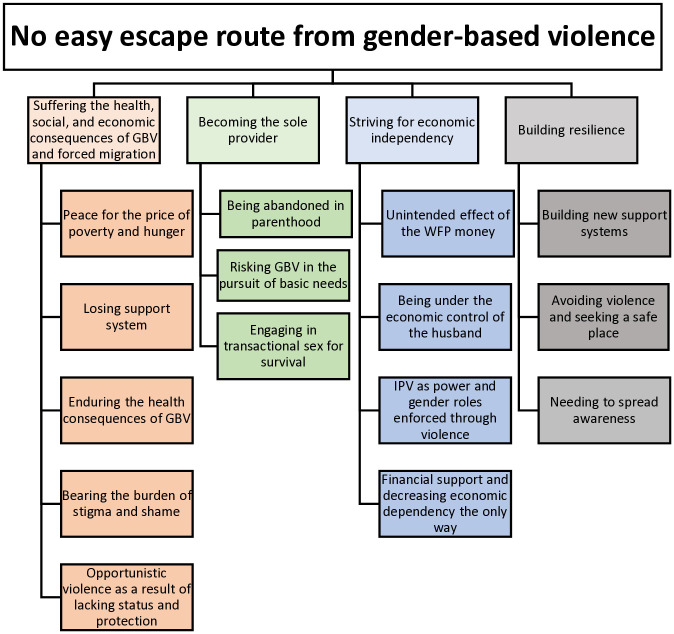
Findings showed no easy escape route from gender-based violence, with a high exposure to GBV throughout the refugee experience. The nature of GBV, the perpetrators and risk contexts however seemed to shift throughout the process from conflict to the refugee camp. Increased marginalization and lack of resources compounded by a shift in gender roles in the refugee camp where women seemed to assume the role of the primary provider increased the risk of violence in pursuit of basic needs. Women described extensive intimate partner violence (IPV) in the camp often connected to new gendered power dynamics and the control of resources. Faced with the struggles of migration, marginalization, and GBV, women displayed various coping mechanisms including rebuilding networks and support systems.

CONCLUSIONS

Our study showed the complexity of GBV in settings such as refugee camps, where various structural and individual changes involved in migration and life in a refugee camp seemed to create new risk contexts for GBV both inside and outside of the household. Interventions across various dimensions including addressing underlying conditions of marginalization and gendered power dynamics are therefore warranted to address GBV in refugee camps. Further research is essential to better understand this complex issue, as well as the perception and effectiveness of services and interventions in place.

摘要

背景

基于性别的暴力(GBV)是一个在国际上广泛存在的人权和公共卫生问题,在人道主义环境以及受冲突影响的人群中,该问题被认为更为严重且报告不足。包括脆弱性增加、缺乏保护和边缘化在内的多种因素,被认为会增加流离失所和难民营等环境中基于性别的暴力风险。需要加深对这些人群中基于性别的暴力的理解,以为未来的政策变化和干预措施提供信息并加以改进。这项定性研究旨在探索乌干达一个难民营环境中妇女对基于性别的暴力的认知和经历,以增进对流离失所和难民营背景下基于性别的暴力动态及风险情况的理解。

方法

这是一项基于个体半结构化访谈和内容分析的定性研究。访谈于2023年10月对居住在乌干达西部一个难民营环境中的妇女进行。参与者(N = 13)包括居住在难民营、年龄在18岁以上且是基于性别的暴力幸存者的女性难民。

结果

研究结果表明,在基于性别的暴力中没有轻松的逃脱途径,在整个难民经历中,遭受基于性别的暴力的情况很普遍。然而,基于性别的暴力的性质、实施者和风险情况在从冲突到难民营的整个过程中似乎发生了变化。在难民营中,边缘化加剧和资源匮乏加上性别角色的转变(女性似乎承担了主要供养者的角色),增加了为满足基本需求而遭受暴力的风险。妇女描述了难民营中广泛存在的亲密伴侣暴力(IPV),这往往与新的性别权力动态和资源控制有关。面对移民、边缘化和基于性别的暴力的种种挣扎,妇女展现出了包括重建网络和支持系统在内的各种应对机制。

结论

我们的研究表明,在难民营等环境中,基于性别的暴力情况复杂,在难民营中的迁移和生活所涉及的各种结构和个体变化,似乎在家庭内外都为基于性别的暴力创造了新的风险情况。因此,有必要在各个层面进行干预,包括解决边缘化的潜在状况和性别权力动态问题,以应对难民营中的基于性别的暴力。进一步的研究对于更好地理解这一复杂问题以及现有服务和干预措施的认知和有效性至关重要。
https://cdn.ncbi.nlm.nih.gov/pmc/blobs/0835/11651565/5caa1a704ede/pone.0314972.g001.jpg

相似文献

1
Exploring perceptions and experiences of gender-based violence among women in a refugee camp setting in Uganda-A qualitative study.探索乌干达难民营环境中女性基于性别的暴力观念与经历——一项定性研究
PLoS One. 2024 Dec 17;19(12):e0314972. doi: 10.1371/journal.pone.0314972. eCollection 2024.
2
Barriers and facilitators to care-seeking among survivors of gender-based violence in the Dadaab refugee complex.性别暴力幸存者在达达布难民营寻求护理的障碍和促进因素。
Sex Reprod Health Matters. 2020 Dec;28(1):1722404. doi: 10.1080/26410397.2020.1722404.
3
Development of a screening tool to identify female survivors of gender-based violence in a humanitarian setting: qualitative evidence from research among refugees in Ethiopia.在人道主义环境中识别基于性别的暴力女性幸存者的筛查工具的开发:来自埃塞俄比亚难民研究的定性证据。
Confl Health. 2013 Jun 12;7(1):13. doi: 10.1186/1752-1505-7-13.
4
Hidden gender-based violence and its causes among women in Okugu Refugee Camp, Ethiopia: a cross-sectional study.埃塞俄比亚奥库古难民营女性中隐藏的基于性别的暴力行为及其成因:一项横断面研究。
BMJ Open. 2025 May 6;15(5):e086405. doi: 10.1136/bmjopen-2024-086405.
5
Exploring sources of insecurity for Ethiopian Oromo and Somali women who have given birth in Kakuma Refugee Camp: A Qualitative Study.探讨在卡卡乌难民营分娩的埃塞俄比亚奥罗莫族和索马里族妇女感到不安全的原因:一项定性研究。
PLoS Med. 2020 Mar 24;17(3):e1003066. doi: 10.1371/journal.pmed.1003066. eCollection 2020 Mar.
6
Evaluation of a mobile approach to gender-based violence service delivery among Syrian refugees in Lebanon.评估在黎巴嫩的叙利亚难民中采用移动方式提供基于性别的暴力服务。
Health Policy Plan. 2018 Sep 1;33(7):767-776. doi: 10.1093/heapol/czy050.
7
Experiences of gender-based violence among female sex workers, men who have sex with men, and transgender women in Latin America and the Caribbean: a qualitative study to inform HIV programming.拉丁美洲和加勒比地区女性性工作者、男男性行为者及变性女性中基于性别的暴力经历:一项为艾滋病防治规划提供信息的定性研究
BMC Int Health Hum Rights. 2019 Mar 5;19(1):9. doi: 10.1186/s12914-019-0187-5.
8
Local constructions of gender-based violence amongst IDPs in northern Uganda: analysis of archival data collected using a gender- and age-segmented participatory ranking methodology.乌干达北部境内流离失所者中基于性别的暴力的局部情况:对采用按性别和年龄划分的参与式排名方法收集的档案数据的分析
Confl Health. 2018 Feb 7;12:10. doi: 10.1186/s13031-018-0140-6. eCollection 2018.
9
Khat use and intimate partner violence in a refugee population: a qualitative study in Dollo Ado, Ethiopia.在埃塞俄比亚的多洛阿多,对难民群体中使用恰特草与亲密伴侣暴力的定性研究。
BMC Public Health. 2020 May 12;20(1):670. doi: 10.1186/s12889-020-08837-9.
10
Gender-based violence among refugee women referred to a Cultural Consultation Service in Montreal.转介至蒙特利尔一家文化咨询服务机构的难民妇女遭受的基于性别的暴力。
Transcult Psychiatry. 2022 Apr;59(2):202-213. doi: 10.1177/13634615211043767. Epub 2021 Nov 2.

本文引用的文献

1
Personal Tools and Psychosocial Resources of Resilient Gender-Based Violence Women.遭受基于性别的暴力的坚韧女性的个人工具和心理社会资源。
Int J Environ Res Public Health. 2021 Aug 5;18(16):8306. doi: 10.3390/ijerph18168306.
2
Understanding the Body and Embodiment in the Context of Women's Resistance to Intimate Partner Violence: A Scoping Review.在女性抵抗亲密伴侣暴力背景下理解身体与具身化:一项范围综述
Trauma Violence Abuse. 2022 Dec;23(5):1461-1477. doi: 10.1177/1524838021995941. Epub 2021 Mar 1.
3
Exploring resource scarcity and contextual influences on wellbeing among young refugees in Bidi Bidi refugee settlement, Uganda: findings from a qualitative study.
探索乌干达比迪比迪难民营年轻难民的资源稀缺状况及其对幸福感的背景影响:一项定性研究的结果
Confl Health. 2021 Jan 7;15(1):3. doi: 10.1186/s13031-020-00336-3.
4
The potential role of network-oriented interventions for survivors of sexual and gender-based violence among asylum seekers in Belgium.面向网络的干预措施在比利时寻求庇护者中性暴力和基于性别的暴力幸存者身上的潜在作用。
BMC Public Health. 2021 Jan 5;21(1):25. doi: 10.1186/s12889-020-10049-0.
5
Research challenges in evaluating gender-based violence response services in a refugee camp.评估难民营中基于性别的暴力应对服务所面临的研究挑战。
Glob Health Action. 2020 Dec 31;13(1):1820713. doi: 10.1080/16549716.2020.1820713.
6
Erratum to Armed conflict and public health: into the 21st century.《武装冲突与公共卫生:步入21世纪》勘误
J Public Health (Oxf). 2021 Apr 12;43(1):e110. doi: 10.1093/pubmed/fdaa036.
7
Prevalence of intimate partner violence and reproductive health outcomes among Afghan refugee women in Iran.伊朗阿富汗难民妇女中亲密伴侣暴力行为的发生率及生殖健康结果
Health Care Women Int. 2019 Feb;40(2):213-237. doi: 10.1080/07399332.2018.1529766. Epub 2018 Dec 20.
8
A Systematic Review of Sexual and Reproductive Health Knowledge, Experiences and Access to Services among Refugee, Migrant and Displaced Girls and Young Women in Africa.非洲难民、移民和流离失所的女孩和年轻妇女的性与生殖健康知识、经验以及获取服务的系统性评价。
Int J Environ Res Public Health. 2018 Jul 26;15(8):1583. doi: 10.3390/ijerph15081583.
9
Drivers of Intimate Partner Violence Against Women in Three Refugee Camps.三个难民营中针对妇女的亲密伴侣暴力行为的驱动因素
Violence Against Women. 2018 Mar;24(3):286-306. doi: 10.1177/1077801216689163. Epub 2017 Feb 19.
10
Methodological challenges in qualitative content analysis: A discussion paper.定性内容分析中的方法学挑战:一篇讨论论文。
Nurse Educ Today. 2017 Sep;56:29-34. doi: 10.1016/j.nedt.2017.06.002. Epub 2017 Jun 17.