Hall Joseph, van Wijck Frederike, Kroll Thilo, Bassil-Morozow Helena
Department of Media and Journalism, Glasgow School for Business and Society, Glasgow Caledonian University, Glasgow, United Kingdom.
Research Centre for Health, School for Health and Life Sciences, Glasgow Caledonian University, Glasgow, United Kingdom.
Front Rehabil Sci. 2024 Dec 3;5:1477414. doi: 10.3389/fresc.2024.1477414. eCollection 2024.
The complex physical, cognitive, and psychological consequences of stroke can disrupt a survivor's sense of pre-stroke normality and identity. This can have a substantial impact on their individual and social lives. Individual reports about life after stroke have improved our understanding of this impact. However, stroke support systems, struggling with increased demands due to a growing stroke population and guideline requirements, require deeper insights based on synthesised narratives into what can enable stroke survivors to rebuild their lives and identities positively to provide person-centred care.
A qualitative study using Charmaz's Constructivist Grounded Theory (GT) method. Semi-structured interviews lasting 60-90 min were conducted. These interviews were held at least 12 months post-stroke.
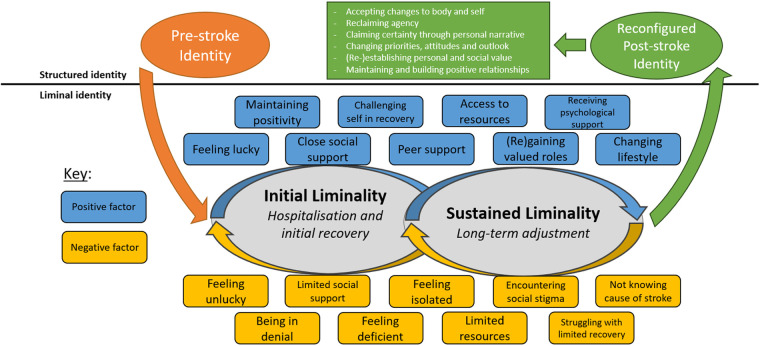
Thirty participants were interviewed from across the UK (14 women, 16 men; aged 31-86; 1-25 years post-stroke). Participants reported the disruption stroke could cause to their sense of identity. The concept of liminality, that describes the ambiguous, transformative state between two distinct stages, where an individual or group exists "betwixt and between" stable conditions, explains the challenge to identity post-stroke. Participants reported developing an uncertain sense of identity as they struggled to structure identity in the same way they did before stroke. This is because the participants' characteristics, traits, hobbies, or future life plans, as well as social relationships and roles, were affected by stroke. Subsequently, participants began a process of reconfiguring their identity, an often-long-term process that involved coming to terms with, and integrating, the impact of stroke on their lives. As a result, participants could enter an indefinite period of sustained liminality as they contend with long-term change and continued uncertainty.
The concept of liminality, which emerged from individual stroke narratives for the first time, conveyed the adaptive and enduring nature of a stroke survivor's journey. Post-stroke liminality may continue indefinitely, sustained by a survivor's subjective individual and social situation. This new insight justifies the urgent call for long-term rehabilitation and support that is tailored towards the unique nature of a survivor's circumstances. Further work is required to understand how tailored, long-term and person-centred support can encourage survivors to positively reconfigure their identity.
中风带来的复杂身体、认知和心理后果可能会扰乱幸存者对中风前正常状态和身份的认知。这可能会对他们的个人生活和社会生活产生重大影响。关于中风后生活的个人报告增进了我们对这种影响的理解。然而,由于中风患者人数不断增加以及指南要求,中风支持系统面临着日益增长的需求,需要基于综合叙述深入了解哪些因素能够使中风幸存者积极重建他们的生活和身份,从而提供以患者为中心的护理。
采用 Charmaz 的建构主义扎根理论(GT)方法进行定性研究。进行了时长 60 - 90 分钟的半结构化访谈。这些访谈在中风后至少 12 个月进行。
来自英国各地的 30 名参与者接受了访谈(14 名女性,16 名男性;年龄 31 - 86 岁;中风后 1 - 25 年)。参与者报告了中风可能对他们的身份认知造成的扰乱。阈限性概念描述了两个不同阶段之间模糊的、变革性的状态,即个人或群体处于稳定状态“之间”和“中间”,这解释了中风后身份认同所面临的挑战。参与者报告称,由于他们难以像中风前那样构建身份认同,从而产生了不确定的身份感。这是因为参与者的特征、特质、爱好或未来生活计划,以及社会关系和角色都受到了中风的影响。随后,参与者开始了重新构建身份的过程,这通常是一个长期的过程,包括接受并整合中风对他们生活的影响。结果,参与者可能会进入一个持续阈限性的不确定时期,因为他们要应对长期的变化和持续的不确定性。
阈限性概念首次从个人中风叙述中浮现,传达了中风幸存者历程的适应性和持久性。中风后的阈限性可能会无限期持续,由幸存者的主观个人和社会状况所维持。这一新见解证明了迫切需要针对幸存者情况的独特性质提供长期康复和支持。需要进一步开展工作,以了解量身定制的、长期的和以患者为中心的支持如何能够鼓励幸存者积极重新构建他们的身份。