Shen Lei, Hu Ya-Xin, Lv Qin-Yu, Yi Zheng-Hui, Gong Jing-Bo, Yan Chao
Key Laboratory of Brain Functional Genomics (MOE&STCSM), School of Psychology and Cognitive Science, Affiliated Mental Health Center (ECNU), East China Normal University, 3663 North Zhongshan Road, Shanghai, 200062, China.
Shanghai Changning Mental Health Center, Affiliated Mental Health Center of East China Normal University, Shanghai, China.
BMC Psychiatry. 2024 Dec 18;24(1):933. doi: 10.1186/s12888-024-06353-3.
Anhedonia-a core symptom of major depressive disorder (MDD)-is closely related to diminished reward sensitivity. Nonetheless, the psychopathological and computational mechanism underlying anhedonia in young patients with MDD remains unclear. Therefore, this study aims to investigate reward sensitivity in adolescents and young adults with MDD using computational modelling.
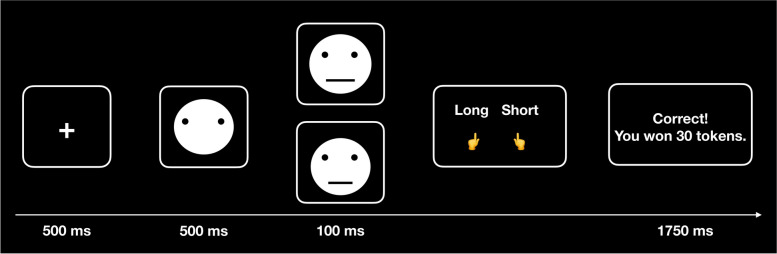
Overall, 70 patients with MDD and 54 age- and sex-matched healthy controls (HC) completed a probabilistic reward task (PRT) to assess their general behavioral inclination towards more frequently reinforced stimuli (i.e., "response bias"). Bayesian hierarchical drift diffusion modeling (HDDM) was employed to determine changes in reward sensitivity and computational process during decision-making.
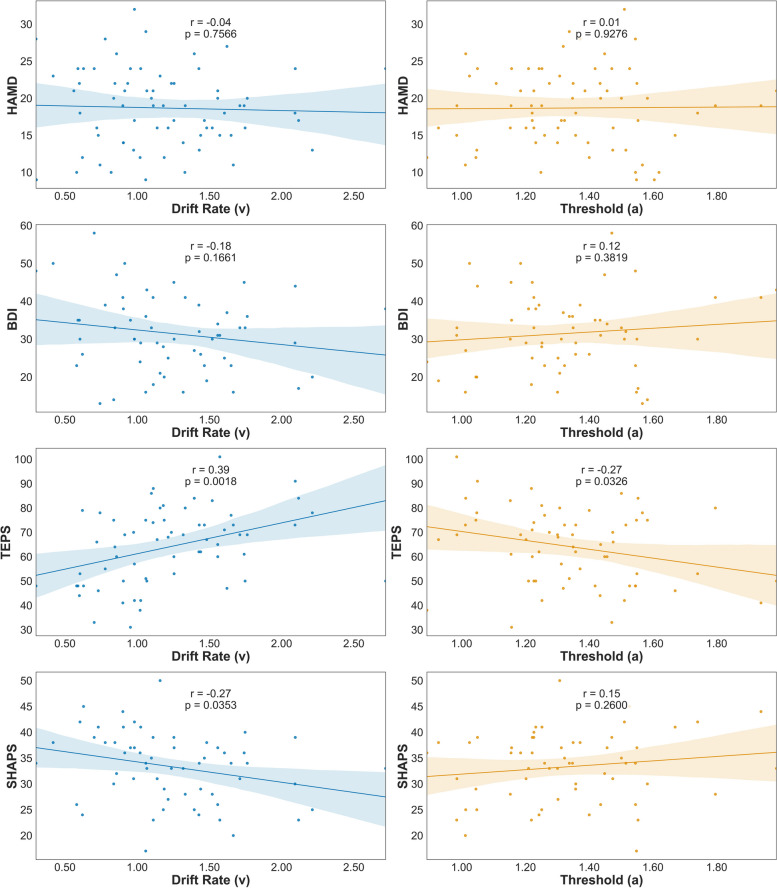
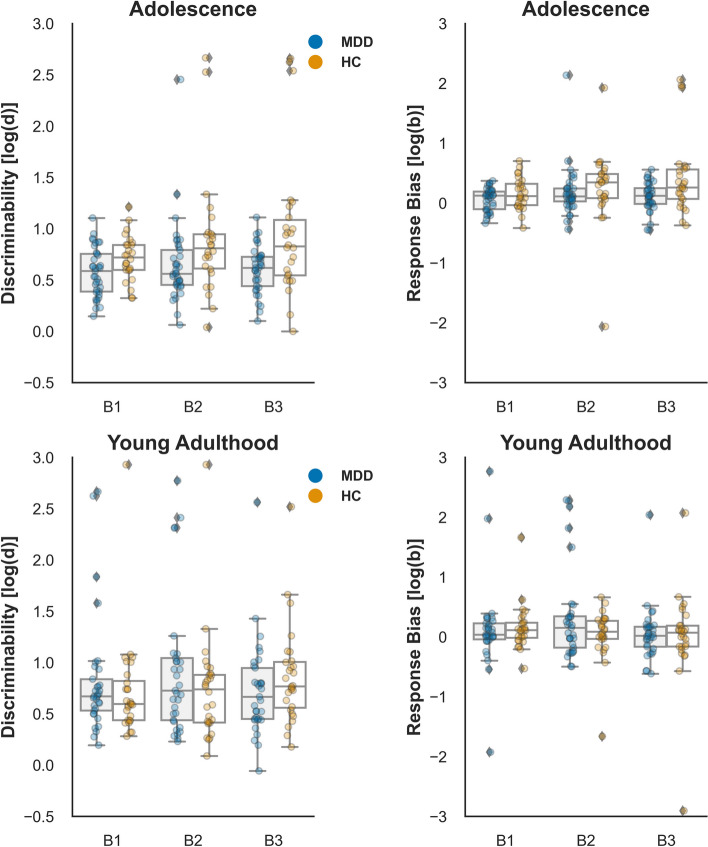
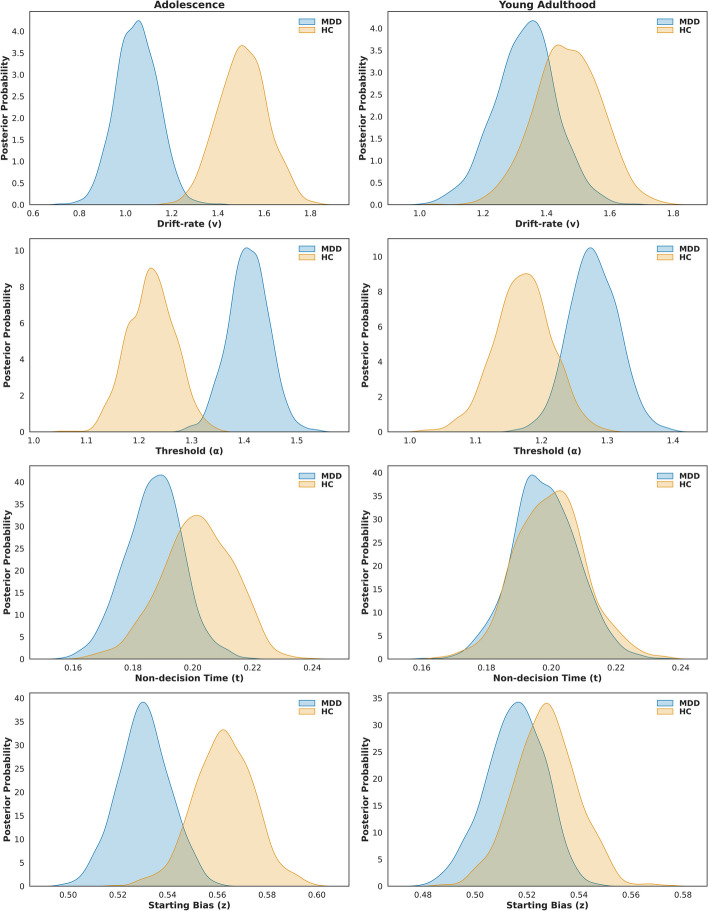
Adolescents with depression showed a trend toward reduced response bias compared to those in HC. HDDM analysis revealed wider decision thresholds in both adolescents and young adults with MDD group. Adolescents with MDD exhibited significantly lower drift rates and reduced starting point bias compared to those in HC. Higher anhedonia levels were linked to lower drift rates and wider decision thresholds. Additionally, increased discriminability correlated with higher drift rates, while higher response bias was linked to larger starting points.
Our findings suggest that reduced reward sensitivity and slower evidence accumulation during reward learning may serve as potential indicators of anhedonia in adolescents with MDD. These findings provided crucial insights into the dysregulated positive affect model, underscoring a dysfunctional reward system as a key factor in anhedonia developmental psychopathology in depression.
快感缺失——重度抑郁症(MDD)的核心症状——与奖赏敏感性降低密切相关。然而,MDD 青年患者快感缺失背后的心理病理学和计算机制仍不清楚。因此,本研究旨在使用计算模型研究 MDD 青少年和青年的奖赏敏感性。
总体而言,70 名 MDD 患者和 54 名年龄及性别匹配的健康对照者(HC)完成了一项概率奖赏任务(PRT),以评估他们对更频繁强化刺激的一般行为倾向(即“反应偏差”)。采用贝叶斯分层漂移扩散模型(HDDM)来确定决策过程中奖赏敏感性和计算过程的变化。
与 HC 组相比,患有抑郁症的青少年表现出反应偏差降低的趋势。HDDM 分析显示,MDD 组的青少年和青年的决策阈值更宽。与 HC 组相比,患有 MDD 的青少年表现出显著更低的漂移率和更低的起始点偏差。更高的快感缺失水平与更低的漂移率和更宽的决策阈值相关。此外,辨别力增加与更高的漂移率相关联,而更高的反应偏差与更大的起始点相关。
我们的研究结果表明,奖赏敏感性降低和奖赏学习过程中证据积累较慢可能是 MDD 青少年快感缺失的潜在指标。这些发现为失调的积极情感模型提供了关键见解,强调功能失调的奖赏系统是抑郁症快感缺失发展心理病理学的关键因素。