Wu Ling Ting, Glass George Frederick, Chew Esther Yin Hui, Ng Emmalene Joo Yong, Chan Ee Yuee
Nursing Implementation, Translation and Research Office (NITRO), Tan Tock Seng Hospital, Nursing Service, Annex 1, Level 1, 11 Jln Tan Tock Seng, Singapore, 308443, Singapore.
Alice Lee Center of Nursing Studies, National University of Singapore, Singapore, 119077, Singapore.
BMC Health Serv Res. 2024 Dec 18;24(1):1620. doi: 10.1186/s12913-024-11931-y.
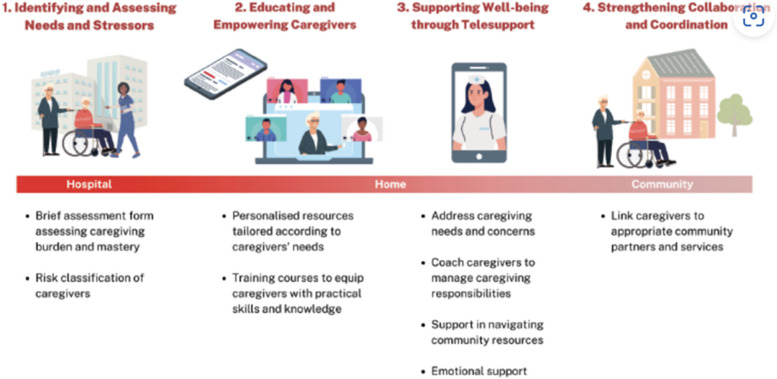
Set against the backdrop of a rapidly ageing population and growing emphasis on the importance of ageing-in-place, family members often assume the role of a caregiver. Navigating through a complex healthcare system while simultaneously juggling the daily care needs of their care-recipients, caregivers often become worn out by the intense caregiver stress and burden, neglecting their own well-being. This translates to adverse health and economic outcomes such as prolonged hospital stays and increased nursing home placement of care-recipients. Seeking to better support caregivers, we developed a theory of change to guide the design and implementation of a caregiver support programme - Project Carer Matters.
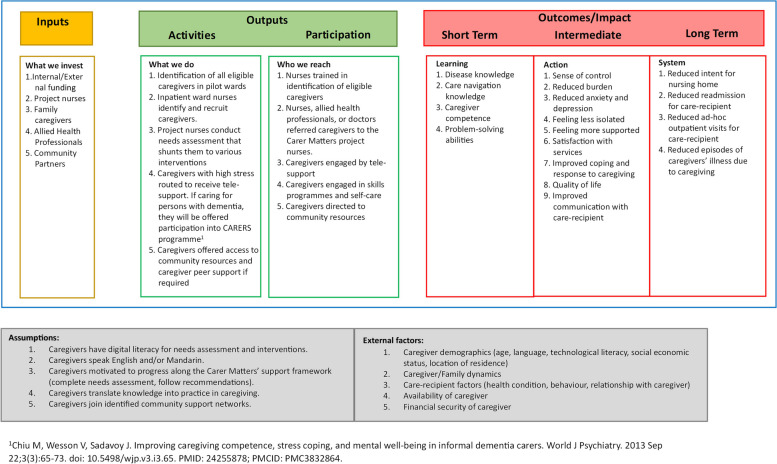
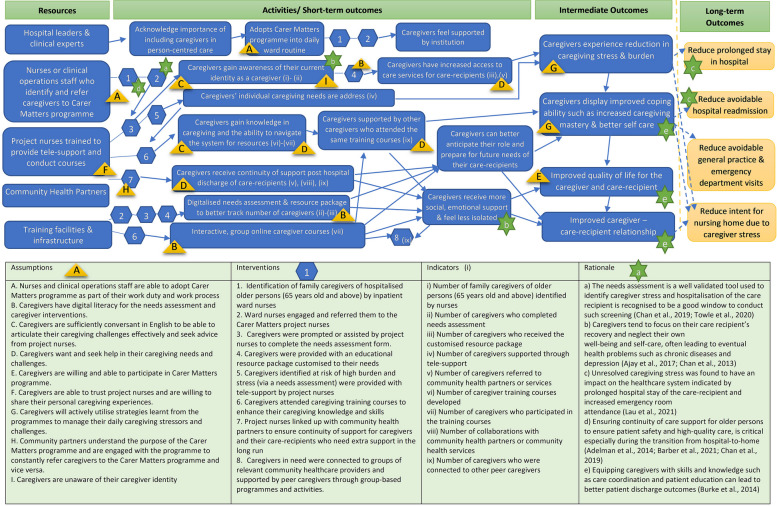
We applied theory of change methodology to explain how the Project's interventions were hypothesised to lead to their identified short-to-long term goals, drawing on a causal analysis based on available evidence. The theory of change was developed with insights garnered from previous research studies conducted on caregiver stress, stakeholder engagement sessions and multiple dialogues with clinical experts and hospital leaders.
Our final theory of change is the result of the evaluation of the Project in its pilot phase. It is populated with the resources, activities and short-to-long term outcomes that can be attributed or linked to the Project. Multiple meetings and discussion with stakeholders over the pilot prompted frequent practice of the Plan, Do, Study, Act model to refine the ongoing implementation process and the theory of change itself.
A theory of change is essential in guiding the design, implementation and evaluation of a complex health care intervention such as Project Carer Matters. The development of the theory of change is a journey and not a resultant product. This journey has also led us to learn that 1) a theory of change needs to be dynamic and ever evolving with time and context, 2) the perspectives of relevant stakeholders need to be included in this process to ensure the feasibility and sustainability of the project in the long run and 3) frequent stakeholder engagements are essential in enabling the implementation team to fine-tune the Project in an effective manner.
ClinicalTrials.gov , NCT05205135, registered on 24/01/2022.
在人口迅速老龄化以及人们越来越重视居家养老的背景下,家庭成员常常承担起照顾者的角色。照顾者既要在复杂的医疗保健系统中周旋,又要同时兼顾照顾对象的日常护理需求,往往会因巨大的照顾压力和负担而疲惫不堪,从而忽视了自身的幸福。这会导致不良的健康和经济后果,如照顾对象住院时间延长以及入住养老院的几率增加。为了更好地支持照顾者,我们制定了一个变革理论,以指导一项照顾者支持计划——关爱照顾者项目的设计与实施。
我们运用变革理论方法,基于现有证据进行因果分析,来解释该项目的干预措施如何被假定为能实现其确定的短期到长期目标。变革理论是通过对以往关于照顾者压力的研究、利益相关者参与会议以及与临床专家和医院领导的多次对话所获得的见解而制定的。
我们最终的变革理论是对该项目试点阶段评估的结果。它包含了可归因于或与该项目相关联的资源、活动以及短期到长期的成果。在试点期间与利益相关者进行的多次会议和讨论促使频繁运用计划、执行、研究、行动模型,以完善正在进行的实施过程以及变革理论本身。
变革理论对于指导像关爱照顾者项目这样复杂的医疗保健干预措施的设计、实施和评估至关重要。变革理论的发展是一个过程,而非一个最终产品。这个过程也让我们认识到:1)变革理论需要与时俱进且不断发展;2)在此过程中需要纳入相关利益者的观点,以确保项目长期的可行性和可持续性;3)利益相关者的频繁参与对于实施团队有效调整项目至关重要。
ClinicalTrials.gov,NCT05205135,于2022年1月24日注册。