• 文献检索
  • 文档翻译
  • 深度研究
  • 学术资讯
  • Suppr Zotero 插件Zotero 插件
  • 邀请有礼
  • 套餐&价格
  • 历史记录
应用&插件
Suppr Zotero 插件Zotero 插件浏览器插件Mac 客户端Windows 客户端微信小程序
定价
高级版会员购买积分包购买API积分包
服务
文献检索文档翻译深度研究API 文档MCP 服务
关于我们
关于 Suppr公司介绍联系我们用户协议隐私条款
关注我们

Suppr 超能文献

核心技术专利:CN118964589B侵权必究
粤ICP备2023148730 号-1Suppr @ 2026

文献检索

告别复杂PubMed语法,用中文像聊天一样搜索,搜遍4000万医学文献。AI智能推荐,让科研检索更轻松。

立即免费搜索

文件翻译

保留排版,准确专业,支持PDF/Word/PPT等文件格式,支持 12+语言互译。

免费翻译文档

深度研究

AI帮你快速写综述,25分钟生成高质量综述,智能提取关键信息,辅助科研写作。

立即免费体验

重症监护病房入院时死亡率的早期预测。

Early prediction of mortality upon intensive care unit admission.

作者信息

Yeh Yu-Chang, Kuo Yu-Ting, Kuo Kuang-Cheng, Cheng Yi-Wei, Liu Ding-Shan, Lai Feipei, Kuo Lu-Cheng, Lee Tai-Ju, Chan Wing-Sum, Chiu Ching-Tang, Tsai Ming-Tao, Chao Anne, Chou Nai-Kuan, Yu Chong-Jen, Ku Shih-Chi

机构信息

Department of Anesthesiology, National Taiwan University Hospital, No 7, Chung Shan South Road, Taipei, Taiwan.

Taiwan AI Labs, Taipei, Taiwan.

出版信息

BMC Med Inform Decis Mak. 2024 Dec 18;24(1):394. doi: 10.1186/s12911-024-02807-6.

DOI:10.1186/s12911-024-02807-6
PMID:39696315
原文链接:https://pmc.ncbi.nlm.nih.gov/articles/PMC11656927/
Abstract

BACKGROUND

We aimed to develop and validate models for predicting intensive care unit (ICU) mortality of critically ill adult patients as early as upon ICU admission.

METHODS

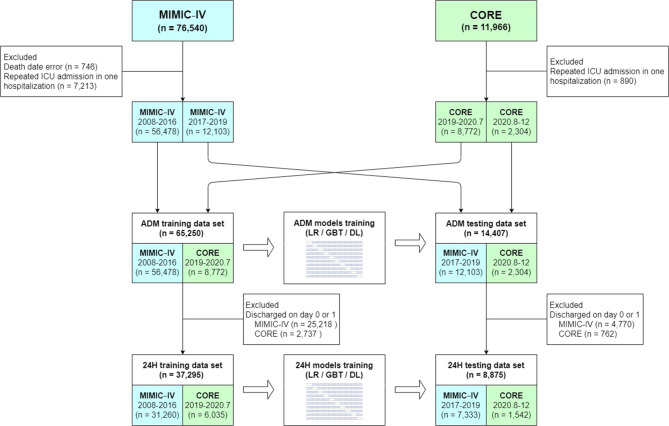
Combined data of 79,657 admissions from two teaching hospitals' ICU databases were used to train and validate the machine learning models to predict ICU mortality upon ICU admission and at 24 h after ICU admission by using logistic regression, gradient boosted trees (GBT), and deep learning algorithms.

RESULTS

In the testing dataset for the admission models, the ICU mortality rate was 7%, and 38.4% of patients were discharged alive or dead within 1 day of ICU admission. The area under the receiver operating characteristic curve (0.856, 95% CI 0.845-0.867) and area under the precision-recall curve (0.331, 95% CI 0.323-0.339) were the highest for the admission GBT model. The ICU mortality rate was 17.4% in the 24-hour testing dataset, and the performance was the highest for the 24-hour GBT model.

CONCLUSION

The ADM models can provide crucial information on ICU mortality as early as upon ICU admission. 24 H models can be used to improve the prediction of ICU mortality for patients discharged more than 1 day after ICU admission.

摘要

背景

我们旨在开发并验证能够尽早预测危重症成年患者入住重症监护病房(ICU)后死亡率的模型,即在患者入住ICU时进行预测。

方法

利用两家教学医院ICU数据库中79,657例入院患者的合并数据,通过逻辑回归、梯度提升树(GBT)和深度学习算法来训练和验证机器学习模型,以预测患者入住ICU时及入住ICU 24小时后的死亡率。

结果

在入院模型的测试数据集中,ICU死亡率为7%,38.4%的患者在入住ICU 1天内出院或死亡。入院GBT模型的受试者工作特征曲线下面积(0.856,95%CI 0.845 - 0.867)和精确召回率曲线下面积(0.331,95%CI 0.323 - 0.339)最高。在24小时测试数据集中,ICU死亡率为17.4%,24小时GBT模型的性能最高。

结论

入院模型能够在患者入住ICU时就提供有关ICU死亡率的关键信息。24小时模型可用于改善对入住ICU 1天以上出院患者的ICU死亡率预测。
https://cdn.ncbi.nlm.nih.gov/pmc/blobs/212f/11656927/ed6a0074f2b2/12911_2024_2807_Fig4_HTML.jpg
https://cdn.ncbi.nlm.nih.gov/pmc/blobs/212f/11656927/9244d58a8c56/12911_2024_2807_Fig1_HTML.jpg
https://cdn.ncbi.nlm.nih.gov/pmc/blobs/212f/11656927/6824e0dc20db/12911_2024_2807_Fig2_HTML.jpg
https://cdn.ncbi.nlm.nih.gov/pmc/blobs/212f/11656927/189917e77979/12911_2024_2807_Fig3_HTML.jpg
https://cdn.ncbi.nlm.nih.gov/pmc/blobs/212f/11656927/ed6a0074f2b2/12911_2024_2807_Fig4_HTML.jpg
https://cdn.ncbi.nlm.nih.gov/pmc/blobs/212f/11656927/9244d58a8c56/12911_2024_2807_Fig1_HTML.jpg
https://cdn.ncbi.nlm.nih.gov/pmc/blobs/212f/11656927/6824e0dc20db/12911_2024_2807_Fig2_HTML.jpg
https://cdn.ncbi.nlm.nih.gov/pmc/blobs/212f/11656927/189917e77979/12911_2024_2807_Fig3_HTML.jpg
https://cdn.ncbi.nlm.nih.gov/pmc/blobs/212f/11656927/ed6a0074f2b2/12911_2024_2807_Fig4_HTML.jpg

相似文献

1
Early prediction of mortality upon intensive care unit admission.重症监护病房入院时死亡率的早期预测。
BMC Med Inform Decis Mak. 2024 Dec 18;24(1):394. doi: 10.1186/s12911-024-02807-6.
2
Early prediction of delirium upon intensive care unit admission: Model development, validation, and deployment.重症监护病房入院时谵妄的早期预测:模型的制定、验证和应用。
J Clin Anesth. 2023 Sep;88:111121. doi: 10.1016/j.jclinane.2023.111121. Epub 2023 Apr 12.
3
Early hospital mortality prediction of intensive care unit patients using an ensemble learning approach.基于集成学习方法的重症监护病房患者早期住院病死率预测。
Int J Med Inform. 2017 Dec;108:185-195. doi: 10.1016/j.ijmedinf.2017.10.002. Epub 2017 Oct 5.
4
Dynamic and explainable machine learning prediction of mortality in patients in the intensive care unit: a retrospective study of high-frequency data in electronic patient records.动态可解释机器学习预测 ICU 患者死亡率:电子患者记录中高频数据的回顾性研究。
Lancet Digit Health. 2020 Apr;2(4):e179-e191. doi: 10.1016/S2589-7500(20)30018-2. Epub 2020 Mar 12.
5
SEVERITAS: An externally validated mortality prediction for critically ill patients in low and middle-income countries.SEVERITAS:一种针对中低收入国家危重症患者的外部验证死亡率预测模型。
Int J Med Inform. 2019 Nov;131:103959. doi: 10.1016/j.ijmedinf.2019.103959. Epub 2019 Sep 4.
6
Early prediction of intensive care unit admission in emergency department patients using machine learning.使用机器学习对急诊科患者入住重症监护病房进行早期预测。
Aust Crit Care. 2025 Mar;38(2):101143. doi: 10.1016/j.aucc.2024.101143. Epub 2024 Dec 5.
7
Machine Learning-Based Prediction Model for ICU Mortality After Continuous Renal Replacement Therapy Initiation in Children.基于机器学习的儿童开始持续肾脏替代治疗后重症监护病房死亡率预测模型
Crit Care Explor. 2024 Dec 17;6(12):e1188. doi: 10.1097/CCE.0000000000001188. eCollection 2024 Dec 1.
8
Investigating SOFA, delta-SOFA and MPM-III for mortality prediction among critically ill patients at a private tertiary hospital ICU in Kenya: A retrospective cohort study.在肯尼亚一家私立三级医院 ICU 中,对危重症患者进行 SOFA、delta-SOFA 和 MPM-III 评分以预测死亡率:一项回顾性队列研究。
PLoS One. 2020 Jul 16;15(7):e0235809. doi: 10.1371/journal.pone.0235809. eCollection 2020.
9
Timing of onset and burden of persistent critical illness in Australia and New Zealand: a retrospective, population-based, observational study.澳大利亚和新西兰持续性危重病发病时间和负担的回顾性、基于人群、观察性研究。
Lancet Respir Med. 2016 Jul;4(7):566-573. doi: 10.1016/S2213-2600(16)30098-4. Epub 2016 May 4.
10
Construction and evaluation of a mortality prediction model for patients with acute kidney injury undergoing continuous renal replacement therapy based on machine learning algorithms.基于机器学习算法的行连续性肾脏替代治疗的急性肾损伤患者死亡率预测模型的构建与评估。
Ann Med. 2024 Dec;56(1):2388709. doi: 10.1080/07853890.2024.2388709. Epub 2024 Aug 19.

引用本文的文献

1
CRISP: A causal relationships-guided deep learning framework for advanced ICU mortality prediction.CRISP:一种用于重症监护病房(ICU)晚期死亡率预测的因果关系引导深度学习框架。
BMC Med Inform Decis Mak. 2025 Apr 15;25(1):165. doi: 10.1186/s12911-025-02981-1.

本文引用的文献

1
Avoiding lead-time bias by estimating stage-specific proportions of cancer and non-cancer deaths.通过估计特定阶段癌症和非癌症死亡比例来避免提前期偏倚。
Cancer Causes Control. 2024 May;35(5):849-864. doi: 10.1007/s10552-023-01842-4. Epub 2024 Jan 18.
2
Risk Factors for Mortality in Abdominal Infection Patients in ICU: A Retrospective Study From 2011 to 2018.重症监护病房腹部感染患者死亡的危险因素:一项2011年至2018年的回顾性研究
Front Med (Lausanne). 2022 Feb 25;9:839284. doi: 10.3389/fmed.2022.839284. eCollection 2022.
3
Development of a new score for early mortality prediction in trauma ICU patients: RETRASCORE.
创伤 ICU 患者早期死亡预测新评分的制定:RETRASCORE。
Crit Care. 2021 Dec 7;25(1):420. doi: 10.1186/s13054-021-03845-6.
4
A catalogue of tools and variables from crisis and routine care to support decision-making about allocation of intensive care beds and ventilator treatment during pandemics: Scoping review.大流行期间支持重症监护床位和呼吸机治疗分配决策的危机和常规护理工具和变量目录:范围综述。
J Crit Care. 2021 Dec;66:33-43. doi: 10.1016/j.jcrc.2021.08.001. Epub 2021 Aug 23.
5
Early Prediction of Mortality, Severity, and Length of Stay in the Intensive Care Unit of Sepsis Patients Based on Sepsis 3.0 by Machine Learning Models.基于脓毒症3.0,通过机器学习模型对脓毒症患者重症监护病房死亡率、严重程度及住院时间的早期预测
Front Med (Lausanne). 2021 Jun 28;8:664966. doi: 10.3389/fmed.2021.664966. eCollection 2021.
6
Prediction and visualization of acute kidney injury in intensive care unit using one-dimensional convolutional neural networks based on routinely collected data.基于常规采集数据的一维卷积神经网络对重症监护病房急性肾损伤的预测和可视化。
Comput Methods Programs Biomed. 2021 Jul;206:106129. doi: 10.1016/j.cmpb.2021.106129. Epub 2021 Apr 27.
7
Application of Machine Learning in Intensive Care Unit (ICU) Settings Using MIMIC Dataset: Systematic Review.使用MIMIC数据集的机器学习在重症监护病房(ICU)环境中的应用:系统评价。
Informatics (MDPI). 2021 Mar;8(1). doi: 10.3390/informatics8010016. Epub 2021 Mar 3.
8
Prediction of Mortality in Surgical Intensive Care Unit Patients Using Machine Learning Algorithms.使用机器学习算法预测外科重症监护病房患者的死亡率
Front Med (Lausanne). 2021 Mar 31;8:621861. doi: 10.3389/fmed.2021.621861. eCollection 2021.
9
Development and validation of the predictive risk of death model for adult patients admitted to intensive care units in Japan: an approach to improve the accuracy of healthcare quality measures.日本重症监护病房成年患者死亡预测风险模型的开发与验证:提高医疗质量指标准确性的一种方法。
J Intensive Care. 2021 Feb 15;9(1):18. doi: 10.1186/s40560-021-00533-z.
10
Dynamic and explainable machine learning prediction of mortality in patients in the intensive care unit: a retrospective study of high-frequency data in electronic patient records.动态可解释机器学习预测 ICU 患者死亡率:电子患者记录中高频数据的回顾性研究。
Lancet Digit Health. 2020 Apr;2(4):e179-e191. doi: 10.1016/S2589-7500(20)30018-2. Epub 2020 Mar 12.