Ranjan Redoy, Adhikary Dipannita, Ken-Dror Gie, Yusuf Md Abdullah, Moureen Adneen, Hakim Maliha, Sharma Pankaj
Department of Biological Sciences, Royal Holloway University of London, London, UK.
Department of Cardiac Surgery, Bangabandhu Sheikh Mujib Medical University, Dhaka, Bangladesh.
J Multidiscip Healthc. 2024 Dec 14;17:5941-5947. doi: 10.2147/JMDH.S502451. eCollection 2024.
Anthropometric measurements used to predict cardiovascular disease vary worldwide but are mostly derived from those of Caucasian ancestry. We sought to undertake such measurements in the little studied Bangladeshi population.
The MAGPIE (Multidimensional Approach of Genotype and Phenotype in Stroke Etiology) study is a Bangladeshi stroke case-control study that recruited nationwide between January 2022 and June 2024. The univariate analysis was utilised to curtail the risk of independent variables, and a receiver operating characteristic (ROC) curve was employed to identify the cut-off values of Body Mass Index (BMI), Waist Circumference (WC), and Hip Circumference (HC). Furthermore, a multivariate logistic regression (LR) model demonstrated the risk of independent predictors of haemorrhagic stroke (HS) among sexes.
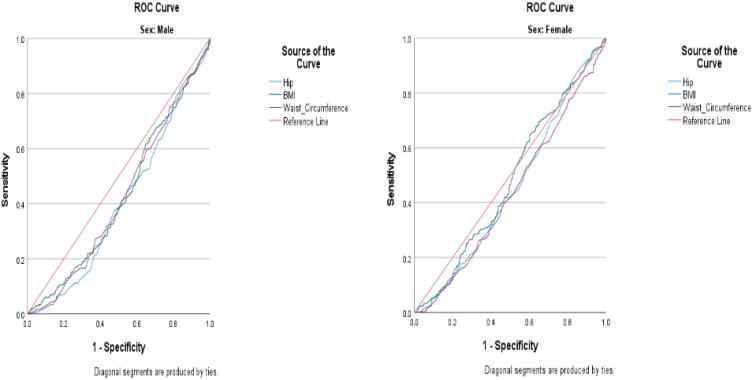
Of a total of 1491 age- and sex-matched study population, 918 were haemorrhagic stroke (61.5%) with female predominance (n=489; 53.3%) and significantly older than men (P=0.003). The BMI (22.9 ±3.0 vs 21.3 ±3.0; P<0.001), WC (84.0 ±7.3 vs 80.8 ±7.3; P<0.001) and HC (90.6 ±7.1 vs 85.5 ±7.7; P<0.001) was significantly higher among women compared to men. A ROC curve demonstrated that the cut-off values of BMI, WC, and HC are 20.6kg/m, 78.8cm, and 84.6cm, respectively, in men and 21.1 kg/m, 81.5cm, and 88.1cm, respectively, in women haemorrhagic stroke population. Furthermore, an age-adjusted multivariate LR model identified a HC of ≥84.6 cm in men (OR 2.8, 95% CI 1.61-4.97; P <0.001) and a WC of ≥81.5cm in women (OR 1.6, 95% CI 1.01-2.37; P=0.001) as potential independent predictors of haemorrhagic stroke.
Bangladeshi men with a hip circumference of ≥84.6cm have about threefold, and women with a waist circumference of ≥81.1cm have about twofold heightened risk of haemorrhagic stroke.
用于预测心血管疾病的人体测量指标在全球范围内存在差异,但大多源自白种人。我们试图在研究较少的孟加拉人群体中进行此类测量。
MAGPIE(中风病因学中基因型和表型的多维方法)研究是一项孟加拉中风病例对照研究,于2022年1月至2024年6月在全国范围内招募。采用单变量分析以降低自变量风险,并使用受试者工作特征(ROC)曲线来确定体重指数(BMI)、腰围(WC)和臀围(HC)的临界值。此外,多变量逻辑回归(LR)模型显示了不同性别中出血性中风(HS)独立预测因素的风险。
在总共1491名年龄和性别匹配的研究人群中,918例为出血性中风(61.5%),女性占主导(n = 489;53.3%),且年龄显著大于男性(P = 0.003)。女性的BMI(22.9±3.0 vs 21.3±3.0;P<0.001)、WC(84.0±7.3 vs 80.8±7.3;P<0.001)和HC(90.6±7.1 vs 85.5±7.7;P<0.001)均显著高于男性。ROC曲线显示,在男性出血性中风人群中,BMI、WC和HC的临界值分别为20.6kg/m、78.8cm和84.6cm,在女性中分别为21.1kg/m、81.5cm和88.1cm。此外,年龄调整后的多变量LR模型确定,男性HC≥84.6cm(OR 2.8,95%CI 1.61 - 4.97;P<0.001)和女性WC≥81.5cm(OR 1.6,95%CI 1.01 - 2.37;P = 0.001)为出血性中风的潜在独立预测因素。
臀围≥84.6cm的孟加拉男性患出血性中风的风险约为三倍,腰围≥81.1cm的女性患出血性中风的风险约为两倍。