Jin Xingsheng, Wang Weiyi, Sun Qian, Chen Yang, Xu Bingxiang, Tian Haili
School of Exercise and Health, Shanghai University of Sport, Yangpu District Qingyuan Huan Road 650, Shanghai, 200438, China.
Sports Department, Baotou Medical College, Baotou, 014040, China.
BMC Public Health. 2024 Dec 19;24(1):3543. doi: 10.1186/s12889-024-21045-z.
Air pollution (AP) has become a substantial environmental issue affecting human cardiorespiratory health. Physical exercise (PE) is widely accepted to promote cardiorespiratory health. There is a paucity of research on the point at which the level of polluted environment engaged in PE could be used as a preventive approach to compensate for the damages of AP.
To assess the effects of acute moderate-intensity PE on the cardio-respiratory and inflammatory responses of young adults in varying levels of AP, and to determine the pollution level at which engaging in short-term PE is considered safe.
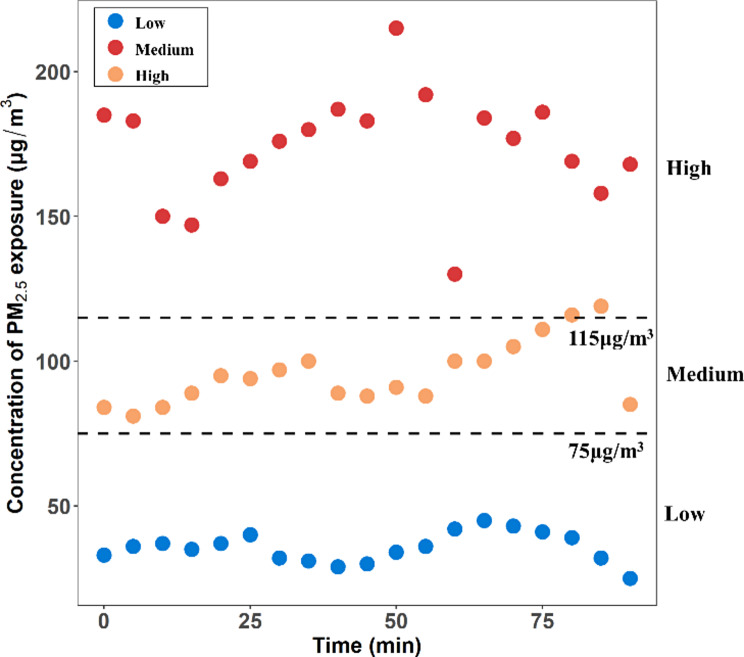
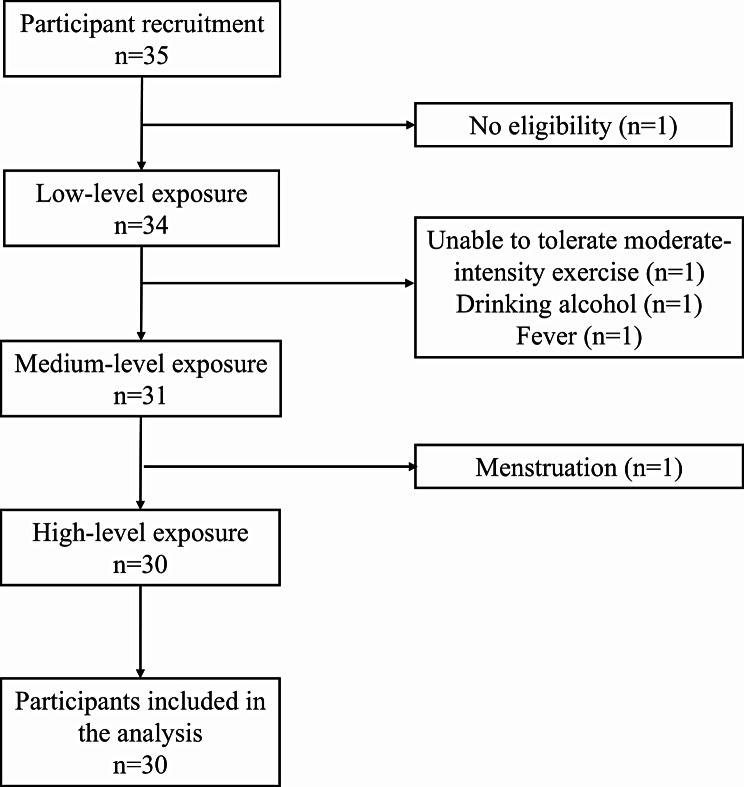
We constructed a real-world crossover study of 30 healthy young adults with repeated measures. Participants participated in 90 min of moderate-intensity PE in different (low, medium, high) AP exposure scenarios. Cardiorespiratory health was measured by assessing systolic blood pressure (SBP), diastolic blood pressure (DBP), heart rate (HR), forced vital capacity (FVC), forced expiratory volume in 1 s (FEV1), peak expiratory flow (PEF), mean forced expiratory flow between 25% and 75% of FVC (FEF), and fractional exhaled nitric oxide (FeNO) before and after the intervention. Blood samples were also collected simultaneously. The percentage changes in cardiorespiratory health markers after exercise in the three AP levels environments were compared using linear mixed-effects models.
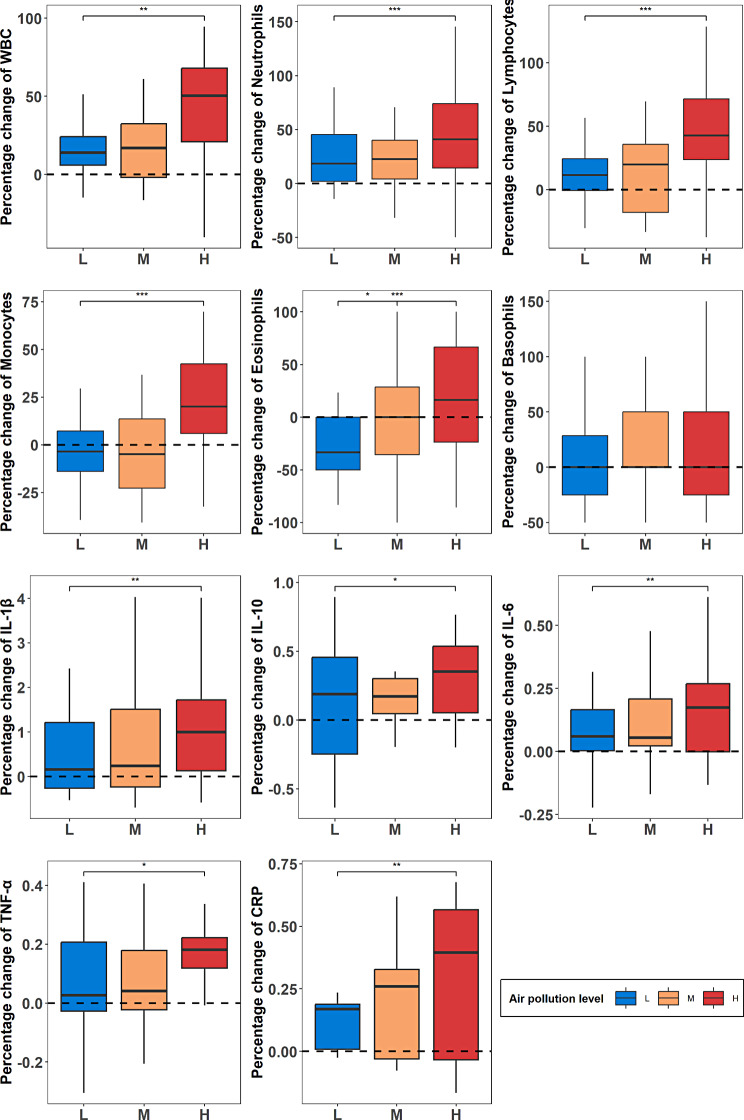
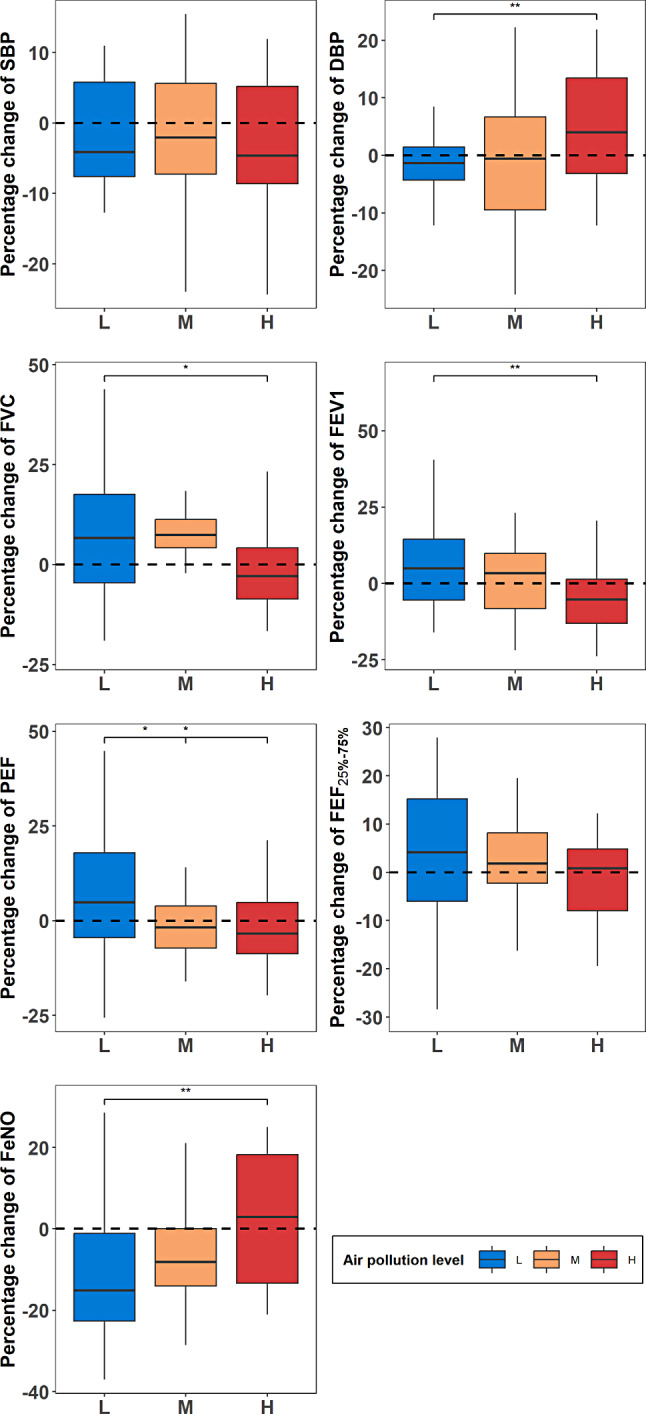
Compared to the changes observed post-exercise in the low-level AP environment, only PEF (-9.36, P = 0.018) showed a significant decrease, and eosinophils showed a significant increase in the medium-level environment (25.64, P = 0.022), with no significant differences in other indicators. Conversely, post-exercise in the high-level AP environment resulted in a significant increase in DBP (6.5, P = 0.05), lung inflammation (FeNO: 13.3, p < 0.001), inflammatory cell counts (WBC: 27.0, p < 0.001; neutrophils: 26.8, p < 0.001; lymphocytes: 32.2, p < 0.001; monocytes: 28.2, p < 0.001; and eosinophils: 48.9, p < 0.001), and inflammatory factors (IL-1β: 0.76, P = 0.003; IL-10: 0.17, P = 0.02; IL-6: 0.1, P = 0.17; TNF-α: 0.97, P = 0.011; CRP: 0.17, P = 0.003). Additionally, there were significant declines in lung function parameters, including FVC (-6.84, P = 0.04), FEV1 (-8.97, P = 0.009), and PEF (-9.50, P = 0.013).
Acute PE in low and medium-level AP environments is generally secure concerning short-term effects on cardiorespiratory health among healthy young adults. However, acute PE in high-level AP environments can be detrimental to cardiorespiratory health, significantly increasing the body's inflammatory response.
ChiCTR2000031851; Registered 12.04.2020.
空气污染已成为影响人类心肺健康的重大环境问题。体育锻炼被广泛认为可促进心肺健康。关于在何种污染程度环境下进行体育锻炼可作为预防手段来弥补空气污染损害的研究较少。
评估急性中等强度体育锻炼对处于不同空气污染水平的年轻人心肺和炎症反应的影响,并确定进行短期体育锻炼被认为安全的污染水平。
我们构建了一项针对30名健康年轻人的真实交叉重复测量研究。参与者在不同(低、中、高)空气污染暴露场景下进行90分钟的中等强度体育锻炼。通过评估干预前后的收缩压(SBP)、舒张压(DBP)、心率(HR)、用力肺活量(FVC)、一秒用力呼气容积(FEV1)、呼气峰值流速(PEF)、FVC的25%至75%之间的平均用力呼气流量(FEF)和呼出一氧化氮分数(FeNO)来测量心肺健康。同时采集血样。使用线性混合效应模型比较在三种空气污染水平环境下运动后心肺健康指标的百分比变化。
与在低水平空气污染环境中运动后观察到的变化相比,仅PEF(-9.36,P = 0.018)显示出显著下降,且在中等水平环境中嗜酸性粒细胞显著增加(25.64,P = 0.022),其他指标无显著差异。相反,在高水平空气污染环境中运动后,DBP显著升高(6.5,P = 0.05),肺部炎症(FeNO:13.3,p < 0.001)、炎症细胞计数(白细胞:27.0,p < 0.001;中性粒细胞:26.8,p < 0.001;淋巴细胞:32.2,p < 0.001;单核细胞:28.2,p < 0.001;嗜酸性粒细胞:48.9,p < 0.001)以及炎症因子(IL-1β:0.76,P = 0.003;IL-10:0.17,P = 0.02;IL-6:0.1,P = 0.17;TNF-α:0.97,P = 0.011;CRP:0.17,P = 0.003)均显著增加。此外,肺功能参数包括FVC(-6.84,P = 0.04)、FEV1(-8.97,P = 0.009)和PEF(-9.50,P = 0.013)均显著下降。
在低水平和中等水平空气污染环境中进行急性体育锻炼,对于健康年轻人的心肺健康短期影响总体上是安全的。然而,在高水平空气污染环境中进行急性体育锻炼可能对心肺健康有害,会显著增加身体的炎症反应。
ChiCTR2000031851;2020年4月12日注册。