Hui Christy Lai Ming, Wong Charlie Cheuk Lam, Lui Eddie Chi Yuen, Chiu Tsz Ching, Tao Tiffany Junchen, Chan Evie Wai Ting, Lin Jingxia, Tong Alan C Y, Suen Yi Nam, Chan Charles W H, Yeung Wai Song, Lee Edwin Ho Ming, Chan Sherry Kit Wa, Chang Wing Chung, Chen Eric Yu Hai
Department of Psychiatry, School of Clinical Medicine, LKS Faculty of Medicine, University of Hong Kong, Hong Kong SAR, China.
Department of Psychological Science, University of California, Irvine, CA, US.
Schizophrenia (Heidelb). 2024 Dec 20;10(1):120. doi: 10.1038/s41537-024-00539-0.
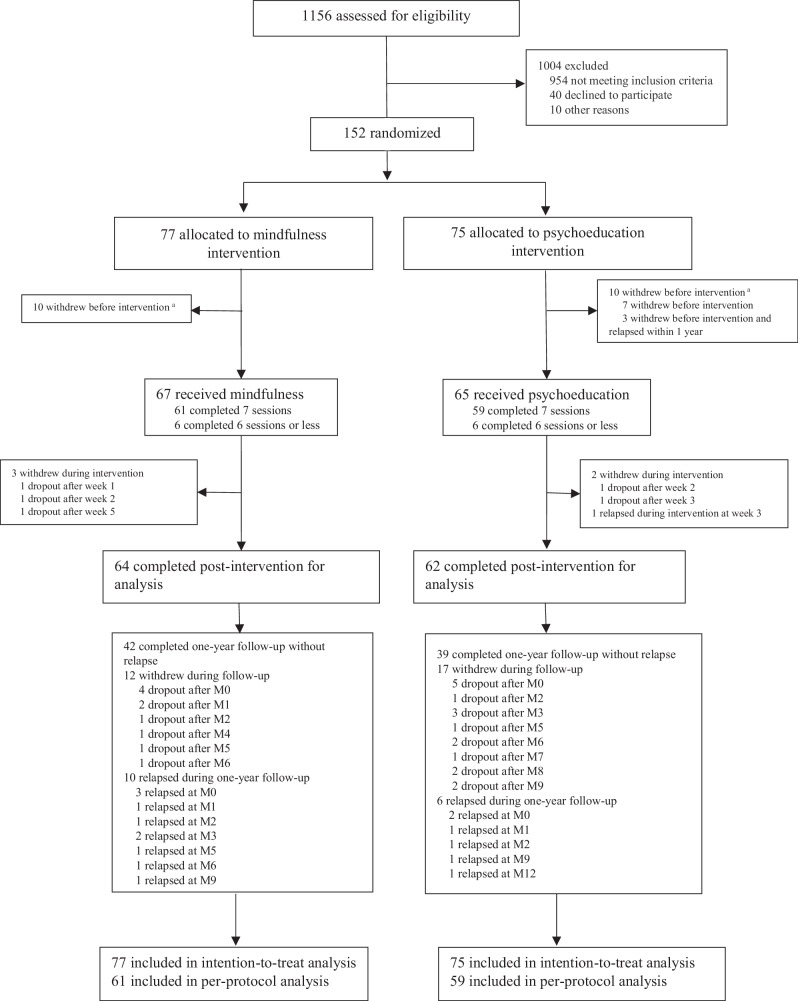
Stress is a key factor in psychotic relapse, and mindfulness offers stress resilience and well-being benefits. This study examined the effects of mindfulness-based intervention for psychosis (MBI-p) in preventing relapse at 1 year among patients with remitted psychosis in Hong Kong. MBI-p is a newly developed manual-based mindfulness protocol and was tested to have improved well-being and clinical outcomes in a pilot study with remitted psychosis patients. In this multisite, single-blind, 1-year randomized controlled trial (RCT), 152 fully remitted patients diagnosed with schizophrenia or non-affective psychosis were randomized to receive either a 7-week MBI-p or a 7-week psychoeducation program. Outcomes were assessed before and after the intervention, and then monthly for one year. Relapse rate and severity at one year were the primary outcomes. Secondary outcomes included psychopathology, functioning, mindfulness, and psychosocial factors such as stress and expressed emotions. No significant differences were found in the rate and severity of relapse between the MBI-p and psychoeducation groups in either intention-to-treat or per-protocol analyses. While MBI-p improved observation and non-reactivity to the inner experience of mindfulness, psychoeducation was found to benefit functioning and psychosocial functioning more than MBI-p. This is the first RCT to test MBI-p's effectiveness in preventing relapse among patients with remitted psychosis in Hong Kong. We postulate that the lack of significance is due to the heightened effectiveness of psychoeducation in coping with stress during the pandemic and the multifactorial causes leading to relapse. This suggests the possibility of combining these two interventions to improve their efficacy. Trial registration: NCT04060498.
压力是精神病复发的关键因素,而正念能增强压力恢复力并带来幸福感。本研究考察了基于正念的精神病干预(MBI-p)对香港缓解期精神病患者预防1年内复发的效果。MBI-p是一种新开发的基于手册的正念方案,在一项针对缓解期精神病患者的试点研究中,经测试其能改善幸福感和临床结局。在这项多中心、单盲、为期1年的随机对照试验(RCT)中,152名被诊断为精神分裂症或非情感性精神病的完全缓解患者被随机分为接受为期7周的MBI-p或为期7周的心理教育项目。在干预前后进行评估,然后在1年内每月评估一次。1年时的复发率和严重程度是主要结局。次要结局包括精神病理学、功能、正念以及压力和表达性情绪等心理社会因素。在意向性分析或符合方案分析中,MBI-p组和心理教育组在复发率和严重程度方面均未发现显著差异。虽然MBI-p改善了对正念内心体验的观察和无反应性,但发现心理教育在功能和心理社会功能方面比MBI-p更有益。这是第一项测试MBI-p对香港缓解期精神病患者预防复发有效性的RCT。我们推测缺乏显著性是由于心理教育在应对疫情期间压力方面的有效性提高以及导致复发的多因素原因。这表明将这两种干预措施结合起来有可能提高它们的疗效。试验注册:NCT04060498。